
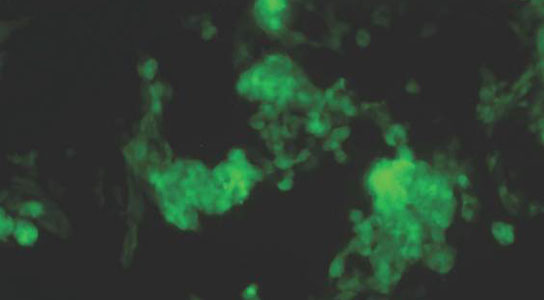
Newly published research details how a team of scientists discovered ITD-1, a molecule with many therapeutic possibilities that can be used to generate unlimited numbers of new heart cells from stem cells.
For years, scientists have been looking for a good source of heart cells that can be used to study cardiac function in the lab, or perhaps even to replace diseased or damaged tissue in heart disease patients. To do this, many are looking to stem cells. Researchers at Sanford-Burnham Medical Research Institute, the Human BioMolecular Research Institute, and ChemRegen, Inc. have been searching for molecules that convert stem cells to heart cells for about eight years—and now they’ve found one. Writing in the August 3 issue of the journal Cell Stem Cell, the team describes how they sifted through a large collection of drug-like chemicals and uncovered ITD-1, a molecule that can be used to generate unlimited numbers of new heart cells from stem cells.
“Heart disease is the leading cause of death in this country. Because we can’t replace lost cardiac muscle, the condition irreversibly leads to a decline in heart function and ultimately death. The only way to effectively replace lost heart muscle cells—called cardiomyocytes—is to transplant the entire heart,” said Mark Mercola, Ph.D., director of Sanford-Burnham’s Muscle Development and Regeneration Program and senior author of the study. “Using a drug to create new heart muscle from stem cells would be far more appealing than heart transplantation.
Searching for a needle in a haystack
Stem cells are important because they do two unique things—1) self-renew, producing more stem cells and 2) differentiate, becoming other, more specialized cell types. To obtain a large number of a certain cell type, such as heart cells, the hard part is figuring out the signals that direct them to become the desired cell type.
Mercola’s group has been hunting for heart-inducing signals for 15 years—in embryos and in stem cells. To find a synthetic molecule that might one day lead to a drug therapy to regenerate the heart, they joined forces with a team of medicinal chemists at the Human BioMolecular Research Institute led by John Cashman, Ph.D. With funding from the California Institute for Regenerative Medicine, they used sophisticated robotic technology to methodically test a large collection of drug-like chemicals, looking for that needle in a haystack that, when added to stem cells, results in cardiomyocytes. The winning compound was ITD-1.
Therapeutic applications
There’s no shortage of therapeutic possibilities for ITD-1. “This particular molecule could be useful to enhance stem cell differentiation in a damaged heart,” explained Erik Willems, Ph.D., postdoctoral researcher in Mercola’s lab and first author of the study. “At some point, it could become the basis for a new therapeutic drug for cardiovascular disease—one that would likely limit scar spreading in heart failure and promote new muscle formation.”
Mercola, Willems, and Cashman are now working with San Diego biotech company ChemRegen, Inc. to further develop ITD-1 into a drug that one day might be used to treat patients.
More scientific detail
The researchers discovered that ITD-1 blocks a cellular process known as TGFβ signaling. TGFβ (short for transforming growth factor-β) is a protein produced by one cell type to influence others’ behaviors, such as proliferation, scarring, and even stem cell differentiation. TGFβ works from outside the cell, binding to a receptor on the surface of a responding cell to initiate an intracellular signaling cascade that causes genes to be switched on or off, ultimately altering cellular behavior—in this case making heart muscle.
ITD-1 triggers degradation of the TGFβ receptor, thus inhibiting the whole process. With TGFβ signaling turned off, stem cells are set on a course toward cardiogenesis. ITD-1 is the first selective inhibitor of TGFβ, meaning that it might also have applications in many other processes controlled by TGFβ.
Reference: “Small Molecule-Mediated TGF-β Type II Receptor Degradation Promotes Cardiomyogenesis in Embryonic Stem Cells” by Erik Willems, Joaquim Cabral-Teixeira, Dennis Schade, Wenqing Cai, Patrick Reeves, Paul J. Bushway, Marion Lanier, Christopher Walsh, Tomas Kirchhausen, Juan Carlos Izpisua Belmonte, John Cashman and Mark Mercola, 3 August 2012, Cell Stem Cell.
DOI: 10.1016/j.stem.2012.04.025
Never miss a breakthrough: Join the SciTechDaily newsletter.
Follow us on Google and Google News.