
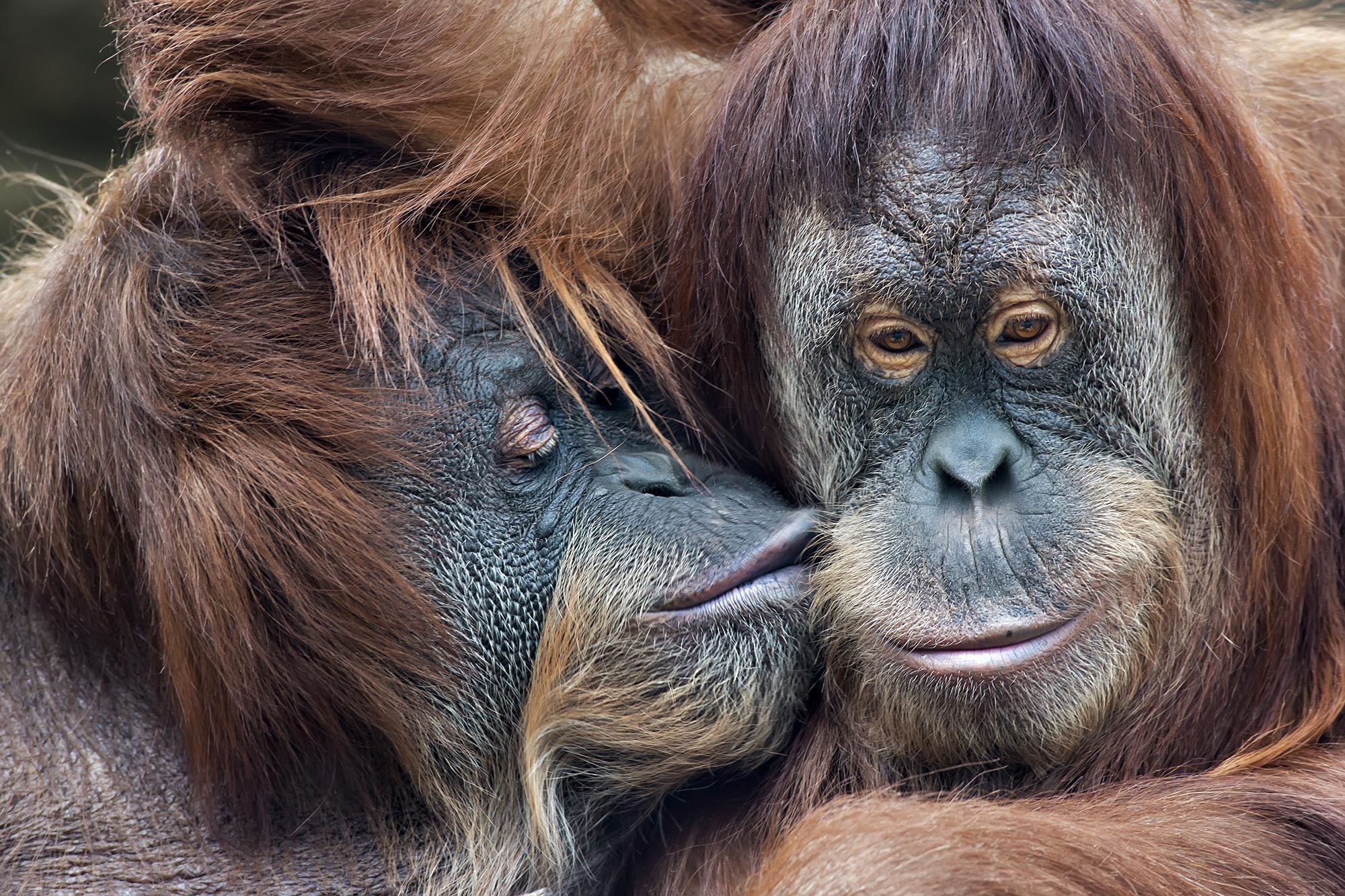
Kissing turns out to be far older—and far more cross-species—than most people imagine.
By tracing this intimate behavior across the primate family tree, researchers uncovered evidence that great apes, early human relatives, and even Neanderthals likely engaged in kissing millions of years ago.
Evolutionary Mystery of Kissing Behavior
Kissing occurs in a variety of animals, but presents an evolutionary puzzle: it appears to carry high risks, such as disease transmission, while offering no obvious reproductive or survival advantage. Despite kissing carrying cultural and emotional significance in many human societies, up to now researchers have paid little attention to its evolutionary history.
In the new study, the researchers carried out the first attempt to reconstruct the evolutionary history of kissing using a cross-species approach based on the primate family tree. The results indicate that kissing is an ancient trait in the large apes, evolving in the ancestor to that group 21.5 – 16.9 million years ago. Kissing was retained over the course of evolution and is still present in most of the large apes.
Neanderthal Clues and Cross-Species Evidence
The team also found that our extinct human relatives, Neanderthals, were likely to have engaged in kissing too. This finding, together with previous studies showing that humans and Neanderthals shared oral microbes (via saliva transfer) and genetic material (via interbreeding), strongly suggests that humans and Neanderthals kissed one another.
Dr. Matilda Brindle, lead author and evolutionary biologist at Oxford’s Department of Biology, said: “This is the first time anyone has taken a broad evolutionary lens to examine kissing. Our findings add to a growing body of work highlighting the remarkable diversity of sexual behaviors exhibited by our primate cousins.”
To run the analyses, the team first defined what constitutes a kiss. This was challenging, because many mouth-to-mouth behaviors look like kissing. Since the researchers were exploring kissing across different species, the definition also needed to be applicable to a wide range of animals. They therefore defined kissing as non-aggressive, mouth-to-mouth contact that did not involve food transfer.
Global Primate Data and Kissing Observations
Having established this definition, the researchers collected data from the literature on which modern primate species have been observed kissing, focusing on the group of monkeys and apes that evolved in Africa, Europe and Asia. This included chimpanzees, bonobos, and orangutans, all of which have been observed kissing.
They then ran a phylogenetic analysis; treating kissing as a ‘trait’ and mapping this to the family tree of primates. They used a statistical approach (called Bayesian modelling) to simulate different evolution scenarios along the branches of the tree, to estimate the probability that different ancestors also engaged in kissing. The model was run 10 million times to give robust statistical estimates.
Using Evolutionary Modeling to Reconstruct Behavior
Professor Stuart West, co-author and Professor of Evolutionary Biology at Oxford, said: “By integrating evolutionary biology with behavioral data, we’re able to make informed inferences about traits that don’t fossilize – like kissing. This lets us study social behavior in both modern and extinct species.”
While the researchers caution that existing data are limited – particularly outside the large apes – the study offers a framework for future work, and provides a way for primatologists to record kissing behaviors in nonhuman animals using a consistent definition.
Cultural Variability and Future Research Directions
“While kissing may seem like an ordinary or universal behavior, it is only documented in 46% of human cultures,” said Catherine Talbot, co-author and Assistant Professor in the College of Psychology at Florida Institute of Technology. “The social norms and context vary widely across societies, raising the question of whether kissing is an evolved behavior or cultural invention. This is the first step in addressing that question.”
Reference: “A comparative approach to the evolution of kissing” by Matilda Brindle, Catherine F. Talbot and Stuart West, 19 November 2025, Evolution and Human Behavior.
DOI: 10.1016/j.evolhumbehav.2025.106788
Never miss a breakthrough: Join the SciTechDaily newsletter.
Follow us on Google and Google News.
1 Comment
This is one of those, life is this so evolution was thus story. LITSEWTS for short. So many of them we need an acronymn.
So 21 million years has transpired? A simple experiment will show it true or false. Here it is. Merely, take actual preserved dinosaur collagen from their fossils and give them a Carbon 14 test. It shoule be depleted whuile regular carbon atoms are still present. There you go/ It’s that easy. So easy a caveman can do it.
One other test with the dinosaur collagen would be to check the chirality of it. Collagen is a protein. If it is 50/50 then a lot of time has passed. It is tis nearly all left-handed molecules, then mere thousands of years has passed.
If the two above experiments are not friendly to deep time, then there has not been enough time for evolution to have happened.
Look at all my knowledge and I didn’t even stay at a Holiday Inn Express last night. Who is like the Flip? Decades of scientific study with any compensation for it.
This has been a public service annoucement by The Flip.