
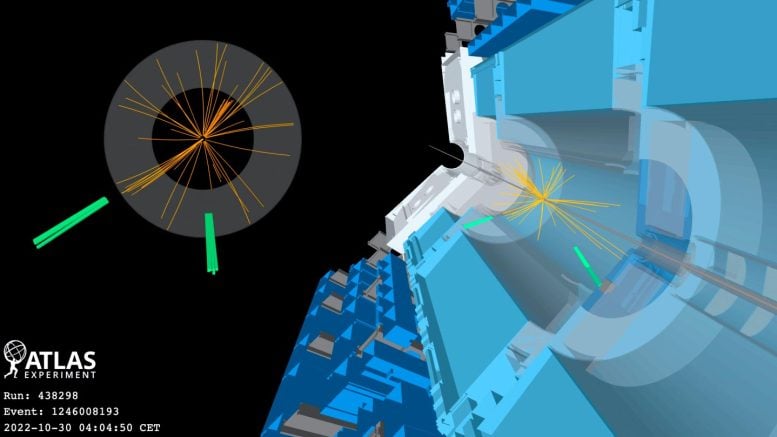
New result from the ATLAS experiment at CERN reaches the unprecedented precision of 0.09%.
The ATLAS collaboration has achieved the most precise measurement to date of the Higgs boson’s mass, reporting a value of 125.11 billion electronvolts with minimal uncertainty. The results were derived from a combination of measurements from the diphoton and four-lepton channels. These findings are crucial for understanding the Universe’s fundamental structure and have been attributed to advanced calibration techniques and powerful reconstruction algorithms.
In the 11 years since its discovery at the Large Hadron Collider (LHC), the Higgs boson has become a central avenue for shedding light on the fundamental structure of the Universe. Precise measurements of the properties of this special particle are among the most powerful tools physicists have to test the Standard Model, currently the theory that best describes the world of particles and their interactions. At the Lepton Photon Conference last week, the ATLAS collaboration reported how it has measured the mass of the Higgs boson more precisely than ever before.
The mass of the Higgs boson is not predicted by the Standard Model and must therefore be determined by experimental measurement. Its value governs the strengths of the interactions of the Higgs boson with the other elementary particles as well as with itself. A precise knowledge of this fundamental parameter is key to accurate theoretical calculations which, in turn, allow physicists to confront their measurements of the Higgs boson’s properties with predictions from the Standard Model. Deviations from these predictions would signal the presence of new or unaccounted-for phenomena. The Higgs boson’s mass is also a crucial parameter driving the evolution and the stability of the Universe’s vacuum.
Record Precision in Mass Measurement
The ATLAS and CMS collaborations have been making ever more precise measurements of the Higgs boson’s mass since the particle’s discovery. The new ATLAS measurement combines two results: a new Higgs boson mass measurement based on an analysis of the particle’s decay into two high-energy photons (the “diphoton channel”) and an earlier mass measurement based on a study of its decay into four leptons (the “four-lepton channel”).
The new measurement in the diphoton channel, which combines analyses of the full ATLAS data sets from Runs 1 and 2 of the LHC, resulted in a mass of 125.22 billion electronvolts (GeV) with an uncertainty of only 0.14 GeV. With a precision of 0.11%, this diphoton-channel result is the most precise measurement to date of the Higgs boson’s mass from a single decay channel.
Compared to the previous ATLAS measurement in this channel, the new result benefits both from the full ATLAS Run 2 data set, which reduced the statistical uncertainty by a factor of two, and from dramatic improvements to the calibration of photon energy measurements, which decreased the systematic uncertainty by almost a factor of four to 0.09 GeV.
“The advanced and rigorous calibration techniques used in this analysis were critical for pushing the precision to such an unprecedented level,” says Stefano Manzoni, convener of the ATLAS electron-photon calibration subgroup. “Their development took several years and required a deep understanding of the ATLAS detector. They will also greatly benefit future analyses.”
When the ATLAS researchers combined this new mass measurement in the diphoton channel with the earlier mass measurement in the four-lepton channel, they obtained a Higgs boson mass of 125.11 GeV with an uncertainty of 0.11 GeV. With a precision of 0.09%, this is the most precise measurement yet of this fundamental parameter.
“This very precise measurement is the result of the relentless investment of the ATLAS collaboration in improving the understanding of our data,” says ATLAS spokesperson Andreas Hoecker. “Powerful reconstruction algorithms paired with precise calibrations are the determining ingredients of precision measurements. The new measurement of the Higgs boson’s mass adds to the increasingly detailed mapping of this critical new sector of particle physics.”
Never miss a breakthrough: Join the SciTechDaily newsletter.
Follow us on Google and Google News.
1 Comment
According to the topological vortex gravitational field theory, as long as it is not 100%, it is not all.