
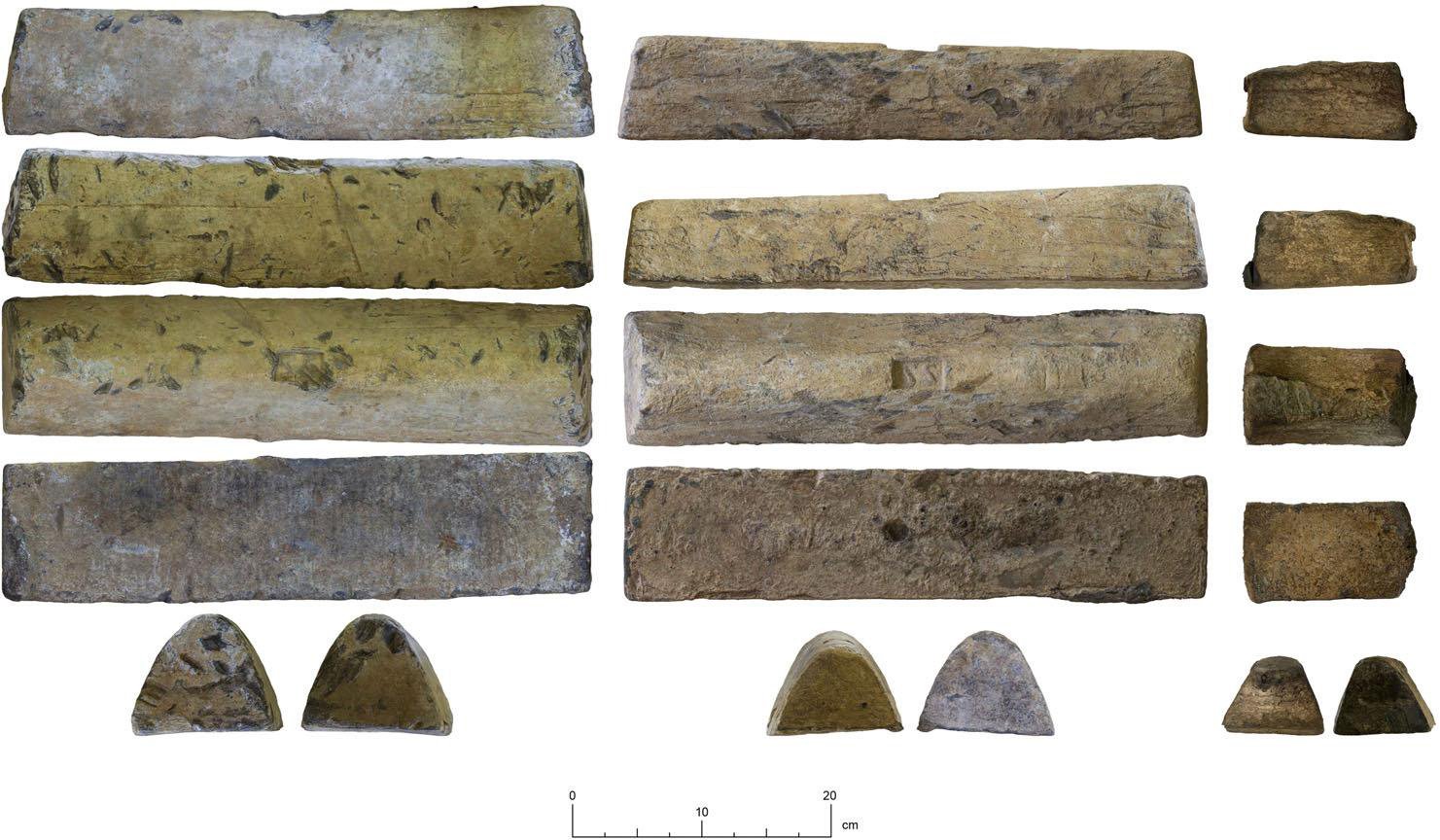
Three lead ingots unearthed at Los Escoriales de Doña Rama (Belmez), dating back to the Roman period, highlight the significance of lead production and export in northern Cordoba.
Measuring approximately 45 centimeters in length and weighing between 24 and 32 kilograms, these triangular-shaped ingots resemble a Toblerone bar. There are only three of them, with one broken in half. Despite this, the study of these three lead ingots, previously unexamined and originating from the Los Escoriales de Doña Rama (Belmez, Córdoba) deposit, provides enough information to assert that ancient Cordoba, the capital of the Roman Empire’s Baetica region, was the primary center for lead smelting in the western ancient world. This region, now encompassing the Guadiato Valley, Los Pedroches, and parts of Jaen, Ciudad Real, and Badajoz, produced lead for numerous everyday items such as spoons, tiles, and pipes.
The ingots, dating from the first century A.D., were unearthed in the twentieth century during work on the Maghreb-Europe gas pipeline and were kept in the Belmez Museum and in private homes. Two of them bear an identifying mark, making it possible to reveal part of their history and to confirm the great importance of mining importance in the central Sierra Morena area during the Roman period. This mark is actually two letters, “S S”, referring to the Societas Sisaponensis, a mining company originally from La Bienvenida (Almodóvar del Campo, Ciudad Real), a land famous for the production of cinnabar, but that must have been headquartered in Cordoba.
Export and Trade
In addition to the ingots’ triangular shape, optimizing their storage capacity, the fact that the ingots bore these letters means that they were supposed to be exported, with the mark identifying the producer of the pieces, which were then to be loaded onto ships along with other products. Thus, the mining activity in northern Cordoba was not limited to the production of lead and silver, something that was already known, but also involved exportation, placing the area among the main producers of metals intended for Mediterranean trade, a conclusion asserted by an international and multidisciplinary team led by the University of Cordoba in an article published in the Journal of Roman Archaeology.
Analysis of the ingots’ chemical composition and stable isotopes allowed the research team to verify that they were desilvered, and that the ore with which they were made was from the district of Fuente Obejuna-Azuaga, a major mining area that included the Doña Rama site where the ingots were found. In other words, the three pieces had a common origin linked to the same site where they were discovered.
Conclusion and Future Research
The fact that the ingots were found in the same area where they were produced is exceptional, and the reason for this is unknown. Most ingots of this type have been found at the bottom of the Mediterranean Sea, at shipwreck sites, and it is precisely at the bottom of the sea where the most information has been obtained since the research team began working with specialists from the Université Toulouse who have spent years studying the composition and creating a catalog of the ingots found there. According to the analysis, more than half of the ingots studied by the French specialists were from the district of Fuente Obejuna-Azuaga, proving Cordoba’s importance as a producer and exporter of lead ingots.
“This information demonstrates that, in antiquity, these northern regions of Cordoba boasted major metallurgical networks of great commercial and economic importance in the Mediterranean,” said UCO researcher Antonio Monterroso Checa, adding that “which reveals the level of industrialization, skill, and knowledge necessary to reach that level of manufacturing.” In fact, although much remains to be studied, the Doña Rama site would seem to be a mining town complete with a foundry, a processing area and, possibly, a fortress. But, as Monterroso Checa has stated, “all this remains to be studied.”
Reference: “La societas Sisaponensis, los lingotes de Doña Rama-Belmez y la explotación minera de los montes de Corduba” by Antonio Monterroso-Checa, Claude Domergue, Christian Rico, Mar Zarzalejos-Prieto, Fernando Palero-Fernández, Sabine Klein, Isabel María García-Magdaleno, Pier Renato Trincherini, Massimo Gasparini, Francesca Marchegiani, Juan Carlos Moreno-Escribano, Stefano Nisi and José Rafael Ruiz-Arrebola, 3 May 2024, Journal of Roman Archaeology.
DOI: 10.1017/S1047759424000035
The study of the ingots was carried out as part of the MEI-Heritage Project: Medio, explotación minera e industria metalúrgica en el sector central de la Beturia de los Túrdulos/Conventus Cordubensis (s.VII a.n.e–s.II d.n.e). Ciencias aplicadas a la investigación de un paisaje patrimonial [The Environment, Mining and the Metallurgical Industry in the Central Area of the Beturia de los Túrdulos/Conventus juridicus Cordubensis (7th century BC – 2nd Century AD). Sciences Applied to Research of a Heritage Landscape]project, funded by the Junta de Andalucía’s PAIDI 2020 (Research, Development and Innovation Plan) (ref. P20_00482) and the University of Cordoba’s Unidad de Investigación y Transferencia en Ciencias del Patrimonio (Heritage Sciences Research and Transfer Unit). The study is also part of theProducción y circulación de bienes en el reborde meridional de la Meseta (sur de la provincia de Ciudad Real) entre la Prehistoria reciente y el fin de la Antigüedad[Production and Circulation of Goods on the Southern Rim of the Meseta (South of the Province of Ciudad Real) between Recent Prehistory and the End of Antiquity] project, funded by the Spanish Ministry of Science and Innovation (ref. PID2019-105094GB-I00).
Never miss a breakthrough: Join the SciTechDaily newsletter.
Follow us on Google and Google News.