
Close Menu
    Facebook X (Twitter) Instagram
    SciTechDaily
    • Biology
    • Chemistry
    • Earth
    • Health
    • Physics
    • Science
    • Space
    • Technology
    Facebook X (Twitter) Pinterest YouTube RSS
    SciTechDaily
    Home»Biology»Microorganisms in Gut Are Essential for Development of Social Behavior in Fish
    Biology

    Microorganisms in Gut Are Essential for Development of Social Behavior in Fish

    By PLOSJune 9, 2023No Comments3 Mins Read
    Facebook Twitter Pinterest Telegram LinkedIn WhatsApp Email Reddit
    Share
    Facebook Twitter LinkedIn Pinterest Telegram Email Reddit
    Useful Microbes Producing Chemicals
    A study published in PLOS Biology indicates that microorganisms significantly influence the social development of zebrafish by affecting neural pruning in the developing brain. The absence of microbiota early in development led to inhibited social behavior and denser neural connections, but the addition of intestinal bacteria restored normal development, highlighting a critical role of microbiota in neural pruning and social behavior in zebrafish larvae.

    Germ-free larvae have altered neural connections due to a reduction in pruning by immune cells.

    Microorganisms are essential for normal social development in zebrafish via their influence on pruning of neural connections in the developing brain, according to a study published in the open access journal PLOS Biology by Joseph Bruckner at the University of Oregon, US, and colleagues.

    Zebrafish larvae have transparent skin, offering researchers a rare window into neural development. In a series of experiments, the researchers investigated the neuronal and social development of zebrafish larvae reared with or without the presence of their normal microbiota for the first seven days of development.

    They found that larval social behavior at day 14 was inhibited by the early absence of microbes, despite the larvae’s normal microbiota being restored a week earlier. Compared to siblings with a normal microbiota, the brains of these germ-free larvae had fewer immune cells called microglia in their forebrains, and denser, more complex neural branching patterns. Single-cell RNA sequencing showed that their microglia also had lower levels of complement c1q, a gene involved in pruning neural connections called synapses.
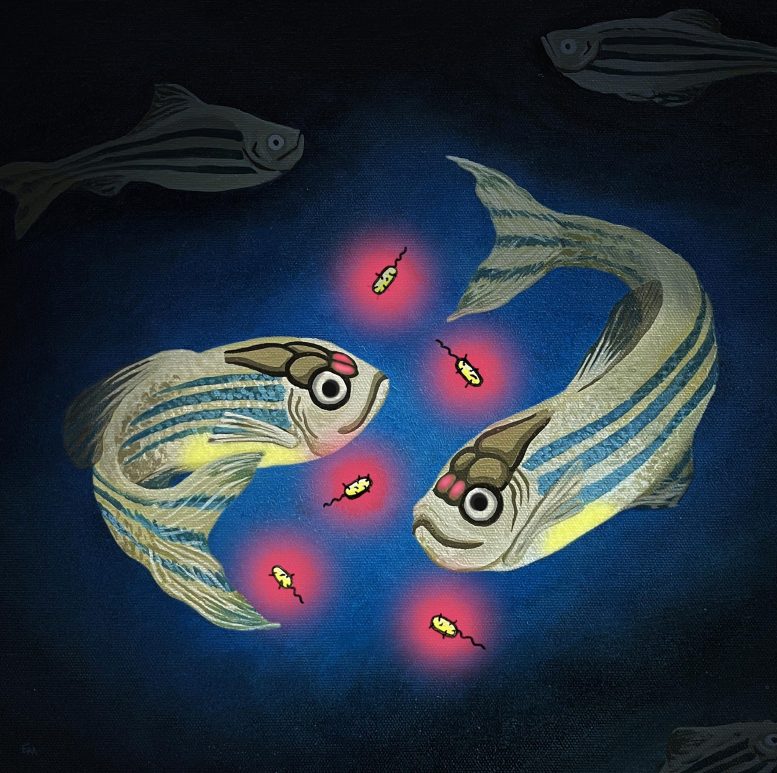
    Gut Bacteria Essential for Social Behavior Development in Fish
    A study published in PLOS Biology indicates that microorganisms significantly influence the social development of zebrafish by affecting neural pruning in the developing brain. The absence of microbiota early in development led to inhibited social behavior and denser neural connections, but the addition of intestinal bacteria restored normal development, highlighting a critical role of microbiota in neural pruning and social behavior in zebrafish larvae.

    Restoring Social and Neural Development

    Genetically reducing microglia without affecting the microbiota produced similar results, increasing neural density and branching relative to controls. Normal neural and social development was restored in germ-free larvae by adding any of several different bacterial groups native to the zebrafish intestine, indicating that microglial pruning activity is sensitive to a feature common across many types of bacteria.

    The study is the first to demonstrate that microglia are required for pruning of neural connections in zebrafish larvae, and that an intact microbiota is essential for normal pruning and fish social behavior. The results also show that there is a critical developmental window during the first week of larval development, during which the microbiota stimulates microglial localization to the forebrain where they prune neural connections, the authors say.

    Eisen adds, “Social interactions are critical for animals and humans. By studying zebrafish social interactions, we discovered that symbiotic bacteria encourage social behavior by promoting the ability of microglia, the brain’s immune cells, to remodel previously identified ‘social’ neurons in the zebrafish brain.”

    For more on this study, see Researchers Uncover a Gut-Brain Connection for Social Development.

    Reference: “The microbiota promotes social behavior by modulating microglial remodeling of forebrain neurons” by Joseph J. Bruckner, Sarah J. Stednitz, Max Z. Grice, Dana Zaidan, Michelle S. Massaquoi, Johannes Larsch, Alexandra Tallafuss, Karen Guillemin, Philip Washbourne and Judith S. Eisen, 1 November 2022, PLOS Biology.
    DOI: 10.1371/journal.pbio.3001838

    Never miss a breakthrough: Join the SciTechDaily newsletter.
    Follow us on Google and Google News.

    Developmental Biology Immunology Microglia Neuroscience PLOS Zebrafish
    Share. Facebook Twitter Pinterest LinkedIn Email Reddit

    Related Articles

    Scientists Uncover a Gut-Brain Connection for Social Development

    Discovery of Vital Role for the Brain’s Immune Cells Reveals a New Aspect of Human Biology

    Incredible Imaging Shows How Neural Circuits Form in a Developing Embryo [Video]

    New Insight on CLOCK Gene May Hold Answers to Human Brain Evolution

    New Study Improves Our Understanding of Intercellular Communication

    Key Process in Brain Development Identified

    Zebrafish Larva Eye Distinguishes Between Prey and Predator

    Scientists Uncover How Beautiful Color Patterns Develop in Zebrafish

    Microglia Are Crucial to Pruning Neurons During Early Development

    Leave A Reply Cancel Reply

    • Facebook
    • Twitter
    • Pinterest
    • YouTube

    Don't Miss a Discovery

    Subscribe for the Latest in Science & Tech!

    Trending News

    First-of-Its-Kind Discovery: Homer’s Iliad Found Embedded in a 1,600-Year-Old Egyptian Mummy

    Beyond Inflammation: Scientists Uncover New Cause of Persistent Rheumatoid Arthritis

    A Simple Molecule Could Unlock Safer, Easier Weight Loss

    Scientists Just Built a Quantum Battery That Charges Almost Instantly

    Researchers Unveil Groundbreaking Sustainable Solution to Vitamin B12 Deficiency

    Millions of People Have Osteopenia Without Realizing It – Here’s What You Need To Know

    Researchers Discover Boosting a Single Protein Helps the Brain Fight Alzheimer’s

    World-First Study Reveals Human Hearts Can Regenerate After a Heart Attack

    Follow SciTechDaily
    • Facebook
    • Twitter
    • YouTube
    • Pinterest
    • Newsletter
    • RSS
    SciTech News
    • Biology News
    • Chemistry News
    • Earth News
    • Health News
    • Physics News
    • Science News
    • Space News
    • Technology News
    Recent Posts
    • After Decades, MIT Researchers Capture the First 3D Atomic View of a Mysterious Material
    • Your Favorite Fishing Spot Is Turning Brown – and the Fish Are Changing
    • 380-Million-Year-Old Fish Fossil Reveals Secrets of Life’s First Steps Onto Land
    • Mezcal “Worm” in a Bottle Mystery: DNA Testing Reveals a Surprise
    • Scientists Turn Red Lettuce Green, Unlocking Hidden Nutrients
    Copyright © 1998 - 2026 SciTechDaily. All Rights Reserved.
    • Science News
    • About
    • Contact
    • Editorial Board
    • Privacy Policy
    • Terms of Use

    Type above and press Enter to search. Press Esc to cancel.