
Undergraduate MIT class blends science, hands-on experimentation, and a love for coffee to fuel curiosity.
In a pioneering MIT course blending chemistry lectures with hands-on brewing, students like Elaine Jutamulia and Omar Orozco experiment with additives to enhance coffee flavors, employing advanced instruments like infrared spectrometers to dissect the impact on coffee’s chemical profile.
Coffee Science and Flavor Experimentation
Elaine Jutamulia ’24 took a sip of coffee infused with a few drops of anise extract. It was her second attempt.
“What do you think?” asked Omar Orozco, standing at a lab table in MIT’s Breakerspace, surrounded by an array of filters, brewing pots, and other coffee-making tools.
“I think when I first tried it, it was still pretty bitter,” Jutamulia said thoughtfully. “But I think now that it’s steeped for a little bit — it took out some of the bitterness.”
Brewing the Perfect Cup
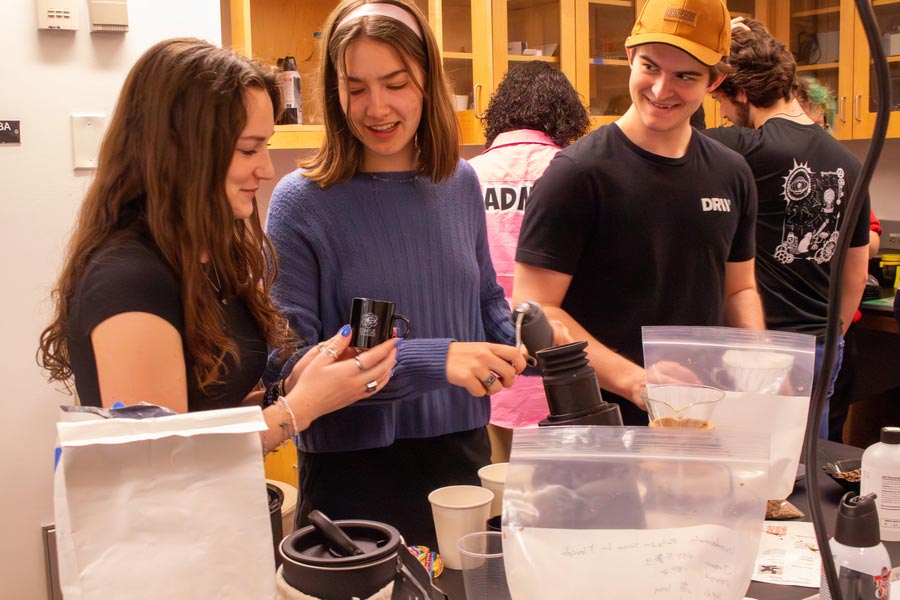
Jutamulia and Orozco, a current MIT senior, were both enrolled in class 3.000, Coffee Matters: Using the Breakerspace to Make the Perfect Cup, a new course introduced in the spring of 2024. The class blends chemistry lectures with hands-on coffee experiments and group projects. Their team focused on how additives such as anise, salt, and chili oil affect coffee extraction — the process of dissolving flavor compounds from ground coffee into water — in an effort to enhance taste and fix common brewing mistakes.
Alongside tasting, they used an infrared spectrometer to identify the chemical compounds in their coffee samples that contribute to flavor. Does anise make bitter coffee smoother? Could chili oil balance the taste?
“Generally speaking, if we could make a recommendation, that’s what we’re trying to find,” Orozco said.
Innovations in Coffee Studies
A three-unit “discovery class” designed to help first-year students explore majors, 3.000 was widely popular, enrolling more than 50 students. Its success was driven by the beverage at its core and the class’s hands-on approach, which pushes students to ask and answer questions they might not have otherwise.
For aeronautics and astronautics majors Gabi McDonald and McKenzie Dinesen, coffee was the draw, but the class encouraged them to experiment and think in new ways. “It’s easy to drop people like us in, who love coffee, and, ‘Oh my gosh, there’s this class where we can go make coffee half the time and try all different kinds of things?’” McDonald says.
Advanced Analytical Techniques
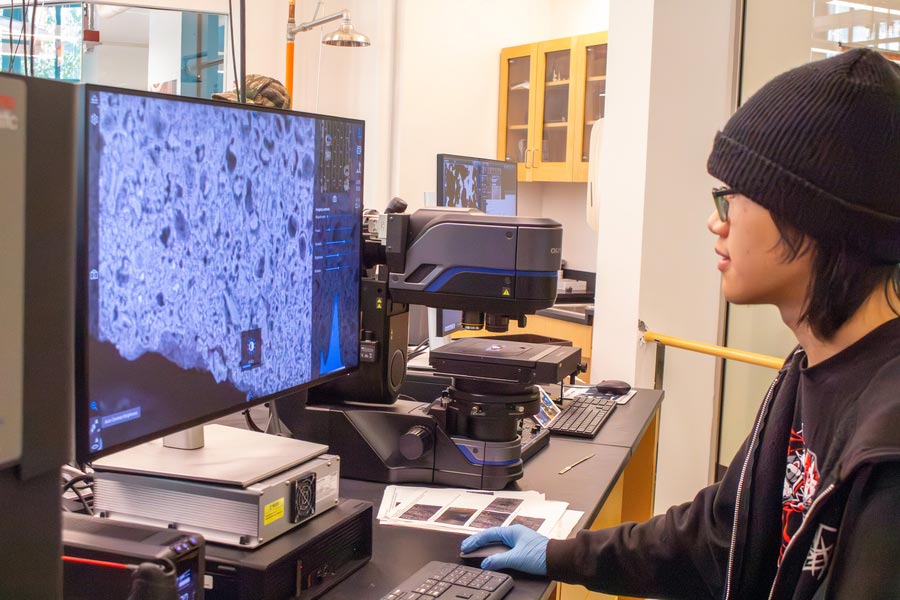
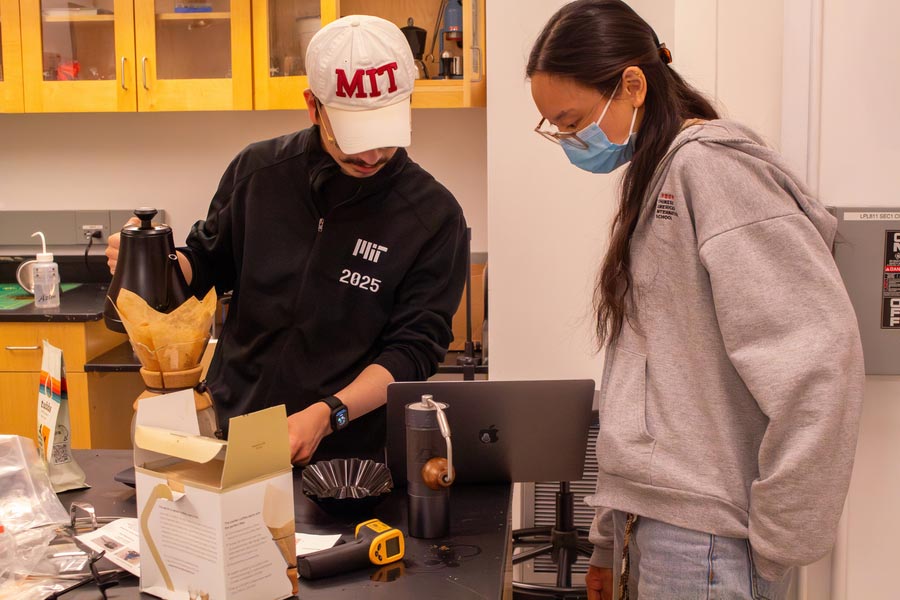
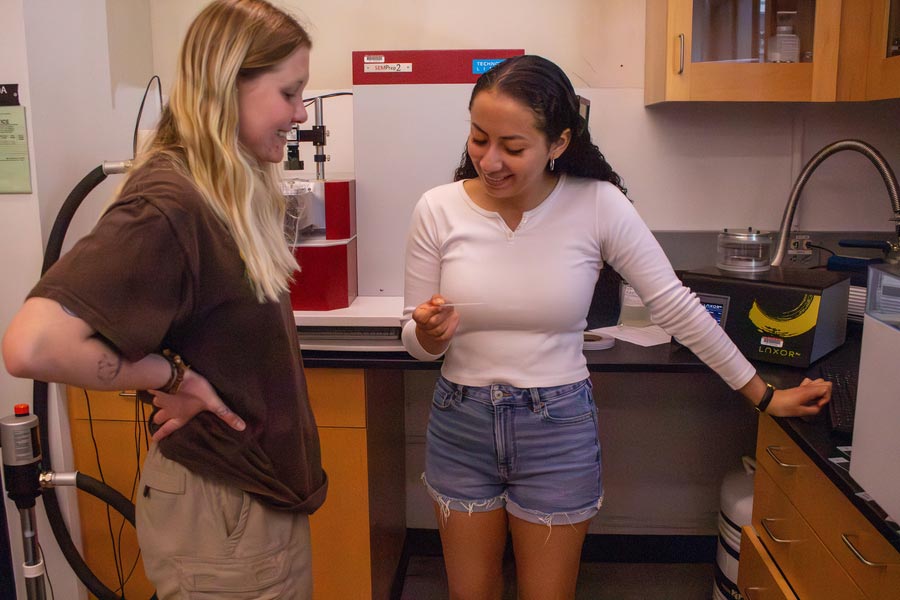
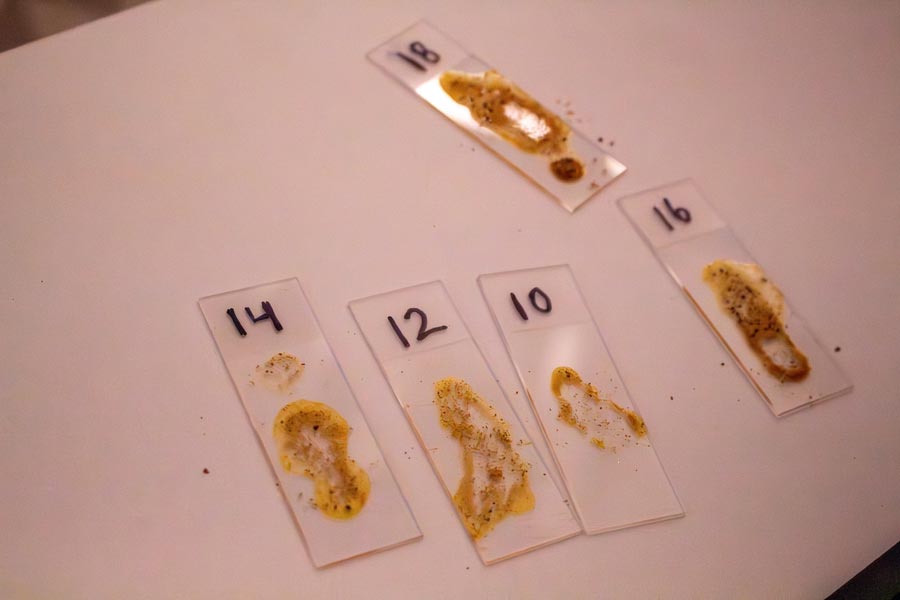
The class pairs weekly lectures on topics such as coffee chemistry, the anatomy and composition of a coffee bean, the effects of roasting, and the brewing process with tasting sessions — students sample coffee brewed from different beans, roasts, and grinds. In the MIT Breakerspace, a new space on campus conceived and managed by the Department of Materials Science and Engineering (DMSE), students use equipment such as a digital optical microscope to examine ground coffee particles and a scanning electron microscope, which shoots beams of electrons at samples to reveal cross-sections of beans in stunning detail.
Once students learn to operate instruments for guided tasks, they form groups and design their own projects.
“The driver for those projects is some question they have about coffee raised by one of the lectures or the tasting sessions, or just something they’ve always wanted to know,” says DMSE Professor Jeffrey Grossman, who designed and teaches the class. “Then they’ll use one or more of these pieces of equipment to shed some light on it.”
Interdisciplinary Approach and Student Projects
Grossman traces the origins of the class to his initial vision for the Breakerspace, a laboratory for materials analysis and lounge for MIT undergraduates. Opened in November 2023, the space gives students hands-on experience with materials science and engineering, an interdisciplinary field combining chemistry, physics, and engineering to probe the composition and structure of materials.
“The world is made of stuff, and these are the tools to understand that stuff and bring it to life,” says Grossman. So he envisioned a class that would give students an “exploratory, inspiring nudge.”
“Then the question wasn’t the pedagogy, it was, ‘What’s the hook?’ In materials science, there are a lot of directions you could go, but if you have one that inspires people because they know it and maybe like it already, then that’s exciting.”
Cup of Ambition
That hook, of course, was coffee, the second-most-consumed beverage after water. It captured students’ imagination and motivated them to push boundaries.
Orozco brought a fair amount of coffee knowledge to the class. In 2023, he taught in Mexico through the MISTI Global Teaching Labs program, where he toured several coffee farms and acquired a deeper knowledge of the beverage. He learned, for example, that black coffee, contrary to general American opinion, isn’t naturally bitter; bitterness arises from certain compounds that develop during the roasting process.
Experimentation and Discovery
“If you properly brew it with the right beans, it actually tastes good,” says Orozco, a humanities and engineering major. A year later, in 3.000, he expanded his understanding of making a good brew, particularly through the group project with Jutamulia and other students to fix bad coffee.
The group prepared a control sample of “perfectly brewed” coffee — based on taste, coffee-to-water ratio, and other standards covered in class — alongside coffee that was under-extracted and over-extracted. Under-extracted coffee, made with water that isn’t hot enough or brewed for too short a time, tastes sharp or sour. Over-extracted coffee, brewed with too much coffee or for too long, tastes bitter.
Those coffee samples got additives and were analyzed using Fourier Transform Infrared (FTIR) spectroscopy, measuring how coffee absorbed infrared light to identify flavor-related compounds. Jutamulia examined FTIR readings taken from a sample with lime juice to see how the citric acid influenced its chemical profile.
“Can we find any correlation between what we saw and the existing known measurements of citric acid?” asks Jutamulia, who studied computation and cognition at MIT, graduating last May.
Freezing Coffee and Its Effects
Another group dove into coffee storage, questioning why conventional wisdom advises against freezing.
“We just wondered why that’s the case,” says electrical engineering and computer science major Noah Wiley, a coffee enthusiast with his own espresso machine.
The team compared methods like freezing brewed coffee, frozen coffee grounds, and whole beans ground after freezing, evaluating their impact on flavor and chemical composition.
“Then we’re going to see which ones taste good,” says Wiley. The team used a class coffee review sheet to record attributes like acidity, bitterness, sweetness, and overall flavor, pairing the results with FTIR analysis to determine how storage affected taste.
Wiley acknowledged that “good” is subjective. “Sometimes there’s a group consensus. I think people like fuller coffee, not watery,” he says.
Other student projects compared caffeine levels in different coffee types, analyzed the effect of microwaving coffee on its chemical composition and flavor, and investigated the differences between authentic and counterfeit coffee beans.
“We gave the students some papers to look at in case they were interested,” says Justin Lavallee, Breakerspace manager and co-teacher of the class. “But mostly we told them to focus on something they wanted to learn more about.”
Broader Learning and Curiosity
Beyond answering specific questions about coffee, both students and teachers gained deeper insights into the beverage.
“Coffee is a complicated material. There are thousands of molecules in the beans, which change as you roast and extract them,” says Grossman. “The number of ways you can engineer this collection of molecules — it’s profound, ranging from where and how the coffee’s grown to how the cherries are then treated to get the beans to how the beans are roasted and ground to the brewing method you use.”
Dinesen learned firsthand, discovering, for example, that darker roasts have less caffeine than lighter roasts, puncturing a common misconception. “You can vary coffee so much — just with the roast of the bean, the size of the ground,” she says. “It’s so easily manipulatable, if that’s a word.”
Exploring Personal Preferences
Dinesen and McDonald not only learned about the science and chemistry of coffee but also picked up new brewing techniques, such as using a pour-over cone. They even made coffee a part of their study routine, brewing and testing different methods while working on problem sets for their other classes.
“I would put my pour-over cone in my backpack with a Ziploc bag full of grounds, and we would go to the Student Center and pull out the cone, a filter, and the coffee grounds,” McDonald says. “And then we would make pour-overs while doing a P-set. We tested different amounts of water, too. It was fun.”
Tony Chen, a materials science and engineering major, reflected on the 3.000’s title — “Using the Breakerspace to Make the Perfect Cup” — and whether making a perfect cup is possible. “I don’t think there’s one perfect cup because each person has their own preferences. I don’t think I’ve gotten to mine yet,” he says.
Enthusiasm for coffee’s complexity and the discovery process was exactly what Grossman hoped to inspire in his students. “The best part for me was also just seeing them developing their own sense of curiosity,” he says.
He recalled a moment early in the class when students, after being given a demo of the optical microscope, saw the surface texture of a magnified coffee bean, the mottled shades of color, and the honeycomb-like pattern of tiny irregular cells.
“They’re like, ‘Wait a second. What if we add hot water to the grounds while it’s under the microscope? Would we see the extraction?’ So, they got hot water and some ground coffee beans, and lo and behold, it looked different. They could see the extraction right there,” Grossman says. “It’s like they have an idea that’s inspired by the learning, and they go and try it. I saw that happen many, many times throughout the semester.”
Never miss a breakthrough: Join the SciTechDaily newsletter.
Follow us on Google and Google News.
12 Comments
Will eating coffee be useful for muscles?
So… How DO you brew the perfect cup then? I’m glad they learned a bunch of stuff, but tell us specifically what to do! Beans, water, brewing, storage, etc.
Get a SPINN 2 coffee brewing machine, explore what they have named, “geek mode,” and perform nearly any extraction you can conceive, short of Turkish coffee.
Right?!
I appreciate this article, but if you’re going to analyze coffee from a scientific standpoint then you should refrain from using “coffee bean” coffee is actually a seed.
Would have loved to see coffee brewed with alternate methods for example effect of sonic emulsifier in hot and cold brews
The term “revolutionize” is used here rather loosely. As a coffee micro importer I was hoping to actually learn something.
I have heard the most expensive coffee beans are those which have passed through a goat. No mention of introducing the cherries to microbial fermentation.
Agreed! Very frustrating. Maybe they will publish a peer reviewed paper with their findings, apply for patents first!!
It’s already a no for me clearly you are not as big of a fan of coffee as me or you’d realize coffee is perfect the way it is and should not under any circumstances be scientifically modified in any way shape or form the last time a consumable (meat) was scientifically modified it got living human cancer cells injected into it. So as a person who’s whole life is coffee I say very respectfully leave the coffee alone and just drink it
Completely Agree With You Mr Lee!!!!
“Grossman traces the origins of the class to his initial vision for the Breakerspace, a laboratory for materials analysis and lounge for MIT undergraduates.” SURE!
This class is a copy of the UC Davis class; they were the first university in USA offering this kinda of class. They have been offering this class for over 10 years.