
Close Menu
    Facebook X (Twitter) Instagram
    SciTechDaily
    • Biology
    • Chemistry
    • Earth
    • Health
    • Physics
    • Science
    • Space
    • Technology
    Facebook X (Twitter) Pinterest YouTube RSS
    SciTechDaily
    Home»Science»Modeling Program to Measure the Friction of Graphene
    Science

    Modeling Program to Measure the Friction of Graphene

    By National Institute of Standards and TechnologyJanuary 13, 2012No Comments3 Mins Read
    Facebook Twitter Pinterest Telegram LinkedIn WhatsApp Email Reddit
    Share
    Facebook Twitter LinkedIn Pinterest Telegram Email Reddit
    Friction of Graphene
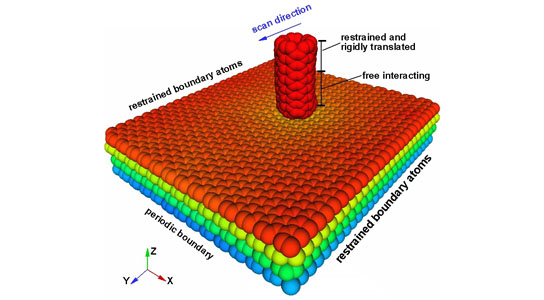
    Researchers developed software to quantify graphene’s friction at an atomic level, simulating atomic force microscopy. Credit: A Smolyanitsky/NIST

    National Institute of Standards and Technology postdoctoral researcher Alex Smolyanitsky developed software to quantify the friction found on graphene. The software is able to show friction at an atomic level by simulating atomic force microscopy.

    Similar to the way pavement, softened by a hot sun, will slow down a car, graphene—a one-atom-thick sheet of carbon with wondrous properties—slows down an object sliding across its surface. But stack the sheets and graphene gets more slippery, say theorists at the National Institute of Standards and Technology (NIST), who developed new software to quantify the material’s friction.

    “I don’t think anyone expects graphene to behave like a surface of a three-dimensional material, but our simulation for the first time explains the differences at an atomic scale,” says NIST postdoctoral researcher Alex Smolyanitsky, who wrote the modeling program and co-authored a new paper about the study. “If people want to use graphene as a solid-state lubricant or even as a part of flexible electrodes, this is important work.”

    With the capacity to be folded, rolled or stacked, graphene is super-strong and has unusual electronic and optical properties. The material might be used in applications ranging from electronic circuits to solar cells to “greasing” moving parts in nanoscale devices.

    Friction is the force that resists the sliding of two surfaces against each other. Studying friction at the atomic scale is a challenge, surmountable in only the past few years. The NIST software simulates atomic force microscopy (AFM) using a molecular dynamics technique. The program was used to measure what happens when a simulated AFM tip moves across a stack of one to four graphene sheets (see image) at different scanning rates.

    The researchers found that graphene deflects under and around the AFM tip. The localized, temporary warping creates rolling friction or resistance, the force that exerts drag on a circular object rolling along a surface. Smolyanitsky compares the effect to the sun melting and softening pavement in the state where he got his doctoral degree, Arizona, causing car tires to sink in slightly and slow down. The NIST results are consistent with those of recent graphene experiments by other research groups but provide new quantitative data.

    Most significantly, the NIST study shows why friction falls with each sheet of graphene added to the stack (fast scanning also has an effect on the friction). With fewer layers, the top layer deflects more, and the friction per unit of AFM contact force rises. The top surface of the stack becomes less yielding and more slippery as graphene layers are added. By contrast, the friction of three-dimensional graphite-like material is virtually unaffected by deformation and rolling friction, and is due instead to heat created by the moving tip.

    Never miss a breakthrough: Join the SciTechDaily newsletter.
    Follow us on Google and Google News.

    Graphene Neurology NIST
    Share. Facebook Twitter Pinterest LinkedIn Email Reddit

    Related Articles

    Visual Repellants May Help Prevent Shark Attacks

    Brain Scans Help Scientists Read Dreams

    The Scientific Cause of Near-Death Experiences

    Atomic Bond Types Clearly Discernible Thanks to Single-Molecule Images

    Olympicene, the Smallest Possible Five-Ringed Structure

    Graphene Invisible to Water

    Graphene is Transparent to Water

    Graphene Turned Magnetic by University of Manchester Researchers

    Size Does Matter When Determining Alzheimer’s Risk

    Leave A Reply Cancel Reply

    • Facebook
    • Twitter
    • Pinterest
    • YouTube

    Don't Miss a Discovery

    Subscribe for the Latest in Science & Tech!

    Trending News

    Scientists Uncover Potential Brain Risks of Popular Fish Oil Supplements

    Scientists Discover a Surprising Way To Make Bread Healthier and More Nutritious

    After 60 Years, Scientists Uncover Unexpected Brain Effects of Popular Diabetes Drug Metformin

    New Research Uncovers Hidden Side Effects of Popular Weight-Loss Drugs

    Scientists Rethink Extreme Warming After Surprising Ocean Discovery

    Landmark Study Links Never Marrying to Significantly Higher Cancer Risk

    Researchers Discover Unknown Beetle Species Just Steps From Their Lab

    Largest-Ever Study Finds Medicinal Cannabis Ineffective for Anxiety, Depression, PTSD

    Follow SciTechDaily
    • Facebook
    • Twitter
    • YouTube
    • Pinterest
    • Newsletter
    • RSS
    SciTech News
    • Biology News
    • Chemistry News
    • Earth News
    • Health News
    • Physics News
    • Science News
    • Space News
    • Technology News
    Recent Posts
    • Scientists Discover Hidden Pathway Inside Catalysts That Defies Decades of Assumptions
    • Scientists Finally Crack Decades-Old Mystery of “Breathing” Lasers
    • “Like Liquid Metal”: Scientists Create Strange Shape-Shifting Material
    • Early Warning Signals of Esophageal Cancer May Be Hiding in Plain Sight
    • Researchers Have Discovered a THC-Free Cannabis Compound That May Replace Opioids
    Copyright © 1998 - 2026 SciTechDaily. All Rights Reserved.
    • Science News
    • About
    • Contact
    • Editorial Board
    • Privacy Policy
    • Terms of Use

    Type above and press Enter to search. Press Esc to cancel.