
Relaxed planetary protection rules could make many Mars missions simpler, while still guarding regions with higher life detection potential.
A new report that could make it simpler to send spacecraft to some areas of Mars while still protecting the planet from Earth-based contamination was presented today at a press conference at the 53rd annual meeting of the American Astronomical Society’s Division for Planetary Sciences by Planetary Science Institute Senior Scientist Amanda Hendrix.
The report from the National Academies of Sciences, Engineering, and Medicine identifies criteria that could allow robotic missions to certain locations on Mars to be carried out with less restrictive “bioburden” requirements, which are designed to prevent harmful contamination by Earth-based microbes at Mars.
“The Committee on Planetary Protection, a standing committee of the National Academies Space Studies Board, was tasked by NASA to write a report discussing criteria that could be used to designate regions on Mars where missions can land with less stringent bioburden requirements than currently in place. Currently, meeting planetary protection requirements – for instance, using rigorous sterilization techniques – can be seen as imposing, costly, and complex, and it could be that these restrictions can be simplified and modernized, in some cases, which can help make some areas of Mars more accessible,” said Hendrix, co-chair of the committee that wrote the report.
Balancing Accessibility and Contamination Risk
“The report suggests techniques for modernizing and providing flexibility in planetary protection implementation. One way to do this is by utilizing a risk management approach, that could be tailored to individual missions’ needs,” Hendrix said. “The Committee’s findings can lead to making portions of Mars more accessible to both commercial and government endeavors by relaxing planetary protection requirements while remaining careful about access to potential habitable zones.”
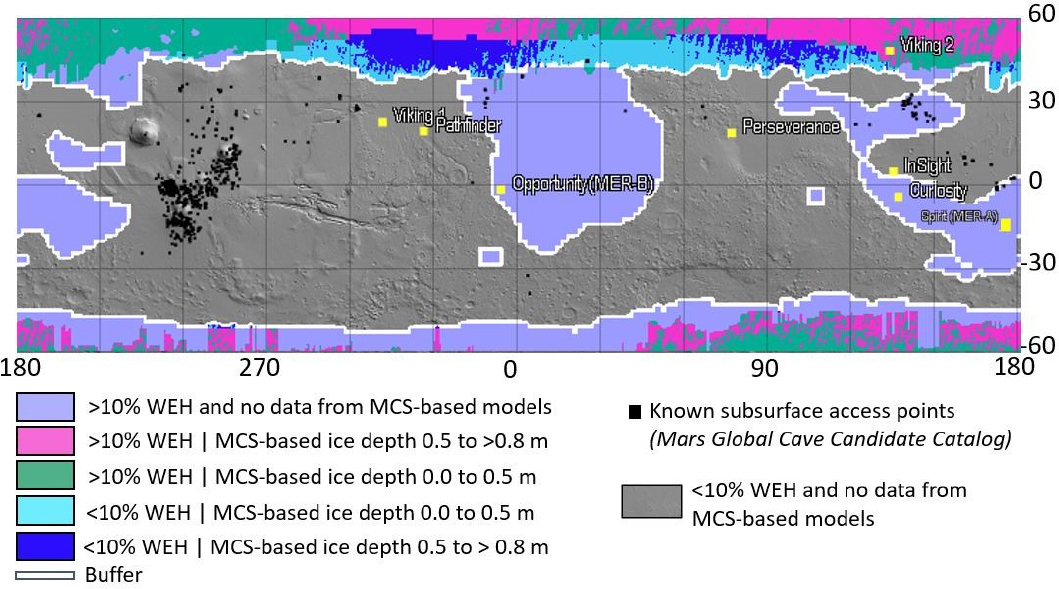
In this report, the Committee focused on regions on Mars that might not be negatively impacted if visited by spacecraft that are not stringently sterilized. For missions that do not access the subsurface, such regions could include a significant portion of the surface of Mars, because the UV environment is so biocidal that terrestrial organisms are, in most cases, not likely to survive more than one to two sols, or Martian days. For missions that access the subsurface (down to 1 meter), regions on Mars expected to have patchy or no water ice below the surface might also be visited by spacecraft with more relaxed bioburden requirements, because such patchy ice is likely not conducive to the proliferation of terrestrial microorganisms.
Surface and Subsurface Guidelines for Relaxed Cleanliness
The report finds that it is imperative that any mission sent to Mars with reduced bioburden requirements remain some conservative distance from any subsurface access points, such as cave openings. Furthermore, though less stringent than current requirements, these missions with relaxed bioburden requirements would still need some level of cleanliness, which could be achieved for instance using standard aerospace cleanliness practices.
“The whole purpose of planetary protection protocols is to minimize the risk of harmful contamination; this means minimizing the risk of introduction of terrestrial biological material that could confound future life detection experiments. This is really important in the case of Mars,” Hendrix said. “At Mars we know that the surface is almost certainly uninhabitable for terrestrial microorganisms, due to the harsh UV environment; however, subsurface regions such as caves, shielded from radiation, could be habitable zones, for terrestrial and/or indigenous Martian life.
“The report will help in the search for life on Mars by identifying those areas on its surface for which planetary protection standards for spacecraft must be most restrictive,” Hendrix said. “Also, by potentially easing planetary protection burdens in the exploration of other areas, NASA could enable more missions to Mars that help us understand the planet and its environment, even if these missions are not pursuing astrobiological studies.”
The committee’s findings apply specifically to missions for which NASA has responsibility for planetary protection. For commercial missions in which NASA has no role or connection, the U.S. government still needs to designate a regulatory agency to authorize and continually supervise space activities in accordance with the Outer Space Treaty, the report says. The study was funded by NASA.
Never miss a breakthrough: Join the SciTechDaily newsletter.
Follow us on Google and Google News.
17 Comments
We know for a fact that ancient space bodies carried what appears to be rna chains. What chance that none of these hit Mars? Zero.
It would take a few billion years for earth contaminates to make any change in Maars. Little atmosphere, O2 levels non-existent, no surface water. Carbon monoxide is created. Even tardigrades need O2. Soooo, what do “scientists” think we are contaminating??
Mars, worried about contaminating Mars.
It’s likely in the paper if you are really curious, but at a guess the usual: contaminating experiments; contaminating a putative deep biosphere.
Oops, I was too hasty and Dylan puts me right in a later comment: it’s just for the purpose too ease the science.
Since The Centrifugal Propeller will soon be replacing all rockets and other propulsion systems, and since it is capable of getting us to Mars in 10 hours, they need to rethink all of these processes. There is a working proof-of-concept prototype of the Centrifugal Propeller, and a video of it posted on Ytube.
“Centrifugal propellor”. Interesting. Do you have the link to the Youtube video? I couldn’t find anything about a propellor that works so efficiently that it will replace rockets, especially in a vacuum.
Please, no pseudoscience on a science site.
What this article propose is not “modernizing” it is in fact retrograding. If you can’t afford to go to mars and respect the planet then stay home.
Doesn’t look like we are not visiting Mars, does it? Specifically, there is no good reason not to do it and many good why we should (science, exploration, …).
This will not prevent some low tech and uninformed country from contaminating the planet. The Israelis for example, when they put Tardigrades on the moon.
You know that it was not an allowed cargo, and that the tardigrades died at impact according to later experiments, don’t you?.
If a nation has poor resources it won’t reach Mars (except by substantial and good collaborations).
He may be thinking of poor, primitive SpaceX
As the article clearly lays out, the purpose of these protocols is not to prevent Earth life from changing Mars, it is to prevent Earth life from making it impossible to tell if organic compounds are the result of actual life on Mars or simply contamination from the landers. It would make scientific investigation into the history of any life on Mars difficult or impossible. Other than this important mission, it would be great to colonize Mars with certain types of microbial life (cyanobacteria, nitrogen fixing bacteria, etc.)
Contaminate Mars? Lol. Of what? For what? That planet is barren, sterile; it has been like that since the begining. Atheist keep wishful thinking they will find martian life or traces of it. There is none. Period. Nobody on earth can avoid the eventual colonization of earthly microbes. Every person has billions of microbes in the body, both outside and inside. Sending steriled machines is useless when the microbes enter through humans. That is unavoidable. So, please gives us a break, no more idiot circus.
Please, no superstition on a science site.
I am pretty sure that when Elon Musk receives a complaining letter from the “comitee for the protection of mars”(lol), he will use it as toilet paper, which is the right thing to do in this nonsense argument.
As soon as they start landing humans on Mars, all this effort to avoid contamination is going to be nothing but big wasted effort.