
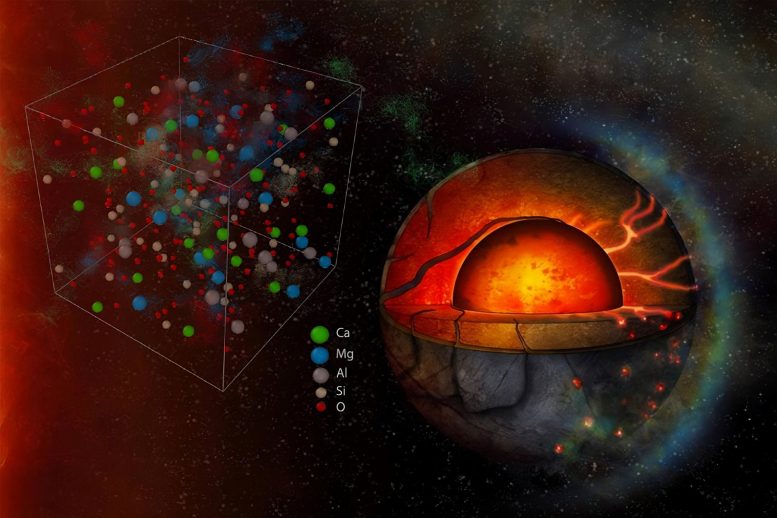
Researchers have discovered that Earth’s early magma ocean cooled in under two million years, driven by its low viscosity.
During the early stages of Earth’s formation, a massive ocean of molten rock known as a “magma ocean” blanketed the planet’s surface and penetrated deep into its core. The cooling rate of this “magma ocean” played a crucial role in shaping the layered structure of the Earth and determining the chemical composition of those layers.
Previous research had suggested that it took hundreds of millions of years for the magma ocean to solidify, but new research from Florida State University published in Nature Communications has reduced these uncertainties to less than just a couple of million years.
“This magma ocean has been an important part of Earth’s history, and this study helps us answer some fundamental questions about the planet,” said Mainak Mookherjee, an associate professor of geology in the Department of Earth, Ocean, and Atmospheric Science.
Viscosity: The Key to Crystallization and Cooling
When magma cools, it forms crystals. Where those crystals end up depends on how viscous the magma is and the relative density of the crystals. Crystals that are denser are likely to sink and thus change the composition of the remaining magma. The rate at which magma solidifies depends on how viscous it is. Less viscous magma will lead to faster cooling, whereas a magma ocean with thicker consistency will take a longer time to cool.
Like this research, previous studies have used fundamental principles of physics and chemistry to simulate the high pressures and temperatures in the Earth’s deep interior. Scientists also use experiments to simulate these extreme conditions. But these experiments are limited to lower pressures, which exist at shallower depths within the Earth. They don’t fully capture the scenario that existed in the planet’s early history, where the magma ocean extended to depths where pressure is likely to be three times higher than what experiments can reproduce.
To overcome those limitations, Mookherjee and collaborators ran their simulation for up to six months in the high-performance computing facility at FSU as well as at a National Science Foundation computing facility. This eliminated much of the statistical uncertainties in previous work.
“Earth is a big planet, so at depth, pressure is likely to be very high,” said Suraj Bajgain, a former post-doctoral researcher at FSU who is now a visiting assistant professor at Lake Superior State University. “Even if we know the viscosity of magma at the surface, that doesn’t tell us the viscosity hundreds of kilometers below it. Finding that is very challenging.”
Chemical Diversity in the Mantle: A Mystery Solved
The research also helps explain the chemical diversity found within the Earth’s lower mantle. Samples of lava — the name for magma after it breaks through the surface of the Earth — from ridges at the bottom of the ocean floor and volcanic islands like Hawaii and Iceland crystallize into basaltic rock with similar appearances but distinct chemical compositions, a situation that has long perplexed Earth scientists.
“Why do they have distinct chemistry or chemical signals?” Mookherjee said. “Since the magma originates from underneath the Earth’s surface, that means the source of the magma there has chemical diversity. How did that chemical diversity begin in the first place, and how has it survived over geological time?”
The starting point of chemical diversity in the mantle can be successfully explained by a magma ocean in the Earth’s early history with low viscosity. Less viscous magma led to the rapid separation of the crystals suspended within it, a process often referred to as fractional crystallization. That created a mix of different chemistry within the magma, rather than a uniform composition.
Reference: “Insights into magma ocean dynamics from the transport properties of basaltic melt” by Suraj K. Bajgain, Aaron Wolfgang Ashley, Mainak Mookherjee, Dipta B. Ghosh and Bijaya B. Karki, 8 December 2022, Nature Communications.
DOI: 10.1038/s41467-022-35171-y
The study was funded by the National Science Foundation.
Never miss a breakthrough: Join the SciTechDaily newsletter.
Follow us on Google and Google News.