

Has the decades-long mystery behind the strange star movements in Omega Centauri, the Milky Way’s largest star cluster, finally been solved?
Omega Centauri has been studied to determine if its high star velocities are caused by an intermediate mass black hole or multiple smaller black holes. Recent data from pulsar accelerations suggest the latter, advancing our understanding of black hole formation.
Omega Centauri’s Mysteries
Omega Centauri, a massive star cluster with nearly ten million stars, is located in the constellation Centaurus. Astronomers have long been puzzled by the unusually high velocities of stars near its center. Two main theories emerged to explain this: the presence of an intermediate-mass black hole (IMBH), weighing about 100,000 times the mass of the Sun, or a cluster of smaller, stellar-mass black holes, each only a few times the Sun’s mass.
Stellar evolution suggests that black holes should naturally form at the cluster’s center. However, astronomers believed that most of these black holes would be ejected over time due to gravitational slingshot interactions with nearby stars. This assumption made the existence of a single IMBH seem more plausible. The IMBH theory gained further support when researchers observed even faster-moving stars near Omega Centauri’s core, which could be explained by interactions with a massive central black hole.

Exploring Intermediate Mass Black Holes
Intermediate mass black holes (IMBHs) are exciting to astronomers because they may be the “missing link” between stellar mass black holes and supermassive black holes. Stellar-mass black holes form from the death of massive stars and have already been found via a variety of different techniques. Supermassive black holes are found at the centers of large galaxies and can weigh millions to billions of times the mass of the Sun. We do not currently know how supermassive black holes form or whether they begin their lives as stellar mass black holes. Finding an IMBH could solve this cosmic puzzle.
The new research involving the University of Surrey looked afresh at the anomalous velocities of stars at the center of Omega Centauri, but this time, it used a new piece of data. The researchers combined the anomalous velocity data with new data for the accelerations of pulsars for the first time. Pulsars, like black holes, are formed from dying stars. Weighing up to twice the mass of the Sun, they are just 20km across and can spin up to 700 times a second. As they spin, they emit radio waves along their spin axis, processing like a spinning top. The radio beam sweeps past the Earth like a lighthouse, allowing us to detect them.
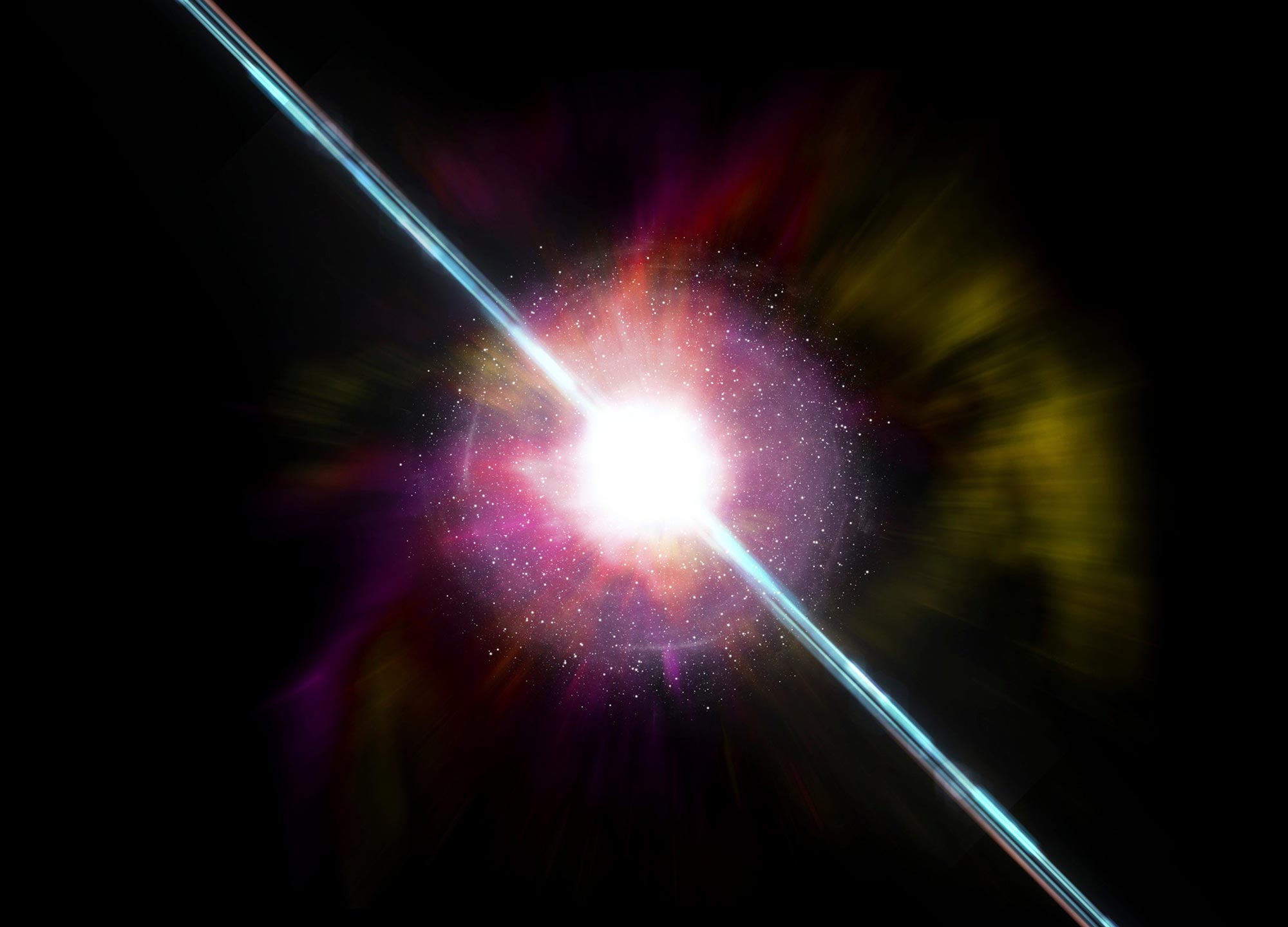
Pulsars: Precision Clocks in Space
Pulsars are natural clocks, almost as accurate as atomic clocks on Earth. By carefully measuring the change in the rate of their spin, astronomers can calculate how the pulsars are accelerating, directly probing the gravitational field strength at the center of Omega Centauri. Combining these new acceleration measurements with the stellar velocities, researchers from Surrey, the Instituto de Astrofísica de Canarias (IAC, Spain) and the Annecy-le-Vieux Laboratoire de Physique Théorique LAPTh in Annecy (France) were able to tell the difference between an IMBH and a cluster of black holes, favoring the latter.
Professor Justin Read, co-author of the study from the University of Surrey, said:
“The hunt for elusive intermediate-mass black holes continues. There could still be one at the center of Omega Centauri, but our work suggests that it must be less than about six thousand times the mass of the Sun and live alongside a cluster of stellar mass black holes. There is, however, every chance of us finding one soon. More and more pulsar accelerations are coming, allowing us to peer into the centers of dense star clusters and hunt for black holes more precisely than ever before.”
Andrés Bañares Hernández, lead author of the study from IAC, said:
“We have long known about supermassive black holes at galaxy centers and smaller stellar-mass black holes within our own galaxy. However, the idea of intermediate-mass black holes, which could bridge the gap between these extremes, remains unproven.”
“By studying Omega Centauri – a remnant of a dwarf galaxy – we have been able to refine our methods and take a step forward in understanding whether such black holes exist and what role they might play in the evolution of star clusters and galaxies. This work helps resolve a two-decade-long debate and opens new doors for future exploration.”
“The formation of pulsars is also an active field of study because a large number of them have recently been detected. Omega Centauri is an ideal environment to study models of their formation, which we have been able to do for the first time in our analysis.”
Reference: “New constraints on the central mass contents of Omega Centauri from combined stellar kinematics and pulsar timing” by Andr’es Bañares-Hernández, Francesca Calore, Jorge Martin Camalich and Justin I. Read, 5 December 2024, Astronomy & Astrophysics.
DOI: 10.1051/0004-6361/202451763
Never miss a breakthrough: Join the SciTechDaily newsletter.
Follow us on Google and Google News.
4 Comments
I take it this is nothing to do with the “Great Attractor” mystery?
Graham Rounce, it is on a different scale altogether. The black holes belong to a stellar cluster with 10,000,000 stars, the Milky Way had 100-400 million stars, and the Great Attractor is the point towards which the Laniakea Supercluster is rushing, where the Laniakea consists of approximately 100,000 galaxies.
CORRECTION: the Milky Way HAS a million stars. Swypo.
“As they spin, they emit radio waves along their spin axis, processing like a spinning top.”
That would be *precessing*.