
Close Menu
    Facebook X (Twitter) Instagram
    SciTechDaily
    • Biology
    • Chemistry
    • Earth
    • Health
    • Physics
    • Science
    • Space
    • Technology
    Facebook X (Twitter) Pinterest YouTube RSS
    SciTechDaily
    Home»Space»NASA Lost Contact With Spacecraft Designed to Study Planets Outside Our Solar System
    Space

    NASA Lost Contact With Spacecraft Designed to Study Planets Outside Our Solar System

    By NASA's Jet Propulsion LaboratoryJanuary 4, 20201 Comment3 Mins Read
    Facebook Twitter Pinterest Telegram LinkedIn WhatsApp Email Reddit
    Share
    Facebook Twitter LinkedIn Pinterest Telegram Email Reddit
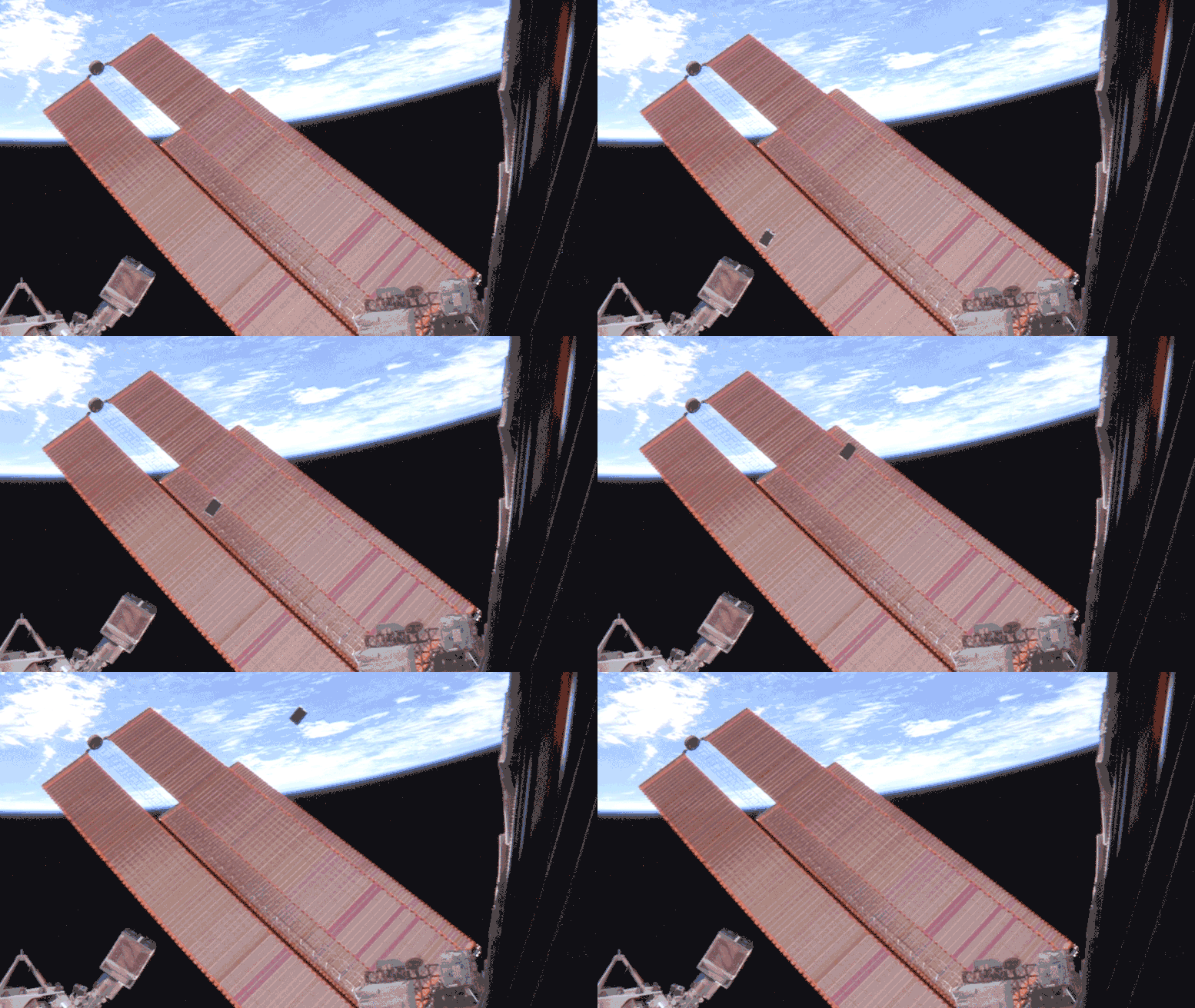
    ASTERIA Deployment
    ASTERIA deployed from the ISS on November 20, 2017. Credit: NASA

    Mission operators at NASA’s Jet Propulsion Laboratory in Pasadena, California, have lost contact with the ASTERIA satellite, a briefcase-sized spacecraft designed to study planets outside our solar system. The last successful communication with ASTERIA, short for Arcsecond Space Telescope Enabling Research in Astrophysics, was on December 5, 2019; attempts to contact it are expected to continue into March 2020.

    ASTERIA belongs to a category of satellites called CubeSats, which vary in size but are typically smaller than a suitcase. Deployed into Earth orbit from the space station on November 20, 2017, the technology demonstration mission showed that many technologies necessary for studying and potentially finding exoplanets (planets orbiting stars other than our Sun) can be shrunk to fit on small satellites. Long-term, the mission aimed to show that small satellites could one day be used to assist larger exoplanet missions, such as NASA’s Transiting Exoplanet Satellite Survey (TESS).
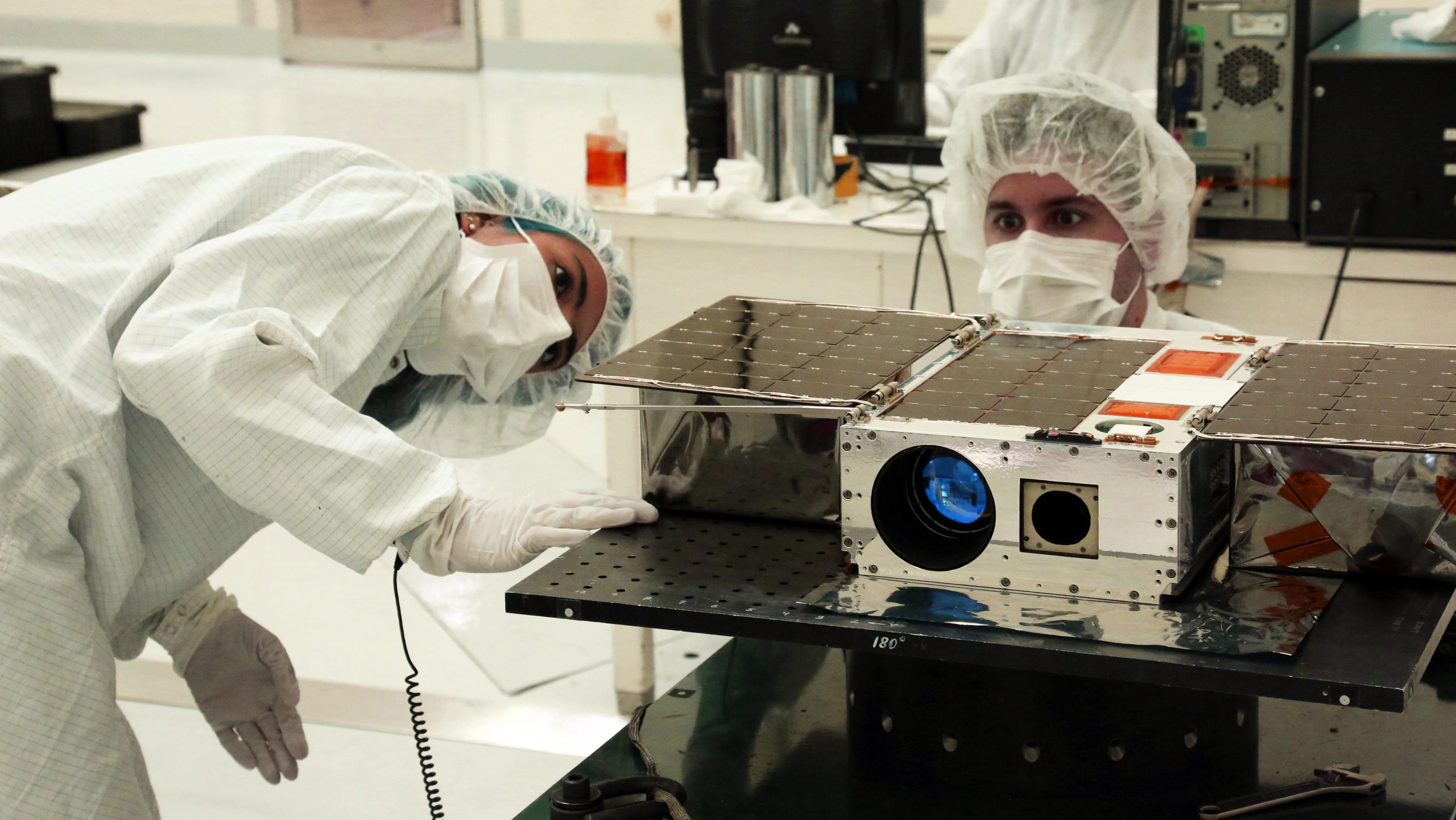
    Esha Murty and Cody Colley
    Left to right: Electrical Test Engineer Esha Murty and Integration and Test Lead Cody Colley prepare the ASTERIA spacecraft for mass-properties measurements in April 2017 prior to spacecraft delivery ahead of launch. ASTERIA was deployed from the International Space Station in November 2017. Credit: NASA/JPL-Caltech

    ASTERIA observed a handful of nearby stars and successfully demonstrated that it could achieve precision measurements of the stars’ brightness. With that data, scientists look for dips in a star’s light that would indicate an orbiting planet passing between the satellite and the star. (This planet-hunting technique is called the transit method.) Mission data is still being analyzed to confirm whether ASTERIA spotted any distant worlds.

    Since completing its primary mission objectives in early February 2018, ASTERIA has continued operating through three mission extensions. During that time, it has been used as an in-space platform to test various capabilities to make CubeSats more autonomous, some of which are based on artificial intelligence programs. ASTERIA also made opportunistic observations of the Earth, a comet, other spacecraft in geo-synchronous orbit, and stars that might host transiting exoplanets.

    Even if contact is not regained with ASTERIA, scientists can still conduct experiments on CubeSat autonomy programs using the mission testbed – a replica of the spacecraft’s internal hardware, kept on Earth for testing purposes.

    “The ASTERIA project achieved outstanding results during its three-month prime mission and its nearly two-year-long extended mission,” said JPL’s Lorraine Fesq, current ASTERIA program manager. “Although we are disappointed that we lost contact with the spacecraft, we are thrilled with all that we have accomplished with this impressive CubeSat.”

    ASTERIA was developed under the Phaeton program at JPL. Phaeton was developed to provide early-career hires, under the guidance of experienced mentors, with the challenges of a flight project. ASTERIA is a collaboration with the Massachusetts Institute of Technology in Cambridge; MIT’s Sara Seager is the principal investigator on the project. The project’s extended missions were partially funded by the Heising-Simons Foundation.

    Never miss a breakthrough: Join the SciTechDaily newsletter.
    Follow us on Google and Google News.

    CubeSat Exoplanet JPL NASA Popular
    Share. Facebook Twitter Pinterest LinkedIn Email Reddit

    Related Articles

    NASA Hits 6,000 Exoplanets. Some Are Stranger Than Sci-Fi

    Cosmic Vanishing Acts: NASA Unraveling the Mystery of Shrinking Exoplanets

    NASA Planet Hunter Discovers Second Habitable, Earth-Size World in TOI 700 System

    NASA Discovers Pair of Super-Earths With 1,000-Mile-Deep Oceans

    Cosmic Milestone: NASA Confirms 5,000 Exoplanets – “It Is Inevitable That We’ll Find Some Kind of Life Somewhere”

    Roman Space Telescope Coronagraph ‘Starglasses’ May Be the Most Complicated Astronomical Instrument Ever Flown

    NASA’s Spitzer Space Telescope Gets a Rare Look at the Surface of a Rocky Exoplanet

    Flower-Shaped Starshade Spacecraft to Acquire Images of Earth-Like Planets

    “Habitable Zone” Might Help Extreme Life Forms Survive on Exoplanets

    1 Comment

    1. Jean claude an on January 9, 2020 10:25 am

      C’est tres cool ca.

      Reply
    Leave A Reply Cancel Reply

    • Facebook
    • Twitter
    • Pinterest
    • YouTube

    Don't Miss a Discovery

    Subscribe for the Latest in Science & Tech!

    Trending News

    Bone-Strengthening Discovery Could Reverse Osteoporosis

    Scientists Uncover Hidden Trigger Behind Stem Cell Aging

    Scientists Find Way to Reverse Fatty Liver Disease Without Changing Diet

    Could Humans Regrow Limbs? New Study Reveals Promising Genetic Pathway

    Scientists Reveal Eating Fruits and Vegetables May Increase Your Risk of Lung Cancer

    Scientists Reverse Brain Aging With Simple Nasal Spray

    Scientists Uncover Potential Brain Risks of Popular Fish Oil Supplements

    Scientists Discover a Surprising Way To Make Bread Healthier and More Nutritious

    Follow SciTechDaily
    • Facebook
    • Twitter
    • YouTube
    • Pinterest
    • Newsletter
    • RSS
    SciTech News
    • Biology News
    • Chemistry News
    • Earth News
    • Health News
    • Physics News
    • Science News
    • Space News
    • Technology News
    Recent Posts
    • Europe’s Most Active Volcano Just Got Stranger – Here’s Why Scientists Are Rethinking It
    • Why Are Giant Ants Letting Tiny Ants Crawl All Over Them?
    • Revolutionary Technique Sends Healthy Mitochondria Exactly Where They’re Needed
    • This Student Recreated the Universe in a Bottle. What She Discovered Could Help Reveal How Life Started on Earth
    • Alzheimer’s Symptoms May Start Outside the Brain, Study Finds
    Copyright © 1998 - 2026 SciTechDaily. All Rights Reserved.
    • Science News
    • About
    • Contact
    • Editorial Board
    • Privacy Policy
    • Terms of Use

    Type above and press Enter to search. Press Esc to cancel.