
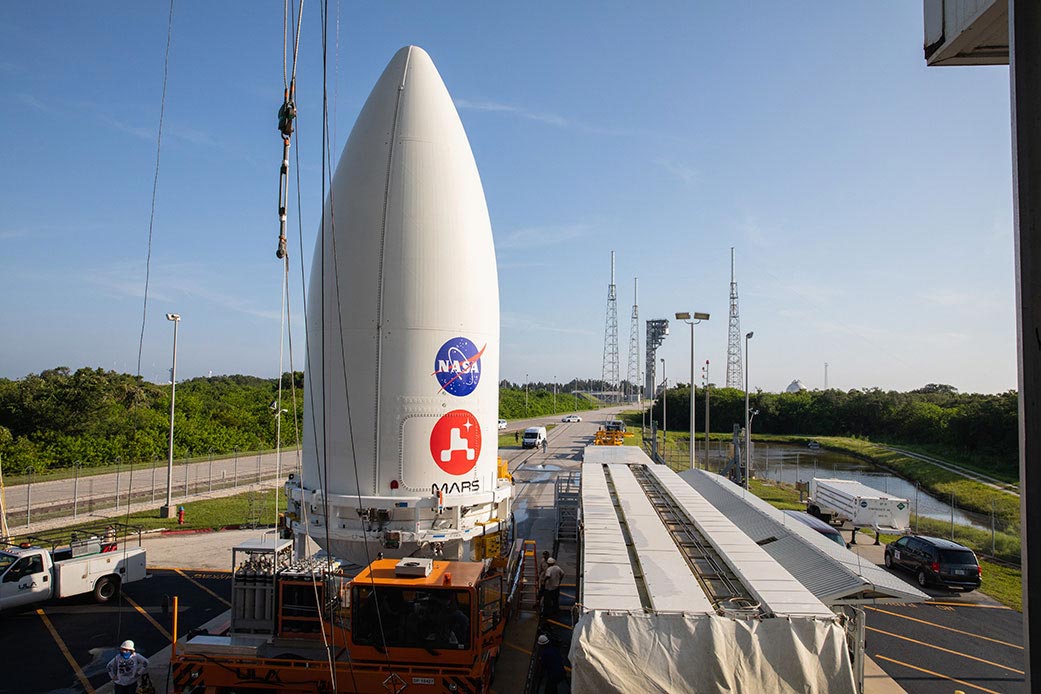
NASA’s Perseverance Mars rover has been attached to the top of the rocket that will send it toward the Red Planet this summer. Encased in the nose cone that will protect it during launch, the rover and the rest of the Mars 2020 spacecraft – the aeroshell, cruise stage, and descent stage – were affixed to a United Launch Alliance Atlas V booster on Tuesday, July 7, at Cape Canaveral Air Force Station in Central Florida.
The process began when a 60-ton hoist on the roof of the Vertical Integration Facility at Space Launch Complex 41 lifted the nose cone, otherwise known as the payload fairing, 129 feet (39 meters) to the top of the waiting rocket. There, engineers made the physical and electrical connections that will remain between booster and spacecraft until about 50 to 60 minutes after launch, when the two are pyrotechnically separated and Perseverance is on its way.
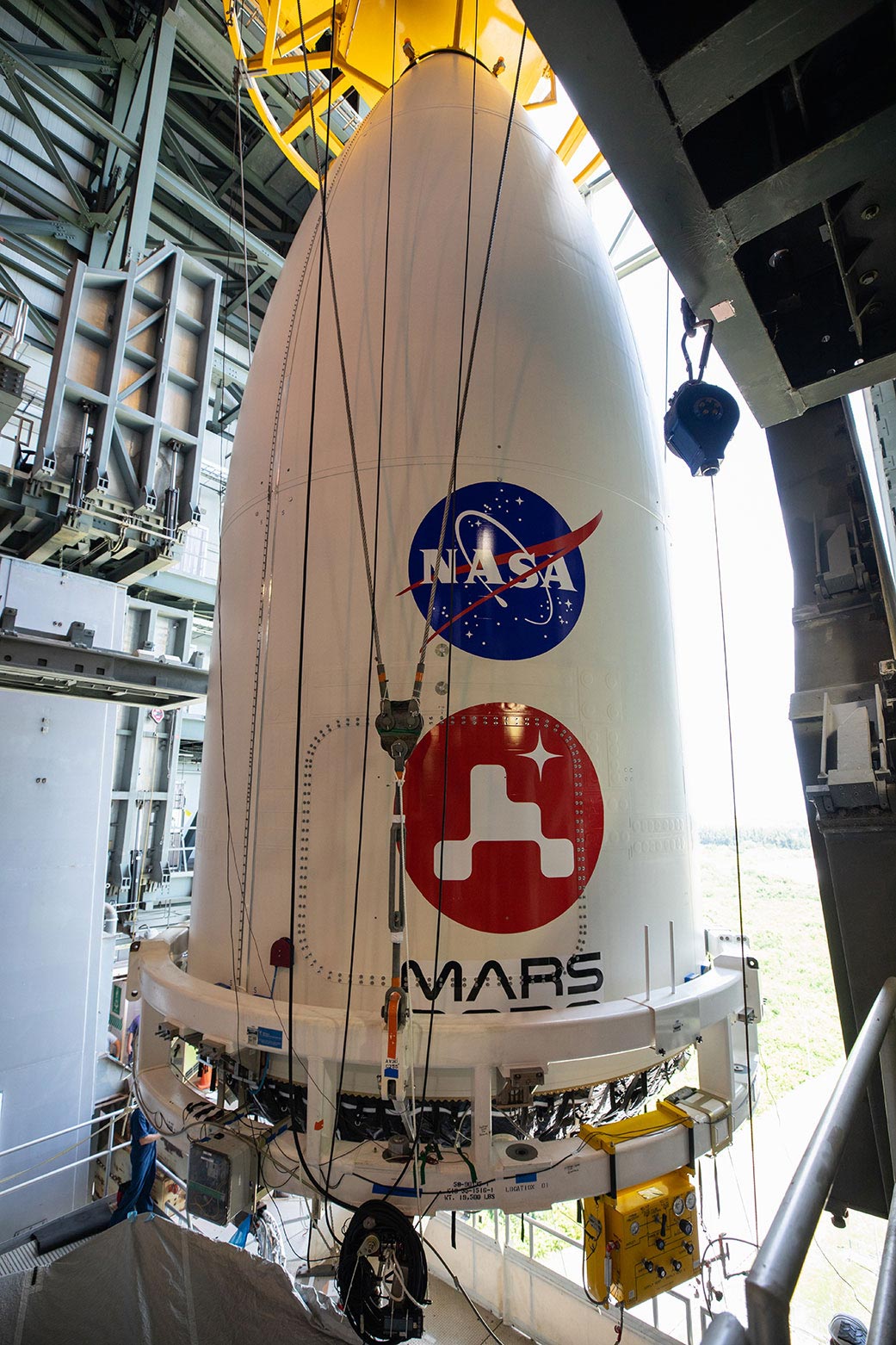
“I have seen my fair share of spacecraft being lifted onto rockets,” said John McNamee, project manager for the Mars 2020 Perseverance rover mission at NASA’s Jet Propulsion Laboratory in Southern California. “But this one is special because there are so many people who contributed to this moment. To each one of them I want to say, we got here together, and we’ll make it to Mars the same way.”
With the mating of spacecraft and booster complete, the final testing of the two (separately and as one unit) will be underway. Then two days before the July 30 launch, the Atlas V will leave the Vertical Integration Facility for good. Traveling by rail, it will cover the 1,800 feet (550 meters) to the launch pad in about 40 minutes. From there, Perseverance has about seven months and 290 million miles (467 million kilometers) to go before arriving at Mars.
The Launch Period
NASA and United Launch Alliance recently updated the mission’s launch period – the range of days the rocket can launch in order to reach Mars. It now spans from July 30 to August 15.
The launch period opening changed from July 17 to 30 due to launch vehicle processing delays in preparation for spacecraft mate operations. Four days were also added to the previously designated August 11 end of the launch period. NASA and United Launch Alliance Flight Teams were able to provide those extra days after final weights of both the spacecraft and launch vehicle became available, allowing them to more accurately calculate the propellant available to get Perseverance on its way.
No matter what day Perseverance lifts off during its July 30 to August 15 launch period, it will land in Mars’ Jezero Crater on February 18, 2021. Targeting landing for one specific date and time helps mission planners better understand lighting and temperature at the landing site, as well as the location of Mars-orbiting satellites tasked with recording and relaying spacecraft data during its descent and landing.
More About the Mission
Managed by JPL, the Mars 2020 Perseverance rover’s astrobiology mission will search for signs of ancient microbial life. It will also characterize the planet’s climate and geology, pave the way for human exploration of the Red Planet, and be the first planetary mission to collect and cache Martian rock and regolith (broken rock and dust). Subsequent missions, currently under consideration by NASA in cooperation with the European Space Agency, would send spacecraft to Mars to collect these cached samples from the surface and return them to Earth for in-depth analysis.

The Mars 2020 mission is part of a larger program that includes missions to the Moon as a way to prepare for human exploration of the Red Planet. Charged with returning astronauts to the Moon by 2024, NASA will establish a sustained human presence on and around the Moon by 2028 through NASA’s Artemis lunar exploration plans.
Never miss a breakthrough: Join the SciTechDaily newsletter.
Follow us on Google and Google News.
1 Comment
We are all waiting for the big launch, we are confidently awaiting the departure of the ATLAS V carrier with Perseverance, Mars is waiting for a new guest, a well-equipped rover that will bring significant progress to the exploration of the red planet for the next future human colonization.
Force Perseverance and go ATLAS V, go up into the blue sky of Cape Canaveral, go like an arrow and launch your precious cargo into the deep space.
Good luck .