
Close Menu
    Facebook X (Twitter) Instagram
    SciTechDaily
    • Biology
    • Chemistry
    • Earth
    • Health
    • Physics
    • Science
    • Space
    • Technology
    Facebook X (Twitter) Pinterest YouTube RSS
    SciTechDaily
    Home»Space»New Horizons Collects Data on Distant Remnant of the Early Solar System
    Space

    New Horizons Collects Data on Distant Remnant of the Early Solar System

    By NASAMay 18, 20161 Comment3 Mins Read
    Facebook Twitter Pinterest Telegram LinkedIn WhatsApp Email Reddit
    Share
    Facebook Twitter LinkedIn Pinterest Telegram Email Reddit
    New Horizons Collects Data on a Post-Pluto Object
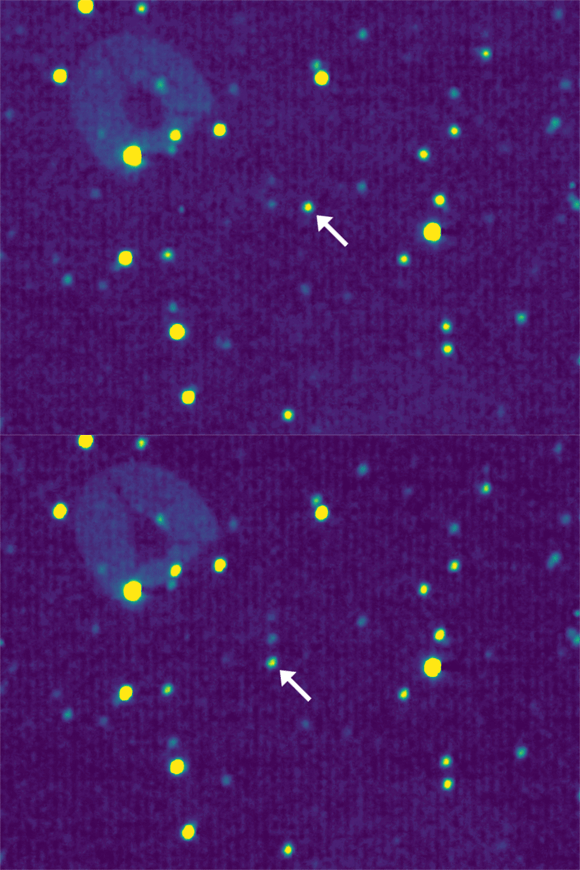
    Above, the first two of the 20 observations that New Horizons made of 1994 JR1 in April 2016. The Kuiper Belt object is the bright moving dot indicated by the arrow. The dots that do not move are background stars. The moving feature in the top left is an internal camera reflection (a kind of selfie) caused by illumination by a very bright star just outside of LORRI’s field of view; it shows the three arms that hold up LORRI’s secondary mirror.

    Recent observations from NASA’s New Horizons Spacecraft reveal new facts about a distant remnant of the early solar system.

    Warming up for a possible extended mission as it speeds through deep space, NASA’s New Horizons spacecraft has now twice observed 1994 JR1, a 90-mile-wide (145-kilometer-wide) Kuiper Belt object (KBO) orbiting more than 3 billion miles (5 billion kilometers) from the sun. Science team members have used these observations to reveal new facts about this distant remnant of the early solar system.

    Taken with the spacecraft’s Long Range Reconnaissance Imager (LORRI) on April 7-8 from a distance of about 69 million miles (111 million kilometers), the images shatter New Horizons’ own record for the closest-ever views of this KBO in November 2015, when New Horizons detected JR1 from 170 million miles (280 million kilometers) away.

    Simon Porter, a New Horizons science team member from Southwest Research Institute (SwRI) in Boulder, Colorado, said the observations contain several valuable findings. “Combining the November 2015 and April 2016 observations allows us to pinpoint the location of JR1 to within 1,000 kilometers (about 600 miles), far better than any small KBO,” he said, adding that the more accurate orbit also allows the science team to dispel a theory, suggested several years ago, that JR1 is a quasi-satellite of Pluto.

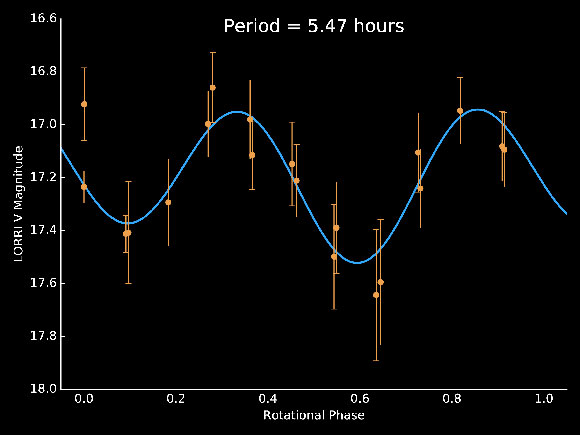
    From the closer vantage point of the April 2016 observations, the team also determined the object’s rotation period, observing the changes in light reflected from JR1’s surface to determine that it rotates once every 5.4 hours (or a JR1 day). “That’s relatively fast for a KBO,” said science team member John Spencer, also from SwRI. “This is all part of the excitement of exploring new places and seeing things never seen before.”
    New Horizons Collects First Data on a Post-Pluto Object
    New Horizons scientists used light curve data – the variations in the brightness of light reflected from the object’s surface – to determine JR1’s rotation period of 5.4 hours.

    Spencer added that these observations are great practice for possible close-up looks at about 20 more ancient Kuiper Belt objects that may come in the next few years, should NASA approve an extended mission. New Horizons flew through the Pluto system on July 14, 2015, making the first close-up observations of Pluto and its family of five moons. The spacecraft is on course for an ultra-close flyby of another Kuiper Belt object, 2014 MU69, on January 1, 2019.

    Never miss a breakthrough: Join the SciTechDaily newsletter.
    Follow us on Google and Google News.

    Astronomy Cosmology NASA New Horizons
    Share. Facebook Twitter Pinterest LinkedIn Email Reddit

    Related Articles

    Webb Explores Cosmic Dawn: Witnessing the First Galaxies Feeding on Cold Gas

    Galactic Collision Captured in Stunning Detail: NASA’s Webb & Hubble Unite To Create Most Colorful View of Universe

    New Horizons Spacecraft Data Shows There Are Far Fewer Galaxies in the Universe Than Previously Thought

    Uniform Heavy Element Distribution Points to Early Cosmic ‘Seeding’

    NASA Data Suggests Black Holes Abundant Among the Earliest Stars

    Fermi’s Motion Captured by Vela Pulsar Video

    WISE Spots Massive Distant Galaxy Cluster

    ESA’s Euclid Mission Receives Final Approval

    The Bolshoi Simulation: Boxing the Universe

    1 Comment

    1. David Tarr on May 18, 2016 2:46 pm

      How about the other objects that are moving between the frames

      Reply
    Leave A Reply Cancel Reply

    • Facebook
    • Twitter
    • Pinterest
    • YouTube

    Don't Miss a Discovery

    Subscribe for the Latest in Science & Tech!

    Trending News

    Even Occasional Binge Drinking May Triple Liver Damage Risk

    Liftoff! NASA’s Artemis II Launch Sends Astronauts Around the Moon for First Time in 50 Years

    Scientists Discover New Way To Eliminate “Zombie Cells” Driving Aging

    This New Quantum Theory Could Change Everything We Know About the Big Bang

    This One Vitamin May Help Protect Your Brain From Dementia Years Later

    Stopping Weight-Loss Drugs Like Ozempic Can Quickly Erase Heart Benefits

    A 500-Million-Year-Old Surprise Is Forcing Scientists to Rethink Spider Evolution

    Coffee and Blood Pressure: What You Need To Know Before Your Next Cup

    Follow SciTechDaily
    • Facebook
    • Twitter
    • YouTube
    • Pinterest
    • Newsletter
    • RSS
    SciTech News
    • Biology News
    • Chemistry News
    • Earth News
    • Health News
    • Physics News
    • Science News
    • Space News
    • Technology News
    Recent Posts
    • Chemists Thought Phosphorus Was Fully Understood – They Were Wrong
    • Scientists Discover Strange Property of Rice and Turn It Into a Smart Material
    • New Water Filter Removes up to 98% of Hard-To-Catch “Forever Chemicals”
    • This Nearby Earth-Sized Planet Could Answer Big Questions About Alien Worlds
    • A Fiery Finale: How NASA’s Artemis II Moon Mission Returns to Earth
    Copyright © 1998 - 2026 SciTechDaily. All Rights Reserved.
    • Science News
    • About
    • Contact
    • Editorial Board
    • Privacy Policy
    • Terms of Use

    Type above and press Enter to search. Press Esc to cancel.