
Close Menu
    Facebook X (Twitter) Instagram
    SciTechDaily
    • Biology
    • Chemistry
    • Earth
    • Health
    • Physics
    • Science
    • Space
    • Technology
    Facebook X (Twitter) Pinterest YouTube RSS
    SciTechDaily
    Home»Earth»New Model Helps Explain the Softness in Earth’s Lithosphere
    Earth

    New Model Helps Explain the Softness in Earth’s Lithosphere

    By Jim Shelton, Yale UniversityJune 15, 2015No Comments3 Mins Read
    Facebook Twitter Pinterest Telegram LinkedIn WhatsApp Email Reddit
    Share
    Facebook Twitter LinkedIn Pinterest Telegram Email Reddit
    Rock From Lithosphere
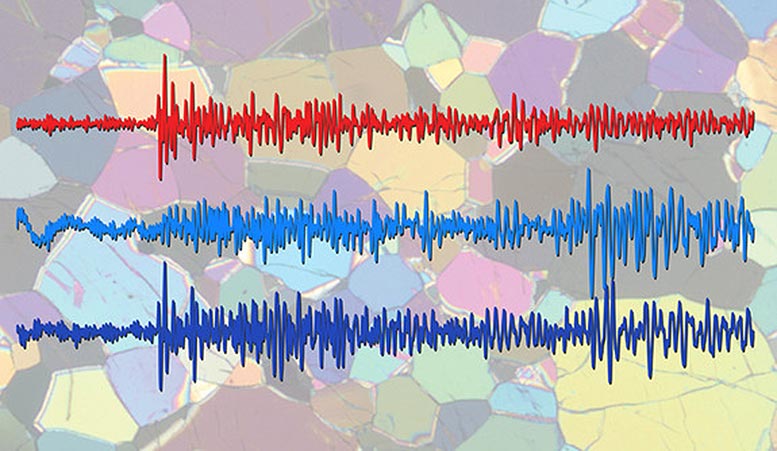
    This figure shows a photo-micrograph of a thin section of a rock from the lithosphere, on which records of seismic waves are superimposed. Regions with different colors show minerals with different orientations. Credit: Yale University

    A new model from researchers at Yale University helps explain the drop in elastic stiffness in the middle of the Earth’s continental lithosphere.

    Lithosphere is the stiff layer of rock that lies atop the slow-motion convection of Earth’s solid, yet ductile, interior. It is the “plate” of plate tectonics, the system of interlocking fragments that explains earthquakes, volcanoes, and even the long-term variation of carbon dioxide in the atmosphere.

    A softening in the middle of the continental lithosphere was discovered when seismologists studied the structure of the United States. This same softening was observed in other continents as well, at a depth of 80 to 150 km (50 to 90 mi). Researchers found the phenomenon puzzling, because softening detected by seismology is usually linked to softening that occurs over millions of years (also known as geologic time). If that were the case, the continental lithosphere would have a weak layer in it, and it would be difficult to explain the continents’ long-term stability.

    Yale geophysicists Shun-ichiro Karato, Tolulope Olugboji (a former Yale student, now at the University of Maryland), and Jeffrey Park may have found the answer.

    In a study published June 15 in the journal Nature Geoscience, they present a new model to describe the phenomenon. They say the softening is a natural consequence of the way rocks deform as temperatures rise below the melting point. The key is that this softening occurs in a second or less (the seismic time scale), rather than over millions of years.

    Rocks are composed of strong mineral crystals separated by grain boundaries, where atoms are disordered and weaker. As temperature increases, the mineral grains remain strong, but grain boundaries weaken and allow sliding to occur. As a consequence of this sliding, the overall stiffness of a rock is reduced at the seismic time scale, but not the geological time scale.

    “Our model is consistent with a stable continent, because the weakness of grain-boundary sliding is limited to deformation of the lithosphere in approximately one second, not its long-term deformation,” Karato said.

    Reference: “Mechanisms and geologic significance of the mid-lithosphere discontinuity in the continents” by Shun-ichiro Karato, Tolulope Olugboji and Jeffrey Park, 15 June 2015, Nature Geoscience.
    DOI: 10.1038/ngeo2462

    Never miss a breakthrough: Join the SciTechDaily newsletter.
    Follow us on Google and Google News.

    Geophysics Geoscience Lithosphere Yale University
    Share. Facebook Twitter Pinterest LinkedIn Email Reddit

    Related Articles

    Yale Researchers Find a Soft Spot in the Nazca Plate

    Geophysicists Find Source Behind “Sudden” Tectonic Plate Movements

    New Model Reveals Spreading Continents Kick-Started Plate Tectonics

    Geophysicists Detect Evidence of Large Amounts of Water in Earth’s Mantle

    Study Reveals How and When Earth Developed Its Rigid Tectonic Plates

    Scientists Link Earth’s Westward Drift of Magnetic Field and Superrotation of Inner Core

    Earthquake Doublets Reveal Changing Speed of the Earth’s Inner Core

    “Iron-Rich Blobs” Penetrate Deep Into Earth’s Mantle

    Low Arctic Snow Cover Could be Trouble for Permafrost

    Leave A Reply Cancel Reply

    • Facebook
    • Twitter
    • Pinterest
    • YouTube

    Don't Miss a Discovery

    Subscribe for the Latest in Science & Tech!

    Trending News

    Largest-Ever Study Finds Medicinal Cannabis Ineffective for Anxiety, Depression, PTSD

    250-Million-Year-Old Egg Solves One of Evolution’s Biggest Mysteries

    Living With Roommates Might Be Changing Your Gut Microbiome Without You Knowing

    Century-Old Cleaning Chemical Linked to 500% Increased Risk of Parkinson’s Disease

    What if Your Memories Never Happened? Physicists Take a New Look at the Boltzmann Brain Paradox

    One of the Universe’s Largest Stars May Be Getting Ready To Explode

    Scientists Discover Enzyme That Could Supercharge Ozempic-Like Weight Loss Drugs

    Popular Sweetener Linked to DNA Damage – “It’s Something You Should Not Be Eating”

    Follow SciTechDaily
    • Facebook
    • Twitter
    • YouTube
    • Pinterest
    • Newsletter
    • RSS
    SciTech News
    • Biology News
    • Chemistry News
    • Earth News
    • Health News
    • Physics News
    • Science News
    • Space News
    • Technology News
    Recent Posts
    • Challenging the Narrative: New Study Shows U.S. Life Expectancy Is Rising Across All States
    • Mystery Illness Kills 5 in Burundi As Doctors Scramble for Answers
    • Bone-Strengthening Discovery Could Reverse Osteoporosis
    • The Most Elusive Number in Physics Just Got Even More Mysterious
    • Scientists Uncover Hidden Trigger Behind Stem Cell Aging
    Copyright © 1998 - 2026 SciTechDaily. All Rights Reserved.
    • Science News
    • About
    • Contact
    • Editorial Board
    • Privacy Policy
    • Terms of Use

    Type above and press Enter to search. Press Esc to cancel.