

Close Menu
    Facebook X (Twitter) Instagram
    SciTechDaily
    • Biology
    • Chemistry
    • Earth
    • Health
    • Physics
    • Science
    • Space
    • Technology
    Facebook X (Twitter) Pinterest YouTube RSS
    SciTechDaily
    Home»Health»New Research Links Screen Time With Childhood Development Delays
    Health

    New Research Links Screen Time With Childhood Development Delays

    By Tohoku UniversityDecember 6, 20231 Comment3 Mins Read
    Facebook Twitter Pinterest Telegram LinkedIn WhatsApp Email Reddit
    Share
    Facebook Twitter LinkedIn Pinterest Telegram Email Reddit
    Young Boys Using Smartphones
    Research from Tohoku University links screen time in one-year-olds to developmental delays, particularly in communication and problem-solving skills, highlighting the need for nuanced understanding and further study of the effects of various types of screen exposure.

    A study conducted by Tohoku University in collaboration with Hamamatsu University School of Medicine, and published in JAMA Pediatrics, has found a correlation between the screen time of one-year-old children and developmental delays.

    The research involved 7,097 mother-child pairs from the Tohoku Medical Megabank Project Birth and Three-Generation Cohort Study. It assessed each child’s exposure to screens, including televisions, video games, tablets, mobile phones, and other electronic devices, using questionnaires completed by parents.

    The children in the study were almost evenly split between boys (51.8%) and girls (48.2%). Their screen time exposure was assigned to the categories of less than one hour (48.5% of subjects), from one to less than two hours (29.5%), from two to less than four hours (17.9%), and four or more hours (4.1%).

    Detailed Developmental Assessment

    The children’s development was assessed at two and four years of age in the five domains of communication, gross motor, fine motor, problem-solving, and personal and social skills. Previous studies in the field have generally not broken development down into different domains, therefore offering a less refined view.
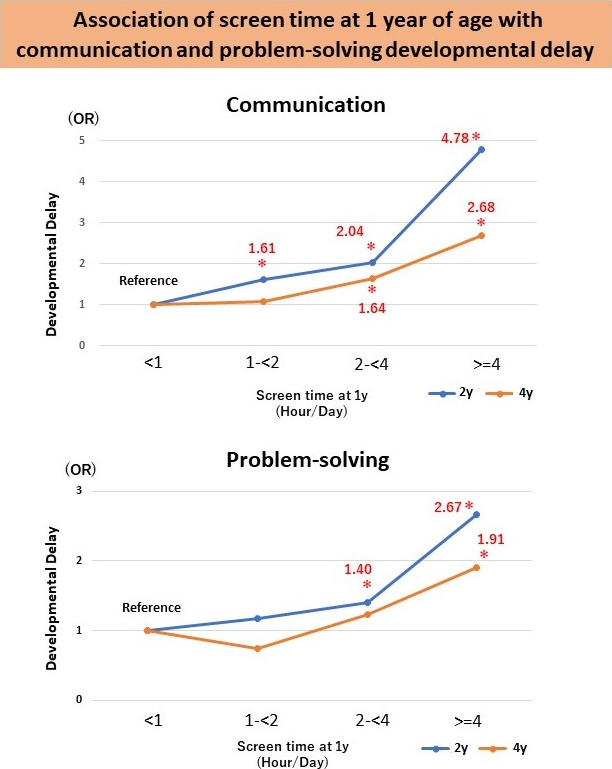
    Association of Screen Time at 1 Year of Age With Communication and Problem Solving Developmental Delay
    Association of screen time at 1 year of age with communication and problem-solving developmental delay. Credit: Tohoku University

    The association between screen time at age one and later developmental delay was assessed using an established statistical technique, revealing a dose-response association; meaning that the level of developmental delay (the response) was correlated to the amount (dose) of screen time.

    For the children aged two, increased screen time when aged one was associated with developmental delays in all domains apart from gross motor skills. By the age of four, however, increased screen time was associated with developmental delays in only the communication and problem-solving domains.

    Unique Insights and Future Considerations

    “The differing levels of developmental delays in the domains, and the absence of any detected delay in some of them at each stage of life examined, suggests that the domains should be considered separately in future discussions of the association between screen time and child development,” says Tohoku University epidemiologist Taku Obara, corresponding author of the research article.

    One reason for undertaking this study was recent evidence published by the World Health Organization and the American Academy of Pediatrics suggesting that only a minority of children are meeting guidelines for limiting screen time exposure. The guidelines were designed to ensure that children engage in sufficient physical activity and social interaction.

    “The rapid proliferation of digital devices, alongside the impact of the COVID pandemic, has markedly increased screen time for children and adolescents, but this study does not simply suggest a recommendation for restricting screen time. This study suggests an association, not causation between screen time and developmental delay” says Obara. “We use the term ‘delay’ in accordance with previous research, but it is debatable whether this difference in development is really a ‘delay’ or not. We would like to gain deeper insight in future studies by examining the effects of different types of screen exposure.”

    Reference: “Screen Time at Age 1 Year and Communication and Problem-Solving Developmental Delay at 2 and 4 Years” by Ippei Takahashi, Taku Obara, Mami Ishikuro, Keiko Murakami, Fumihiko Ueno, Aoi Noda, Tomomi Onuma, Genki Shinoda, Tomoko Nishimura, Kenji J. Tsuchiya and Shinichi Kuriyama, 21 August 2023, JAMA Pediatrics.
    DOI: 10.1001/jamapediatrics.2023.3057

    Never miss a breakthrough: Join the SciTechDaily newsletter.
    Follow us on Google and Google News.

    Development Pediatrics Tohoku University
    Share. Facebook Twitter Pinterest LinkedIn Email Reddit

    Related Articles

    Study of 1.2 Million Infants Reveals the Truth About Vegan Baby Diets

    Mother’s Childhood Trauma May Worsen Child’s Autism or ADHD, Study Finds

    Reassuring Findings: COVID-19’s Impact on Child Development More Subtle Than Expected

    A New Study Links Infant Antibiotic Use to Adult Diseases

    Fewer Doses of Prophylaxis Provides Near-Optimal Protection Against RSV

    Study Shows Low level Drinking Not Associated With Higher Risk of Poor Birth Outcomes

    Yale Study Shows Siblings of Children with Autism Can Show Signs at 18 Months

    UCLA Study Shows Childhood Obesity Linked to More Health Problems Than Previously Thought

    Children Exposed to Nicotine in Utero Have Lower Reading Scores

    1 Comment

    1. Paul on December 12, 2023 12:40 am

      This result may not be due to the exposure to screens, but rather lack of interaction with other people (parents/siblings etc.).

      Reply
    Leave A Reply Cancel Reply

    • Facebook
    • Twitter
    • Pinterest
    • YouTube

    Don't Miss a Discovery

    Subscribe for the Latest in Science & Tech!

    Trending News

    Even Occasional Binge Drinking May Triple Liver Damage Risk

    Liftoff! NASA’s Artemis II Launch Sends Astronauts Around the Moon for First Time in 50 Years

    Scientists Discover New Way To Eliminate “Zombie Cells” Driving Aging

    This New Quantum Theory Could Change Everything We Know About the Big Bang

    This One Vitamin May Help Protect Your Brain From Dementia Years Later

    Stopping Weight-Loss Drugs Like Ozempic Can Quickly Erase Heart Benefits

    A 500-Million-Year-Old Surprise Is Forcing Scientists to Rethink Spider Evolution

    Coffee and Blood Pressure: What You Need To Know Before Your Next Cup

    Follow SciTechDaily
    • Facebook
    • Twitter
    • YouTube
    • Pinterest
    • Newsletter
    • RSS
    SciTech News
    • Biology News
    • Chemistry News
    • Earth News
    • Health News
    • Physics News
    • Science News
    • Space News
    • Technology News
    Recent Posts
    • Tiny 436-Million-Year-Old Fish Fossil Rewrites the Origins of Vertebrates
    • 1,800 Miles Down: Scientists Uncover Mysterious Movements at the Edge of Earth’s Core
    • Scientists Uncover Earth’s Hidden “Gold Kitchen” Beneath the Ocean Floor
    • You Don’t Need To Be Rich: New Study Reveals a Simple Life Is the Real Secret to Happiness
    • “Crazy Dice” Help Scientists Prove Only One 150-Year-Old Theory About Randomness Works
    Copyright © 1998 - 2026 SciTechDaily. All Rights Reserved.
    • Science News
    • About
    • Contact
    • Editorial Board
    • Privacy Policy
    • Terms of Use

    Type above and press Enter to search. Press Esc to cancel.