
Close Menu
    Facebook X (Twitter) Instagram
    SciTechDaily
    • Biology
    • Chemistry
    • Earth
    • Health
    • Physics
    • Science
    • Space
    • Technology
    Facebook X (Twitter) Pinterest YouTube RSS
    SciTechDaily
    Home»Health»New Treatment Repairs Gut and Tames Aging Cells
    Health

    New Treatment Repairs Gut and Tames Aging Cells

    By Impact Journals LLCMay 3, 2025No Comments4 Mins Read
    Facebook Twitter Pinterest Telegram LinkedIn WhatsApp Email Reddit
    Share
    Facebook Twitter LinkedIn Pinterest Telegram Email Reddit
    Gut Flora Microbiome
    A new study reveals that the enzyme ADAM19 plays a vital role in controlling inflammatory signals from aging cells in the gut. By inhibiting this enzyme in fruit flies, mice, and human cells, researchers reduced inflammation and signs of cellular aging, offering a potential new treatment pathway for age-related gut disorders that focuses on altering cell behavior rather than destroying the cells themselves.

    ADAM19 appears to play a significant role in reducing the inflammatory response associated with intestinal damage and cellular senescence.

    Researchers led by first author Sudipta Bar and corresponding authors Amit Sharma and Pankaj Kapahi at the Buck Institute for Research on Aging have identified the enzyme ADAM19 as a key regulator of cellular aging and gut inflammation.

    Their study, published in the journal Aging, demonstrates that inhibiting ADAM19 significantly reduced intestinal damage and inflammatory responses in fruit flies, mice, and human cell models. These findings suggest a promising new approach for treating age-related gut disorders by suppressing harmful signals released from senescent, or aging, cells.

    With age, accumulated DNA damage contributes to the buildup of senescent cells—cells that permanently stop dividing but continue to secrete pro-inflammatory molecules known as the senescence-associated secretory phenotype (SASP). In this study, the researchers used Drosophila melanogaster (fruit flies) to identify genes that influence gut damage caused by radiation. They discovered a gene called meltrin, the fly equivalent of human ADAM19. When meltrin was deactivated, the flies showed reduced intestinal permeability, decreased inflammation, and fewer molecular signs of cellular senescence.
    Inhibition of the Metalloprotease ADAM19 as a Novel Senomorphic Strategy
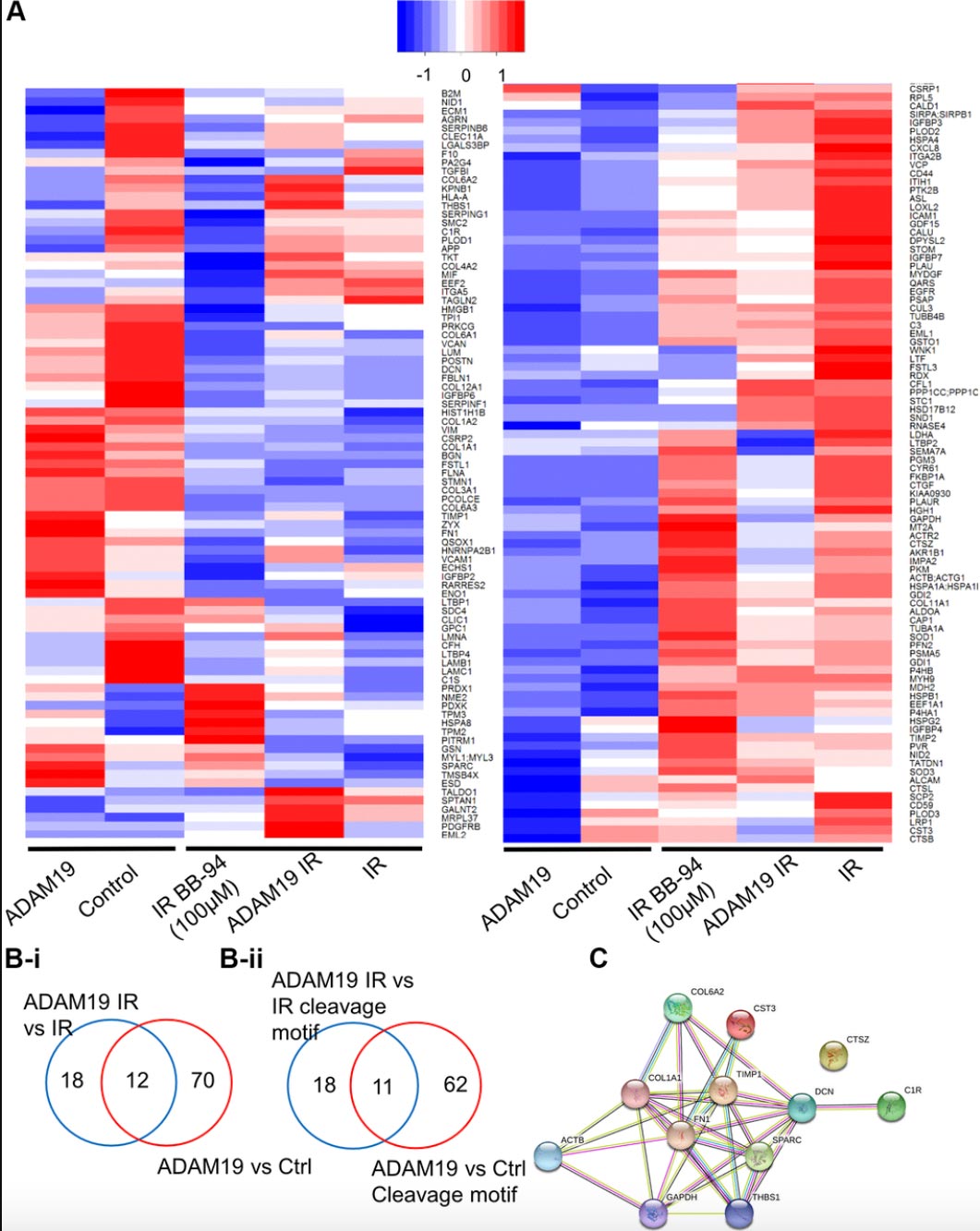
    Figure 4. ADAM19 knockdown or inhibition alters secretory factors from senescent cells. (A) Heat map showing changes in the secretome composition from senescent IMR-90 cells with or without ADAM19 shRNA. (B-i) Venn diagram shows altered protein between ADAM 19 vs. IR and IR only groups. (B-ii) Venn diagram shows altered protein with cleavage motif in groups between ADAM 19 vs. IR and ADAM19 vs. control. (C) Protein network 12 commonly altered protein in groups between ADAM 19 vs. IR and IR. Credit: 2025 Bar et al.

    The researchers state, “Through an unbiased genome-wide association study (GWAS) utilizing 156 strains from the Drosophila Genetic Reference Panel (DGRP), we identified meltrin (the drosophila orthologue of mammalian ADAM19) as a potential modulator of the senescence-associated secretory phenotype (SASP).”

    Confirming Results in Mice and Human Cells

    To test if these results applied beyond flies, the team inhibited ADAM19 in mice using a drug called batimastat. Mice treated with the drug after chemotherapy exposure had stronger gut barriers and lower levels of inflammatory markers. The findings extended to human cell cultures, where ADAM19 inhibition reduced signs of cellular aging, including the expression of SASP proteins and β-galactosidase, a classic aging marker.

    Importantly, this approach does not kill aging cells like many ‘senolytic’ therapies but instead reduces the harmful substances they release, making it a potential “senomorphic” strategy. The study also showed that ADAM19 helps release certain SASP proteins by cutting them at the cell surface, suggesting a direct role in regulating inflammatory signals.

    Through proteomic analysis, the team identified 12 SASP proteins that were significantly reduced when ADAM19 was blocked. Many of these proteins are linked to inflammation, immune response, and tissue remodeling in diseases such as inflammatory bowel disease and Crohn’s disease. This connection underlines the relevance of the findings for treating chronic gut disorders in aging populations.

    By targeting ADAM19, researchers may have found a new way to protect gut health and lower inflammation caused by aging cells. This study offers a promising path for creating treatments that maintain healthy tissues without having to destroy aging cells, which could benefit people with gut damage related to aging or medical treatments.

    Reference: “Inhibition of the metalloprotease ADAM19 as a novel senomorphic strategy to ameliorate gut permeability and senescence markers by modulating senescence-associated secretory phenotype (SASP)” by Sudipta Bar, Tyler A.U. Hilsabeck, Blaine Pattavina, José Alberto López-Domínguez, Nathan Basisty, Joanna Bons, Mark Watson, Birgit Schilling, Judith Campisi, Pankaj Kapahi and Amit Sharma, 20 March 2025, Aging.
    DOI: 10.18632/aging.206224

    Never miss a breakthrough: Join the SciTechDaily newsletter.
    Follow us on Google and Google News.

    Aging Cell Biology Gut Inflammation Molecular Biology
    Share. Facebook Twitter Pinterest LinkedIn Email Reddit

    Related Articles

    As Our Gut Ages, Key Genes Fall Silent. Scientists Now Know Why

    Aging Immune Cells May Rewrite Their Own DNA To Stay Inflammatory

    Gray Hair May Be Your Body’s Secret Cancer Defense

    “Pausing” Cell Death Could Be the Key to Longevity

    Can We Reverse Aging? Scientists Uncover a Key “Zombie Cell” Pathway

    The Molecular Secret to Longevity: Scientists Have Discovered a “Lifespan Limit Line”

    Age-Defying Health Benefits: New Research Unravels Secrets of the “Longevity” Gene

    Longevity Breakthrough: New Treatment Reverses Multiple Hallmarks of Aging

    Unlocking the Secrets of Aging: Could Protein Clumps Predict Age-Related Diseases?

    Leave A Reply Cancel Reply

    • Facebook
    • Twitter
    • Pinterest
    • YouTube

    Don't Miss a Discovery

    Subscribe for the Latest in Science & Tech!

    Trending News

    Artificial Sweeteners May Harm Future Generations, Study Suggests

    Splashdown! NASA Artemis II Returns From Record-Breaking Moon Mission

    What If Consciousness Exists Beyond Your Brain

    Scientists Finally Crack the 100-Million-Year Evolutionary Mystery of Squid and Cuttlefish

    Beyond “Safe Levels”: Study Challenges What We Know About Pesticides and Cancer

    Researchers Have Found a Dietary Compound That Increases Longevity

    Scientists Baffled by Bizarre “Living Fossil” From 275 Million Years Ago

    Your IQ at 23 Could Predict Your Wealth at 27, Study Finds

    Follow SciTechDaily
    • Facebook
    • Twitter
    • YouTube
    • Pinterest
    • Newsletter
    • RSS
    SciTech News
    • Biology News
    • Chemistry News
    • Earth News
    • Health News
    • Physics News
    • Science News
    • Space News
    • Technology News
    Recent Posts
    • What if Dark Matter Has Two Forms? Bold New Hypothesis Could Explain a Cosmic Mystery
    • Researchers Expose Hidden Chemistry of “Ore-Forming” Elements in Biology
    • Geologists Reveal the Americas Collided Earlier Than We Thought
    • 20x Difference: Study Reveals True Source of Airborne Microplastics
    • Scientists Uncover Hidden Force Powering Yellowstone’s Supervolcano
    Copyright © 1998 - 2026 SciTechDaily. All Rights Reserved.
    • Science News
    • About
    • Contact
    • Editorial Board
    • Privacy Policy
    • Terms of Use

    Type above and press Enter to search. Press Esc to cancel.