

Close Menu
    Facebook X (Twitter) Instagram
    SciTechDaily
    • Biology
    • Chemistry
    • Earth
    • Health
    • Physics
    • Science
    • Space
    • Technology
    Facebook X (Twitter) Pinterest YouTube RSS
    SciTechDaily
    Home»Health»Gray Hair May Be Your Body’s Secret Cancer Defense
    Health

    Gray Hair May Be Your Body’s Secret Cancer Defense

    By The Institute of Medical Science, The University of TokyoNovember 8, 2025No Comments3 Mins Read
    Facebook Twitter Pinterest Telegram LinkedIn WhatsApp Email Reddit
    Share
    Facebook Twitter LinkedIn Pinterest Telegram Email Reddit
    Premature Gray Hair
    A new study reveals how melanocyte stem cells (McSCs) respond differently to DNA damage, leading either to hair graying or to cancer risk. When McSCs undergo senescence-coupled differentiation, they irreversibly mature and are lost, a process that protects against malignancy. Credit: Shutterstock

    The study reveals how hair pigment stem cells respond to DNA damage by making fate decisions that can result in either hair graying or the development of melanoma.

    Throughout life, our cells face continual challenges from both external and internal influences that can harm their DNA. This type of damage is known to play a role in aging and the development of cancer. However, scientists have long struggled to fully understand how damaged stem cells influence the long-term health and stability of tissues.

    Melanocyte stem cells (McSCs) are a special type of stem cell that generates melanocytes, the pigment-producing cells responsible for hair and skin color. In mammals, these stem cells are located in the bulge–sub-bulge region of hair follicles, where they exist as immature melanoblasts. Through repeated regeneration cycles, McSCs help maintain normal pigmentation.

    In a study published in Nature Cell Biology, Professor Emi Nishimura and Assistant Professor Yasuaki Mohri from The University of Tokyo explored how McSCs react to different forms of DNA damage.

    Using long-term in vivo lineage tracing and gene expression profiling in mice, the researchers discovered a distinct response to DNA double-strand breaks: senescence-coupled differentiation (seno-differentiation). During this process, McSCs permanently transform into mature cells and are eventually lost, leading to hair graying. This protective mechanism is controlled by activation of the p53–p21 pathway.
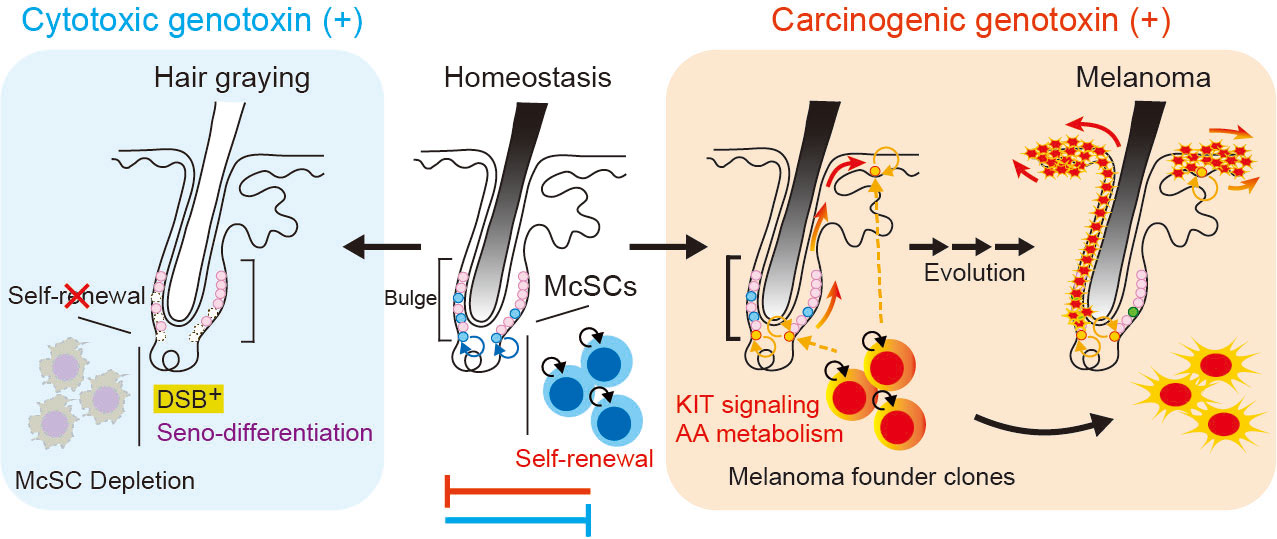
    Genotoxic Stress and Melanocyte Stem Cell Fate
    Genotoxic insults drive divergent outcomes in melanocyte stem cells (McSCs). Under cytotoxic genotoxin exposure, such as X-ray irradiation, McSC self-renewal is impaired, leading to depletion and hair graying. In homeostasis, McSCs maintain self-renewal and pigment balance. Carcinogenic genotoxins, however, promote KIT signaling and alter arachidonic acid metabolism, giving rise to melanoma founder clones and progression to melanoma. Credit: Emi K. Nishimura from The University of Tokyo, Japan

    When Protection Fails: The Cancer Connection

    In contrast, when exposed to certain carcinogens, such as 7,12-dimethylbenz(a)anthracene or ultraviolet B, McSCs bypass this protective differentiation program—even in the presence of DNA damage. Instead, they retain self-renewal capacity and expand clonally, a process supported by KIT ligand secreted both from the local niche and within the epidermis. This niche-derived signal suppresses seno-differentiation, tipping McSCs toward a tumor-prone fate.

    Nishimura says, “These findings reveal that the same stem cell population can follow antagonistic fates—exhaustion or expansion—depending on the type of stress and microenvironmental signals.” She adds, “It reframes hair graying and melanoma not as unrelated events, but as divergent outcomes of stem cell stress responses.”

    Importantly, this study does not suggest that graying hair prevents cancer, but rather that seno-differentiation represents a stress-induced protective pathway that removes potentially harmful cells. Conversely, when this mechanism is bypassed, the persistence of damaged McSCs may predispose to melanomagenesis.

    By identifying the molecular circuits that govern this fate bifurcation, the study provides a conceptual framework that links tissue aging and cancer, and highlights the beneficial role of eliminating potentially harmful stem cells through natural “senolysis,” resulting in a phenotype that safeguards against cancer.

    Reference: “Antagonistic stem cell fates under stress govern decisions between hair greying and melanoma” by Yasuaki Mohri, Jialiang Nie, Hironobu Morinaga, Tomoki Kato, Takahiro Aoto, Takashi Yamanashi, Daisuke Nanba, Hiroyuki Matsumura, Sakura Kirino, Kouji Kobiyama, Ken J. Ishii, Masahiro Hayashi, Tamio Suzuki, Takeshi Namiki, Jun Seita and Emi K. Nishimura, 6 October 2025, Nature Cell Biology.
    DOI: 10.1038/s41556-025-01769-9

    Never miss a breakthrough: Join the SciTechDaily newsletter.
    Follow us on Google and Google News.

    Aging Cancer Cell Biology Molecular Biology Stem Cells University of Tokyo
    Share. Facebook Twitter Pinterest LinkedIn Email Reddit

    Related Articles

    Parkinson’s, Cancer, and Type 2 Diabetes Share a Key Element That Drives Disease

    RNA-Binding Proteins: Molecular Targeted Therapy for Difficult-to-Treat Breast Cancer

    Engineered Natural Killer Cells Can Eliminate Glioblastoma Cancer Stem Cells

    Uprooting Cancer: Innovative Hydrogel Rapidly Reverts Cancer Cells Back to Cancer Stem Cells

    Obesity / Type 2 Diabetes Changes Cell Response to Glucose, Uses Slower Metabolic Path

    Major Implications for Human Disease Uncovered in Mysterious Microproteins

    Molecular Switch Serves as New Target Point for Cancer and Diabetes Therapies

    New Research Shows Cellular Clean-Up Can Also Sweep Away Forms of Cancer

    MIT Research Shows How Diet Influences Colon Cancer

    Leave A Reply Cancel Reply

    • Facebook
    • Twitter
    • Pinterest
    • YouTube

    Don't Miss a Discovery

    Subscribe for the Latest in Science & Tech!

    Trending News

    5 Simple Ways To Remember More and Forget Less

    The Atomic Gap That Could Cost the Semiconductor Industry Billions

    Researchers Finally Solve 50-Year-Old Blood Group Mystery

    Scientists Discover “Molecular Switch” That Fuels Alzheimer’s Brain Inflammation

    Trees Emit Tiny Lightning Flashes During Storms and Scientists Finally Prove It

    Pomegranate Compound Could Help Protect Against Heart Disease

    Your Blood Test Might Already Show Alzheimer’s Risk

    Scientists Were Wrong About This Strange “Rule-Breaking” Particle

    Follow SciTechDaily
    • Facebook
    • Twitter
    • YouTube
    • Pinterest
    • Newsletter
    • RSS
    SciTech News
    • Biology News
    • Chemistry News
    • Earth News
    • Health News
    • Physics News
    • Science News
    • Space News
    • Technology News
    Recent Posts
    • Harvard Breakthrough Brings Powerful UV Light Sources Onto a Chip
    • This Strange Quantum “Dance” Could Rewrite Superconductivity
    • Scientists Make Breakthrough in Turning Plastic Trash Into Clean Fuel Using Sunlight
    • Scientists Complete Largest 3D Map of the Universe to Probe Dark Energy
    • Hidden Parasite Found in Popular Portuguese Lake Raises Health Concerns
    Copyright © 1998 - 2026 SciTechDaily. All Rights Reserved.
    • Science News
    • About
    • Contact
    • Editorial Board
    • Privacy Policy
    • Terms of Use

    Type above and press Enter to search. Press Esc to cancel.