
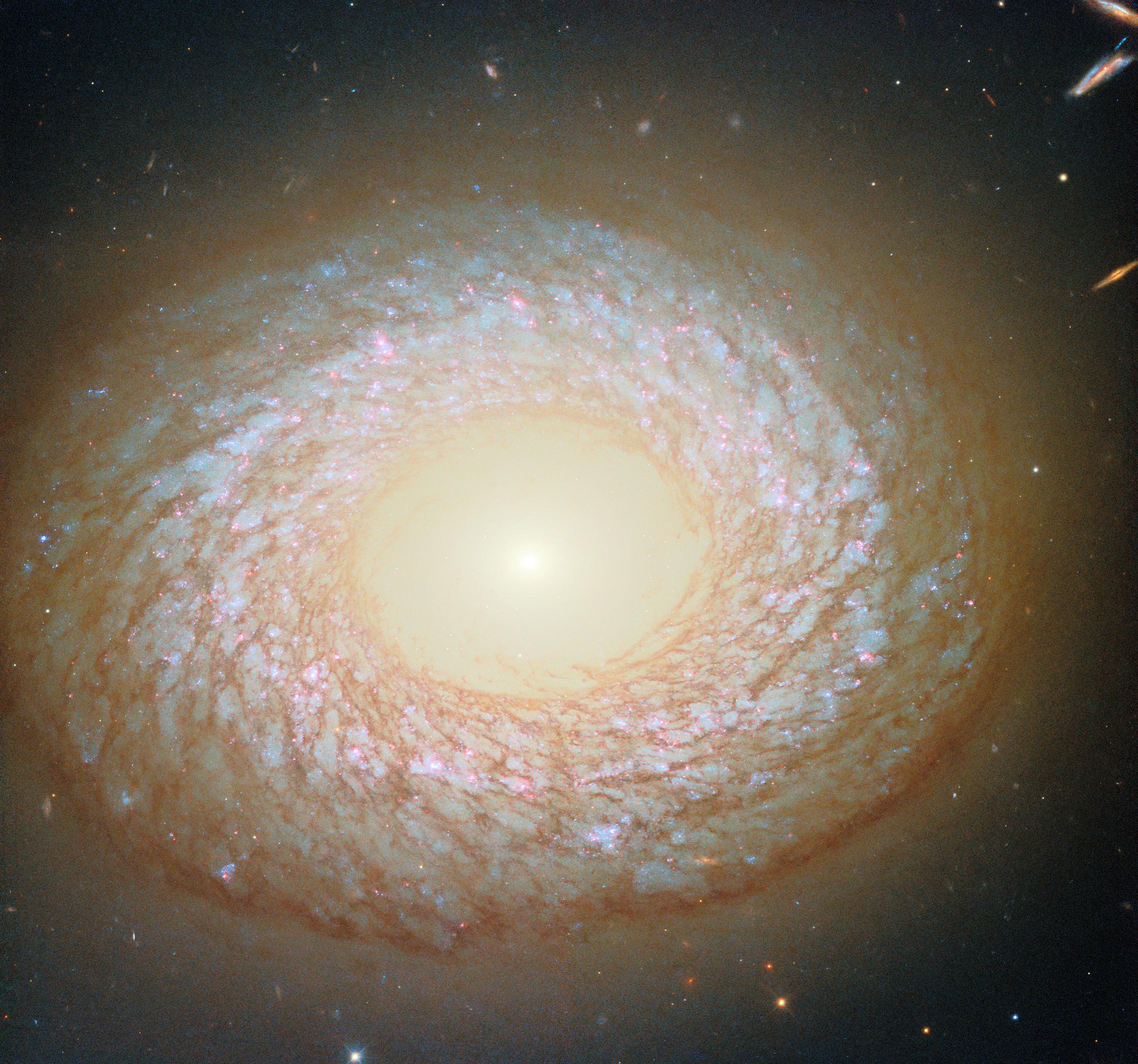
NGC 2775, a galaxy 67 million light-years away, is puzzling astronomers with its mix of traits.
The Hubble Space Telescope has released a new Picture of the Week, and this time the spotlight is on a galaxy that refuses to fit neatly into any category. The subject, known as NGC 2775, is located about 67 million light-years away in the constellation Cancer (The Crab). At its center lies a smooth, gas-free core that looks strikingly similar to an elliptical galaxy. Surrounding it, however, is a dusty ring sprinkled with uneven clusters of young stars, giving it the appearance of a spiral galaxy. So what is it exactly: spiral, elliptical — or something in between?
Because astronomers can only observe NGC 2775 from a single perspective, its true nature remains uncertain. Some scientists argue that it should be considered a spiral galaxy due to its delicate ring of dust and stars. Others, however, classify it as a lenticular galaxy, a transitional type that shares characteristics of both spirals and ellipticals.
The Mystery of Lenticular Galaxies
How lenticular galaxies form is still an open question, and several possibilities exist. They may have started out as spiral galaxies that either collided with other galaxies or used up most of their star-forming gas, leaving their spiral arms to fade away. Another theory suggests they could have been more like elliptical galaxies at first, later pulling in enough gas to build a disk around them.
Some evidence suggests that NGC 2775 has merged with other galaxies in the past. Invisible in this Hubble image, NGC 2775 has a tail of hydrogen gas that stretches almost 100,000 light-years around the galaxy. This faint tail could be the remnant of one or more galaxies that wandered too close to NGC 2775 before being stretched apart and absorbed. If NGC 2775 merged with other galaxies in the past, it could explain the galaxy’s strange appearance today.
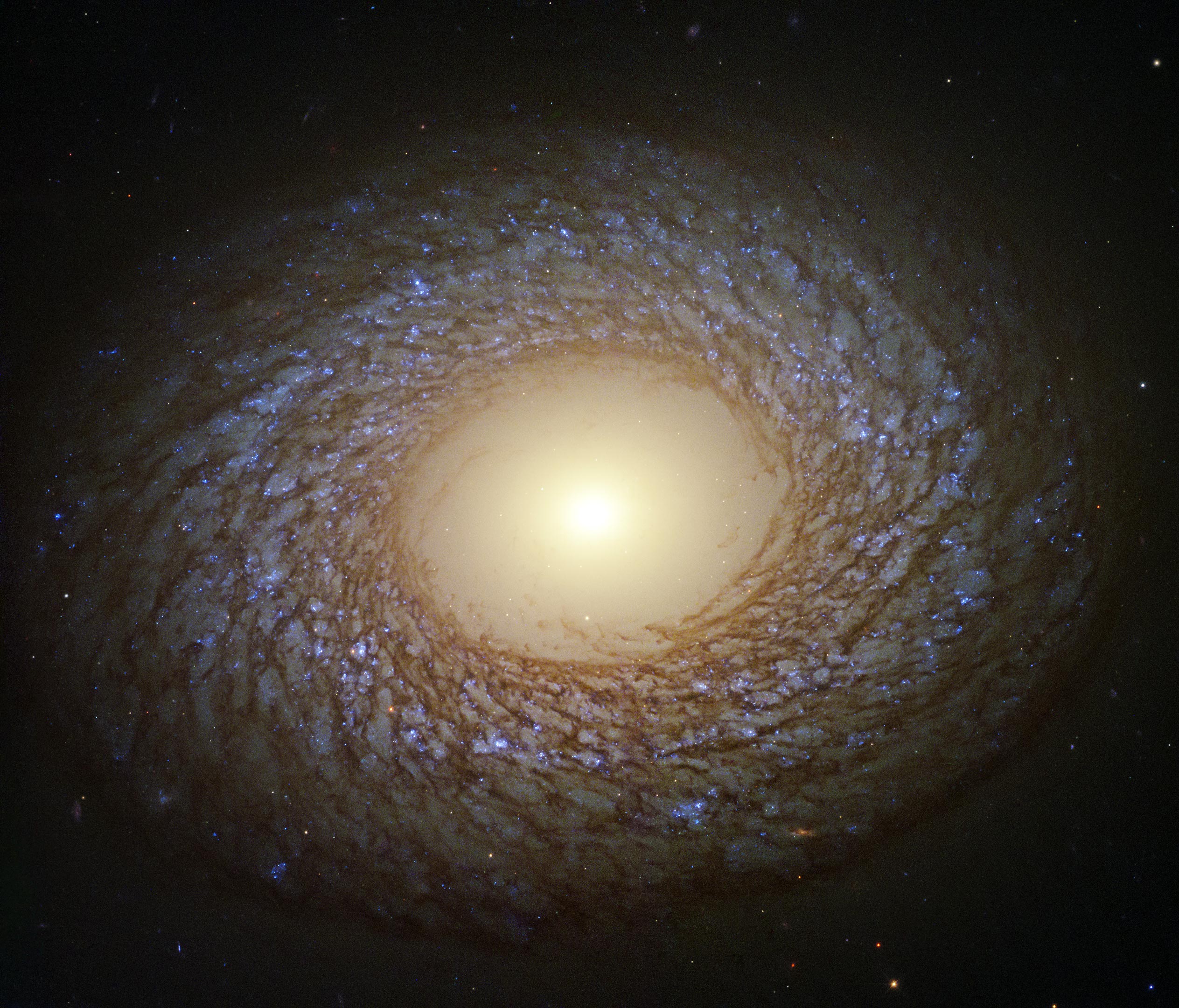
A Fresh Look With Hubble
A Hubble image of NGC 2775 was previously released in 2020 (see above). The new version adds observations of a specific wavelength of red light that is emitted by clouds of hydrogen gas surrounding massive young stars.
Never miss a breakthrough: Join the SciTechDaily newsletter.
Follow us on Google and Google News.
6 Comments
Not Spiral. Not Elliptical. So What Exactly Is This Galaxy?
very good!
Topological vortex theory (TVT) posits that the background space is a physical entity that exhibits characteristics of an ideal fluid. Physical vacuum is not empty but a medium with a complex structure, analogous to a superfluid or Bose-Einstein condensate. In this context, stable excitations are not point particles but topological defects.
If researchers are interested, please visit https://zhuanlan.zhihu.com/p/1954126217461602098 (If the link is available).
Topological vortex theory shows that the richness and diversity of nature are not a negation of fundamental laws but their abundant expression. More is not merely a quantitative increase, but a qualitative leap; difference is not opposition, but the diverse manifestation of unity. In this picture, the complexity and simplicity of the universe are harmoniously unified, jointly demonstrating the profound beauty of natural laws.
If researchers are interested, please visit https://zhuanlan.zhihu.com/p/1951573390151378560 (If the link is available).
Swirl Galaxy
You heard it here first
Looks like an intermediary between spiral galaxy and sombrero ring type. Is the center obscured due to viewing SMBH jet pointing towards Earth and jet plume obscuring fainter arms or bars?
Note 2509250421_Source1.Reinterpreting [】
Source 1.
https://scitechdaily.com/not-spiral-not-elliptical-so-what-exactly-is-this-galaxy/
1.
It’s not a spiral, it’s not an ellipse. So what exactly is this galaxy?
ESA/Hubble Presented September 23, 2025
_NGC 2775 has blurred the boundaries between spiral and elliptical galaxies, prompting a debate among astronomers about its identity.
_ Hubble’s latest observations further amplify the mystery, showing evidence from past galaxy mergers and active hydrogen gas clouds. Source: ESA/Hubble & NASA, F. Belfiore, J. Lee, and PHANGS-HST teams
1-1.
_The galaxy NGC 2775, 67 million light-years away, has a variety of features, perplexing astronomers.
_The Hubble Space Telescope has released a new weekly photo. This time, we’re looking at galaxies that don’t fit perfectly into any category.
_ The galaxy, known as NGC 2775, is about 67 million light-years away from the constellation of Crab.
_At the center is a smooth, gas-free core that is surprisingly similar to an elliptical galaxy. However, around it is a dusty ring that irregularly gathers young stars, making it look like a spiral galaxy.
_ So what exactly is this galaxy? Is it a spiral galaxy, an oval, or halfway between?
【>>>>
>>What does msbase.galaxy look like? The square image is the trend. But the mass is drawn as a bar graph,
>>> From the side, it still looks loose with open.cluster without the center of gravity,
>>> Overall, it is a very tightly closed sphere [a galaxy of scattered globular mass or a cluster].
[For reference 1.],
*An open cluster is a group of thousands of stars that are born from the same molecular cloud and are about the same age. There have been more than 1,100 open clusters in our galaxy alone, and it is estimated that there are far more open clusters than that. Stars in clusters are gravitationally loosely bound to each other, and when they orbit the center of the galaxy and meet with other clusters or gas clouds, the former orbit may be broken or some stars in the cluster may deviate due to the gravity of the object. The duration of a scattered cluster’s shape is usually around hundreds of millions of years. In contrast, globular clusters are much more strongly gravitationally bound and remain for billions of years. Scattered clusters are only found in spiral and irregular galaxies, both of which are actively where stars are born.]
>>>> But can they be interpreted as a merger or part of the debris? The apparent observation change was seen as part of the banc effect.
>>>How can that happen in front of my eyes? Even if it is smooth when viewed through visible light, it looks different when viewed through x-rays or extreme ultraviolet rays.
>>>> On the other hand, it is a very stable gravitational addition and subtraction with a perfect !magicsum state as a whole.
<<<<<<】
1-2.
_Since astronomers can observe NGC 2775 from only a single viewpoint, its true nature remains uncertain.
-Some scientists argue that this galaxy should be classified as a spiral galaxy because of its delicate ring of dust and stars.
-However, other scientists classify it as a lensed galaxy, a transition galaxy that shares the characteristics of both spiral and elliptical galaxies.
2. Mystery of the Lens-type Galaxy
_How lensed galaxies form is still unknown, and many possibilities exist.
_It is possible that the lensed galaxy started as a spiral galaxy but collided with another galaxy, or that the spiral arm disappeared as it exhausted most of its star-forming gas.
2-1.
_Another theory suggests that lensed galaxies were initially similar to elliptical galaxies, but later absorbed enough gas to form a disk around them.
_Some evidence suggests that NGC 2775 has merged with other galaxies in the past. Invisible from this image taken with the Hubble Space Telescope, NGC 2775 has a hydrogen gas tail that extends around the galaxy for nearly 100,000 light years. This faint tail may be the remnant of one or more galaxies that have come so close to NGC 2775 that they are then pulled tight and absorbed.
3.
_If NGC 2775 had merged with other galaxies in the past, it could explain the strange appearance of today's galaxies.
Galaxy NGC 2775, photographed by the Hubble Space Telescope. Photo courtesy of ESA/Hubble & NASA, J. Lee, PHANGS-HST Team. Thanksgiving: Judy Schmidt (Geckzilla).
~~~~~~~~~~~
Relying on my hypothesis of galaxy formation from early 80s, I see an old spiral galaxy, maturing, or approaching the age of globular class galaxies.
~~~~~~~~~~~
P.S.: It took me 1 hour to post these three words.
AI is far stupider than humans!
DENIAL of service excuses:
1. This IP is flagged for spam potential… //VPN
2. You already posted that // I couldn’t! //adding the ~~~ to conform
3. You are posting too often // another denial escalated on its own stupidity build up.