
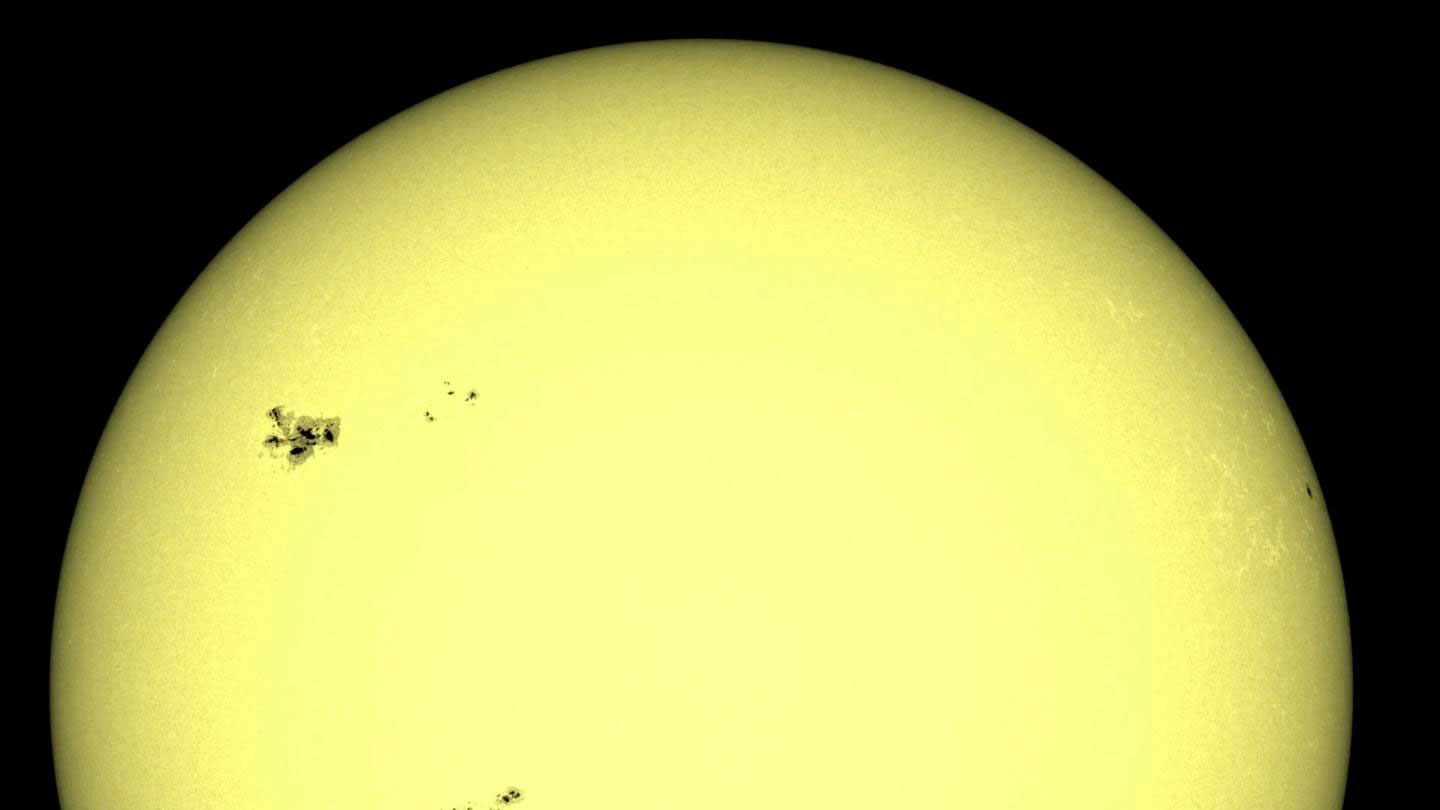
The spots on the surface of the Sun come and go with an 11-year periodicity known as the solar cycle. The solar cycle is driven by the solar dynamo, which is an interplay between magnetic fields, convection, and rotation. However, our understanding of the physics underlying the solar dynamo is far from complete. One example is the so-called Maunder Minimum, a period in the 17th century, where spots almost disappeared from the surface of the Sun for a period of over 50 years.
A Rossetta Stone for stellar dynamos
Now, a large international team led by Christoffer Karoff from Aarhus University has found a star that can help shed light on the physics underlying the solar dynamo. The star is located 120 light-years away in the constellation of Cygnus, and on the surface, the star looks just like the Sun: it has the same mass, radius, and age – but inside, the chemical composition of the star is very different. It consists of around twice as many heavy elements as in the Sun. Heavy elements here means elements heavier than hydrogen and helium.
The team has succeeded in combining observations from the Kepler spacecraft with ground-based observations dating as far back as 1978, thereby reconstructing a 7.4-year cycle in this star. “The unique combination of a star almost identical to the Sun, except for the chemical composition, with a cycle that has been observed from both the Kepler spacecraft and from ground makes this star a Rosetta Stone for the study of stellar dynamos,” explains Karoff.
Heavy elements make the star more variable
By combining photometric, spectroscopic, and asteroseismic data, the team collected the most detailed set of observations for a solar-like cycle in any star other than the Sun. The observations revealed that the amplitude of the cycle seen in the star’s magnetic field is more than twice as strong as what is seen on the Sun, and the cycle is even stronger in visible light.
This allowed the team to conclude that more heavy elements make a stronger cycle. Based on models of the physics taking place in the deep interior and the atmosphere of the star, the team was also able to propose an explanation of the stronger cycle. Actually, they came up with a two-part explanation. First, the heavy elements make the star more opaque, which changes the energy transport deep inside the star from radiation to convection. This makes the dynamo stronger, affecting both the amplitude of the variability in the magnetic field and the rotation pattern near the surface. The latter effect was also measured. Second, the heavy elements affect the processes on the surface and in the atmosphere of the star. Specifically, the contrast between diffuse bright regions called faculae and the quiet solar background increases as the mix of heavy elements is increased. This makes the cyclic photometric variability of the star stronger.
Can help us understand how the Sun affects our climate
The new study can help us understand how the irradiance of the Sun has changed over time, which is likely to have an effect on our climate. In general special attention is paid to the Maunder Minimum, which coincided with a period of relatively cold climate, especially in Northern Europe. The new measurements offer an important constraint on the models trying to explain the weak activity and possible reduced brightness of the Sun during the Maunder minimum.
Reference: “The Influence of Metallicity on Stellar Differential Rotation and Magnetic Activity” by Christoffer Karoff, Travis S. Metcalfe, Ângela R. G. Santos, Benjamin T. Montet, Howard Isaacson, Veronika Witzke, Alexander I. Shapiro, Savita Mathur, Guy R. Davies, Mikkel N. Lund, Rafael A. Garcia, Allan S. Brun, David Salabert, Pedro P. Avelino, Jennifer van Saders, Ricky Egeland, Margarida S. Cunha, Tiago L. Campante, William J. Chaplin, Natalie Krivova, Sami K. Solanki, Maximilian Stritzinger and Mads F. Knudsen, 5 January 2018, The Astrophysical Journal.
DOI: 10.3847/1538-4357/aaa026
Never miss a breakthrough: Join the SciTechDaily newsletter.
Follow us on Google and Google News.