
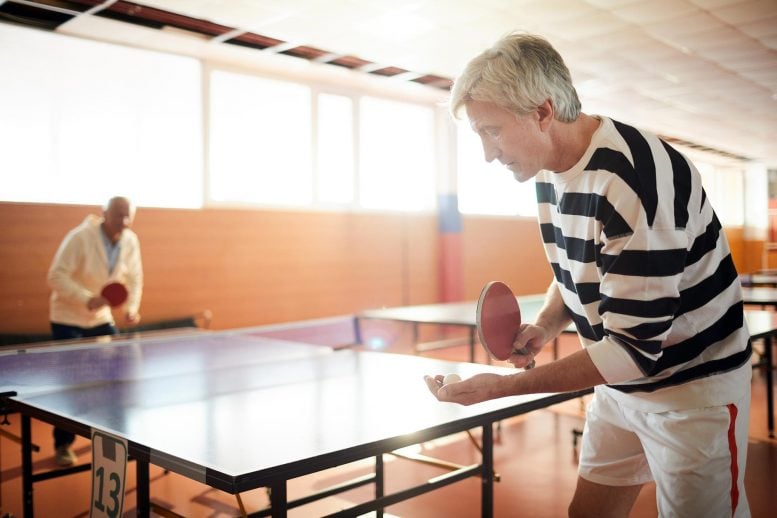
Ping-pong may hold promise as a possible form of physical therapy for Parkinson’s disease. People with Parkinson’s who participated in a ping-pong exercise program once a week for six months showed improvement in their Parkinson’s symptoms, according to a preliminary study released today that will be presented at the American Academy of Neurology’s 72nd Annual Meeting in Toronto, Canada, April 25 to May 1, 2020.
Parkinson’s disease is a movement disorder in which a chemical in the brain called dopamine is gradually reduced. This process results in slowly worsening symptoms that include tremors, stiff limbs, slowed movements, impaired posture, walking problems, poor balance, and speech changes.
“Ping-pong, which is also called table tennis, is a form of aerobic exercise that has been shown in the general population to improve hand-eye coordination, sharpen reflexes, and stimulate the brain,” said study author Ken-ichi Inoue, M.D., of Fukuoka University in Fukuoka, Japan. “We wanted to examine if people with Parkinson’s disease would see similar benefits that may, in turn, reduce some of their symptoms.”
The study found that at both three months and six months, study participants experienced significant improvements in speech, handwriting, getting dressed, getting out of bed and walking.
The study involved 12 people with an average age of 73 with mild to moderate Parkinson’s disease. The people had been diagnosed with Parkinson’s for an average of seven years.
The people were tested at the start of the study to see which symptoms they had and how severe the symptoms were.
Participants then played ping-pong once a week for six months. During each weekly five-hour session, they performed stretching exercises followed by table tennis exercises with instruction from an experienced table tennis player. The program was developed specifically for Parkinson’s disease patients by experienced table tennis players from the department of Sports Science of Fukuoka University.
Parkinson’s symptoms were evaluated again after three months and at the end of the study.
The study found that at both three months and six months, study participants experienced significant improvements in speech, handwriting, getting dressed, getting out of bed and walking. For example, it took participants an average of more than two attempts to get out of bed at the beginning of the study compared to an average of one attempt at the end of the study.
Study participants also experienced significant improvements in facial expression, posture, rigidity, slowness of movement, and hand tremors. For example, for neck muscle rigidity, researchers assessed symptoms and scored each participant on a scale of zero to four with a score of one representing minimal rigidity, two representing mild rigidity, three representing moderate rigidity, and four representing severe rigidity. The average score for all participants at the start of the study was three compared to an average score of two at the end of the study.
Two participants experienced side effects. One person developed a backache and another person fell.
“While this study is small, the results are encouraging because they show ping-pong, a relatively inexpensive form of therapy, may improve some symptoms of Parkinson’s disease,” said Inoue. “A much larger study is now being planned to confirm these findings.”
The main limitation of the study was that the participants were not compared to a control group of people with Parkinson’s disease who did not play ping-pong. Another limitation was that a single specialist assessed the patients.
Never miss a breakthrough: Join the SciTechDaily newsletter.
Follow us on Google and Google News.