
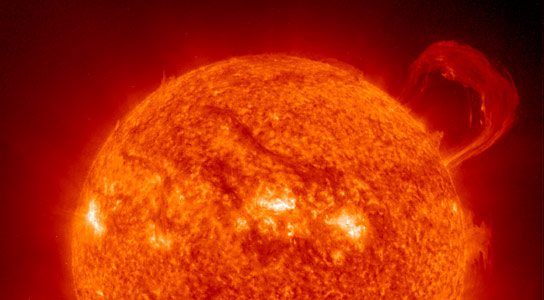
For the first time, an international team of physicists has directly detected neutrinos created by the proton-proton fusion process going on at the sun’s core.
Amherst, Massachusetts – Using one of the most sensitive neutrino detectors on the planet, an international team of physicists including Andrea Pocar, Laura Cadonati, and doctoral student Keith Otis at the University of Massachusetts Amherst report in the current issue of Nature that for the first time they have directly detected neutrinos created by the “keystone” proton-proton (pp) fusion process going on at the sun’s core.
The pp reaction is the first step of a reaction sequence responsible for about 99 percent of the Sun’s power, Pocar explains. Solar neutrinos are produced in nuclear processes and radioactive decays of different elements during fusion reactions at the Sun’s core. These particles stream out of the star at nearly the speed of light, as many as 420 billion hitting every square inch of the Earth’s surface per second.
Because they only interact through the nuclear weak force, they pass through matter virtually unaffected, which makes them very difficult to detect and distinguish from trace nuclear decays of ordinary materials, he adds.
The UMass Amherst physicist, one principal investigator on a team of more than 100 scientists, says, “With these latest neutrino data, we are directly looking at the originator of the sun’s biggest energy producing process, or chain of reactions, going on in its extremely hot, dense core. While the light we see from the Sun in our daily life reaches us in about eight minutes, it takes tens of thousands of years for energy radiating from the sun’s center to be emitted as light.”
“By comparing the two different types of solar energy radiated, as neutrinos and as surface light, we obtain experimental information about the Sun’s thermodynamic equilibrium over about a 100,000-year timescale,” Pocar adds. “If the eyes are the mirror of the soul, with these neutrinos, we are looking not just at its face, but directly into its core. We have glimpsed the sun’s soul.”
“As far as we know, neutrinos are the only way we have of looking into the Sun’s interior. These pp neutrinos, emitted when two protons fuse forming a deuteron, are particularly hard to study. This is because they are low energy, in the range where natural radioactivity is very abundant and masks the signal from their interaction.”
The Borexino instrument, located deep beneath Italy’s Apennine Mountains, detects neutrinos as they interact with the electrons of an ultra-pure organic liquid scintillator at the center of a large sphere surrounded by 1,000 tons of water. Its great depth and many onion-like protective layers maintain the core as the most radiation-free medium on the planet.
Indeed, it is the only detector on Earth capable of observing the entire spectrum of solar neutrino simultaneously. Neutrinos come in three types, or “flavors.” Those from the Sun’s core are of the “electron” flavor, and as they travel away from their birthplace, they oscillate or change between two other flavors, “muon” to “tau.” With this and previous solar neutrino measurements, the Borexino experiment has strongly confirmed this behavior of the elusive particles, Pocar says.
One of the crucial challenges in using Borexino is the need to control and precisely quantify all background radiation. Pocar says the organic scintillator at Borexino’s center is filled with a benzene-like liquid derived from “really, really old, millions-of-years-old petroleum,” among the oldest they could find on Earth.
“We needed this because we want all the Carbon-14 to have decayed, or as much of it as possible, because carbon-14 beta decays cover the neutrino signals we want to detect. We know there is only three atoms of C14 for each billion, billion atoms in the scintillator, which shows how ridiculously clean it is.”
A related problem the physicists discuss in their new paper is that when two C14 atoms in the scintillator decay simultaneously, an event they call a “pileup,” its signature is similar to that of a pp solar neutrino interaction. In a great advance for the analysis, Pocar says, “Keith Otis figured out a way to solve the problem of statistically identifying and subtracting these pileup events from the data, which basically makes this new pp neutrino analysis process possible.”
Though detecting pp neutrinos was not part of the original National Science Foundation-sponsored Borexino experiment, “it’s a little bit of a coup that we could do it,” the astrophysicist says. “We pushed the detector sensitivity to a limit that has never been achieved before.”
Borexino is an international collaboration funded by NSF, the Italian National Institute for Nuclear Physics (INFN), which manages the Gran Sasso labs, and similar organizations in Germany, Russia, Poland, and France.
Reference: “Neutrinos from the primary proton–proton fusion process in the Sun,” by G. Bellini, J. Benziger, D. Bick, G. Bonfini, D. Bravo, B. Caccianiga, L. Cadonati, F. Calaprice, A. Caminata, P. Cavalcante, A. Chavarria, A. Chepurnov, D. D’Angelo, S. Davini, A. Derbin, A. Empl, A. Etenko, K. Fomenko, D. Franco, F. Gabriele, C. Galbiati, S. Gazzana, C. Ghiano, M. Giammarchi, M. Göger-Neff, A. Goretti, M. Gromov, C. Hagner, E. Hungerford, Aldo Ianni, Andrea Ianni, V. Kobychev, D. Korablev, G. Korga, D. Kryn, M. Laubenstein, B. Lehnert, T. Lewke, E. Litvinovich, F. Lombardi, P. Lombardi, L. Ludhova, G. Lukyanchenko, I. Machulin, S. Manecki, W. Maneschg, S. Marcocci, Q. Meindl, E. Meroni, M. Meyer, L. Miramonti, M. Misiaszek, M. Montuschi, P. Mosteiro, V. Muratova, L. Oberauer, M. Obolensky, F. Ortica, K. Otis, M. Pallavicini, L. Papp, L. Perasso, A. Pocar, G. Ranucci, A. Razeto, A. Re, A. Romani, N. Rossi, R. Saldanha, C. Salvo, S. Schönert, H. Simgen, M. Skorokhvatov, O. Smirnov, A. Sotnikov, S. Sukhotin, Y. Suvorov, R. Tartaglia, G. Testera, D. Vignaud, R. B. Vogelaar, F. von Feilitzsch, H. Wang, J. Winter, M. Wojcik, A. Wright, M. Wurm, O. Zaimidoroga, S. Zavatarelli, K. Zuber and G. Zuzel, 27 August 2014, Nature.
DOI: 10.1038/nature13702
Never miss a breakthrough: Join the SciTechDaily newsletter.
Follow us on Google and Google News.