

Spotted thanks to a fleeting light distortion in 2011, a mysterious duo — a tiny star and its hefty companion — has turned out to be much faster and stranger than first imagined.
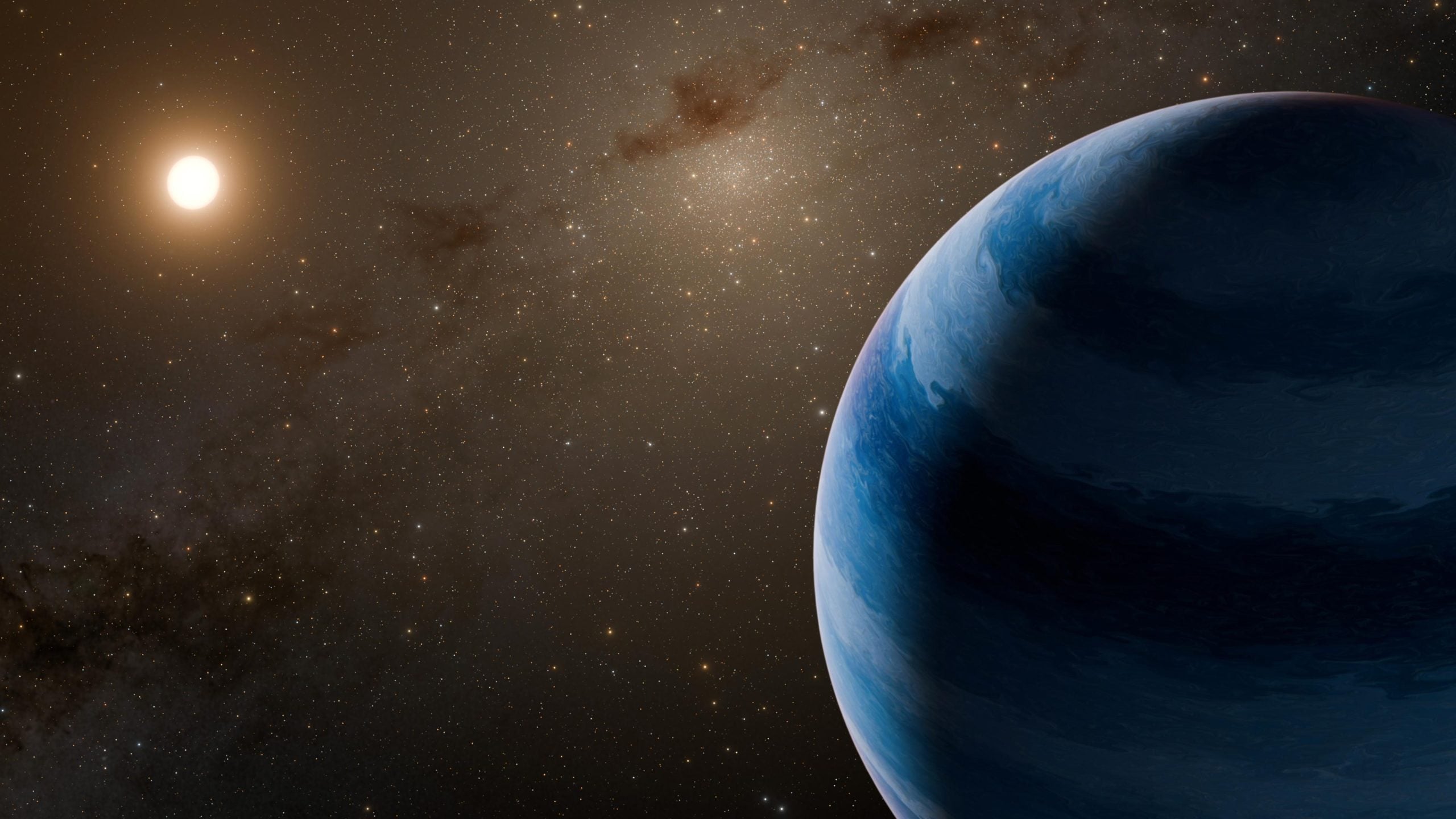
Astronomers have observed hypervelocity stars before, but NASA scientists may have just identified a truly extraordinary system. They’ve found what appears to be the first known case of a super-Neptune exoplanet orbiting a hypervelocity star, a star hurtling through space at extraordinary speed.
This remarkable find could reshape our understanding of how planets form and survive in extreme gravitational environments. The fact that a planet has remained gravitationally bound to such a fast-moving star challenges existing models of stellar and planetary evolution. However this system formed, it’s astonishing that the planet has managed to stay in orbit through such a tumultuous journey.
Racing Through the Cosmos at Incredible Speeds
Hypervelocity stars are rare celestial objects that travel at incredible speeds, often hundreds of kilometers per second. These stars are usually ejected from their home galaxies by powerful gravitational interactions, such as close encounters with supermassive black holes or other massive stars. Some travel so fast that they can escape the gravitational pull of the Milky Way entirely. Studying these runaway stars offers valuable insight into the structure and evolution of our Galaxy, the behavior of black holes, and even the distribution of dark matter throughout the cosmos.
The details of this groundbreaking discovery were published in The Astronomical Journal, led by astronomer Sean Terry of the University of Maryland. The research describes a low-mass star moving at approximately 540 kilometers per second (~1.2 million miles per hour), with a likely super-Neptune-sized planet in orbit. If placed in our own Solar System, this planet would lie somewhere between the orbits of Venus and Earth. According to Terry, this is likely the first planet ever discovered orbiting a hypervelocity star—a finding that pushes the boundaries of what scientists thought was possible in planetary dynamics.

Tracing the Signal Back to 2011
Finding objects like this in space is tricky. This object was first seen in 2011 following analysis of data from the Microlensing Observations in Astrophysics survey that had been conducted by the University of Canterbury in New Zealand. The study had been on the lookout for evidence for exoplanets around distant stars.
The presence of a mass between Earth and a distant object creates these microlensing events. As such, when a mass passes between us and a star, its presence can be revealed through analysis of its light curve. In the 2011 data, the signals revealed a pair of celestial bodies and allowed the researchers to calculate that one was about 2,300 times heavier than the other.
The 2011 study suggested the star was about 20 percent as massive as the Sun and a planet 29 times heavier than Earth. Either that, or it was a nearer planet about four times the mass of Jupiter, maybe even with a moon. To learn more about the object, the team searched through data from Keck Observatory and the Gaia satellite. They found the star was located about 24,000 light years away, so still within the Milky Way. By comparing the location of the star in 2011 and then ten years later in 2021, the team was able to calculate its speed.
Chasing a Star Into Intergalactic Space
Having calculated the speed of the star to be around 540,000 kilometers per second, the team is keen to secure more observations in the years ahead. If it is around the 600,000 kilometers per second mark, then it’s likely to escape the gravity of the Milky Way and enter intergalactic space millions of years in the future.
Adapted from an article originally published on Universe Today.
Explore Further: NASA Spots a Star and Planet Racing at 1.2 Million MPH
Reference: “A Candidate High-velocity Exoplanet System in the Galactic Bulge” by Sean K. Terry, Jean-Philippe Beaulieu, David P. Bennett, Aparna Bhattacharya, Jon Hulberg, Macy J. Huston, Naoki Koshimoto, Joshua W. Blackman, Ian A. Bond, Andrew A. Cole, Jessica R. Lu, Clément Ranc, Natalia E. Rektsini and Aikaterini Vandorou, 10 February 2025, The Astronomical Journal.
DOI: 10.3847/1538-3881/ad9b0f
Never miss a breakthrough: Join the SciTechDaily newsletter.
Follow us on Google and Google News.
20 Comments
How is it possible to travel at a speed higher than the speed of light?
Ask the folks who still cling to the big bang theory.
I WONDERED THAT TOO
The second mention has incorrect units. It should be 540000 m/s, not km/s.
That makes sense, not faster than light but approaching 0.2% of light speed (300,000,000 m/s)
The speed of light is about 670,000,000 miles per hour. So, this star (and planet) are traveling at a tiny fraction of the speed of light.
It’s not. It’s traveling at 540 kilometers per second (~1.2 million miles per hour); Speed of light: 671 million miles per hour.
That second mention of it’s speed later in the story is a mistake. It’s driving me crazy that it’s not corrected.
It’s not travelling faster than light! It’s about 300 times slower!
That is speed per hour not second.
Opposite to light
Opposite to light is faster than light
Just go outside and touch a grass
Go and touch some grass
Literally The war of the worlds!
Hello sir namaste god bless all family members danke fur god.das gotsubergabe for und.alle members schwere zeit tragen.beliben alls gusend.schone gruss Rajveer Singh sun of karnail singh batth village kotala bet po chhourian district Ludhiana Punjab India thanks for alls
Buh-Bye!
You’ll have a great view of the galaxy though. Send photos back!
Only off by a factor of 1000.
Our understanding of God’s mind will never fully be understood. Gods mind has no limits or boundaries, the same goes for our galaxy and our universe! Milky Way Galaxy for life, for eternity homes!
In re: to the Neptune-like Planet and it’s speeding Small Star – the reason is relative gravity as it is effected by the great speed, which also pulls the large Planet very hard in the direction it is going at 1 2 million mph, so the gravitational pull is multiplied millions of times and only the Planet’s urge to leave actually by a freak of their creations has kept the Psuedo-Neptune in step with that speed…and try to remember your Speed of Light @ 386,000 miles per second hits 1.2 million in just over 3 seconds. Imagine the seemingly infintessimal speed of 1.2 million miles per hour and then imagine how much faster 386k/second is, and how far just 1 Light Year is – Aplpga Centauri, our nearest Star, is over 4 million Light Years away.
Impossible that there isn’t evolved and super intelligent life forms all over the Universe which is beyond any stretch of forever and ever we could try to define, imagine or theorize in our advanced but not fully evolved human minds.
When I wake up, well, I know I’m gonna be
I’m gonna be the man who wakes up next to you