

A new superconducting camera with 400,000 pixels offers unprecedented capabilities in low-noise, high-resolution imaging for astronomy and quantum technology applications.
In the pursuit of faint celestial objects like distant stars and exoplanets, capturing every photon is essential for maximizing the scientific yield of a mission. Cameras used for this task need to operate with extremely low noise levels and detect the smallest quantities of light—single photons.
Historically, superconducting cameras, while meeting these low-noise and high-sensitivity requirements, have been limited by their small size, often not exceeding a few thousand pixels, which restricts their capacity to capture high-resolution images. However, a breakthrough by a research team has recently shattered that barrier, creating a superconducting camera with 400,000 pixels. This advancement enables the detection of faint astronomical signals across a broad spectrum, from ultraviolet to infrared wavelengths.

While plenty of other camera technologies exist, cameras using superconducting detectors are very appealing for use in astronomical missions due to their extremely low-noise operation. When imaging faint sources, it is crucial that a camera report the quantity of received light faithfully, and not skew the amount of light received or inject its own false signals. Superconducting detectors are more than capable of this task, owing to their low-temperature operation and unique composition. As described by project lead Dr. Adam McCaughan, “with these detectors you could take data all day long, capturing billions of photons, and fewer than ten of those photons would be the result of noise.”
But while superconducting detectors hold great promise for astronomical applications, their usage in that field has been stymied by small camera sizes that permit relatively few pixels. Because these detectors are so sensitive, it is difficult to pack a lot of them into a small area without them interfering with each other. In addition, since these detectors need to be kept cold in a cryogenic refrigerator, only a handful of wires can be used to carry the signals from the camera to the warmer readout electronics.
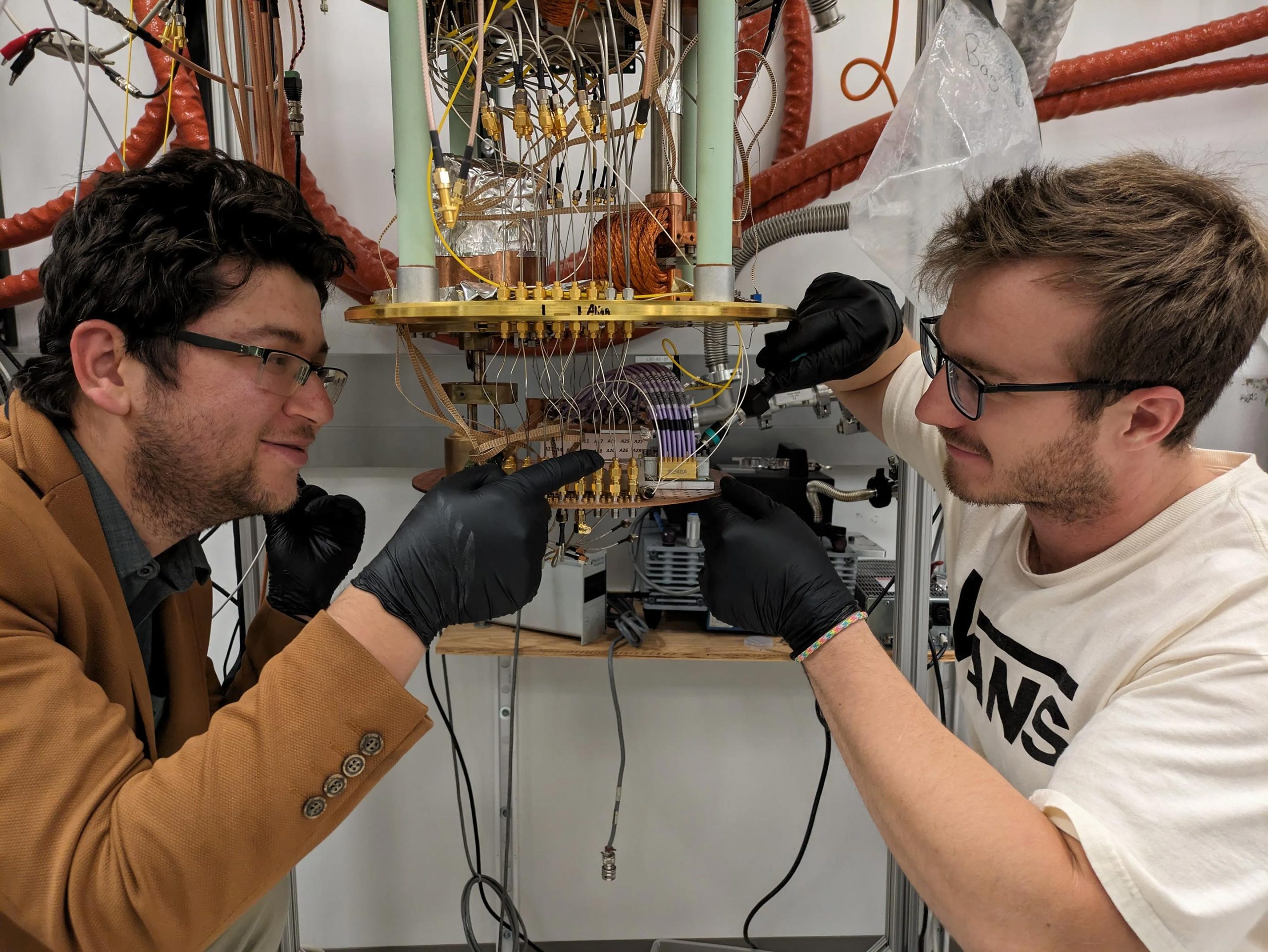
To overcome these limitations, researchers at the National Institute of Standards and Technology (NIST), the NASA Jet Propulsion Laboratory (JPL), and the University of Colorado Boulder applied time-domain multiplexing technology to the interrogation of two-dimensional superconducting-nanowire single photon detector (SNSPD) arrays. The individual SNSPD nanowires are arranged as intersecting rows and columns. When a photon arrives, the times it takes to trigger a row detector and a column detector are measured to ascertain which pixel sent the signal. This method allows the camera to efficiently encode its many rows and columns onto just a few readout wires instead of thousands of wires.
This animation depicts the newly developed readout system that made it possible for researchers to build a 400,000 single-wire superconducting camera, the highest resolution camera of its type. Credit: S. Kelley/NIST
SNSPDs are one type of detector in a collection of many such superconducting detector technologies, including microwave kinetic inductance detectors (MKID), transition-edge sensors (TES), and quantum capacitance detectors (QCD). SNSPDs are unique in that they are able to operate much warmer than the millikelvin temperatures required by those other technologies, and can have extremely good timing resolution, although they are not able to resolve the color of individual photons. SNSPDs have been collaboratively researched by NIST, JPL, and others in the community for almost two decades, and this most recent work was only possible thanks to the advances generated by the wider superconducting detector community.
Once the team implemented this readout architecture, they found it immediately became straightforward to construct superconducting cameras with extremely large numbers of pixels. As described by technical lead Dr. Bakhrom Oripov, “The big advance here is that the detectors are truly independent, so if you want a camera with more pixels, you just add more detectors to the chip.” The researchers note that while their recent project was a 400,000-pixel device, they also have an upcoming demonstration of a device with over a million pixels, and have not found an upper limit yet.
One of the most exciting things that the researchers think their camera could be useful for is a search for Earth-like planets outside of our solar system. To detect these planets successfully, future space telescopes will observe distant stars and look for tiny portions of reflected or emitted light coming from orbiting planets. Detecting and analyzing these signals is extremely challenging and requires very long exposures, which means that every photon collected by the telescope is very valuable. A reliable, low-noise camera will be critical to detect these incredibly small quantities of light.
SNSPD cameras can also be used on Earth to detect optical communication signals from missions in deep space. In fact, NASA is currently demonstrating this capability via the Deep Space Optical Communications (DSOC) project, which is the first demonstration of free-space optical communication from interplanetary space. DSOC is sending data from a spacecraft called Psyche—which was launched on October 13 and is on its way to the Psyche asteroid—to an SNSPD-based ground terminal at Palomar Observatory. Optical links can transmit data at a much higher rate than radio frequency links from interplanetary distances. The excellent timing resolution of the camera developed for the ground station receiving Psyche data allows it to decode optical data from the spacecraft, which enables much more data to be received in a given time than if radio signals were employed.
These sensors will also be useful for many applications on Earth. Because the operating wavelength of this camera is very flexible, it could be optimized for applications in biomedical imaging to detect faint signals from cells and molecules, which were previously not detectable. Dr. McCaughan noted, “We would love to get these cameras in the hands of neuroscientists. This technology could provide them with a new tool to study our brains, in a completely non-intrusive way.”
Finally, the rapidly growing field of quantum technology, which promises to change the way we secure communications and transactions as well as the way we simulate and optimize complex processes, also stands to gain from this exciting technology. A single photon can be used to transfer or compute a single bit of quantum information. Many companies and governments are currently trying to scale up quantum computers and communication links and access to a single-photon camera that is so easily scalable, could overcome one of the major hurdles to unlocking the full potential of quantum technologies.
According to the research team, the next steps will be to take this initial demonstration and optimize it for space applications. “Right now, we have a proof-of-concept demonstration,” says co-project lead Dr. Boris Korzh, “but we’ll need to optimize it to show its full potential.” The research team is currently planning ultra-high-efficiency camera demonstrations that will validate the utility of this new technology in both the ultraviolet and the infrared.
Never miss a breakthrough: Join the SciTechDaily newsletter.
Follow us on Google and Google News.
1 Comment
Look,it aint rights to scare People with faze things