
A new study has discovered the origin of the persistent emission of radiation observed in some deep-space fast radio bursts.
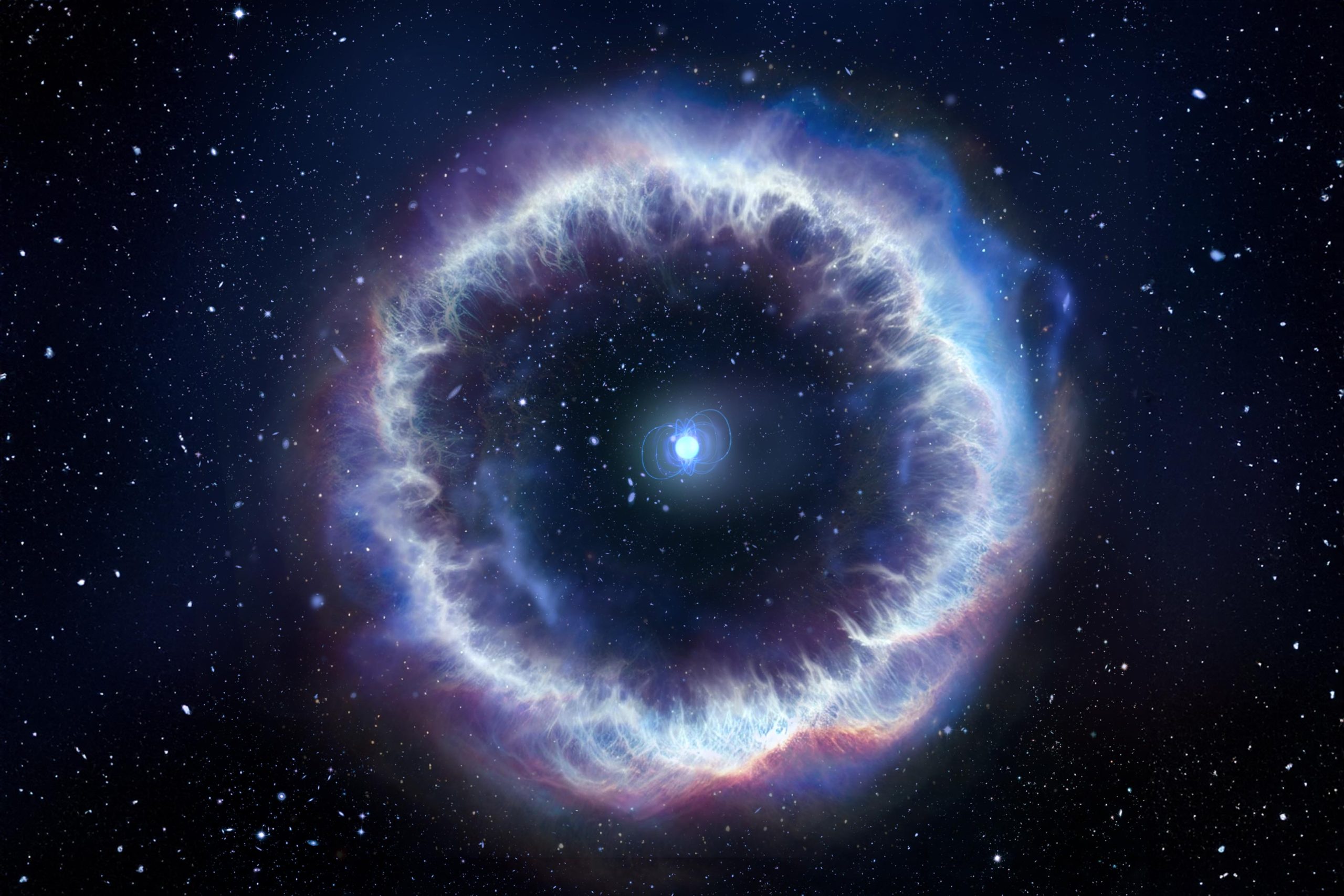
New research into fast radio bursts suggests that their persistent emissions could be explained by plasma bubbles formed by magnetars or X-ray binaries, offering deeper insight into these cosmic enigmas.
An international team of scientists has uncovered a new clue in the quest to understand what powers some fast radio bursts (FRBs)—violent cosmic explosions in deep space that generate the energy equivalent of our sun’s annual output in just milliseconds.
Unraveling the Mystery of FRBs
First discovered just over a decade ago, FRBs remain among the most mysterious events in the universe. Despite extensive research, the precise mechanisms driving these bursts remain unclear. However, in a few instances, the brief flash of an FRB is accompanied by a weaker, persistent radio emission.
A new study has revealed that plasma bubbles likely generate the persistent emission of radiation following the initial flash of some FRBs. The study, led by the Italian National Institute for Astrophysics (INAF) and an international team of scientists, including University of Nevada, Las Vegas (UNLV) astrophysicist Bing Zhang, was published recently in the journal Nature.
Observational Breakthroughs
Researchers focused on FRB20201124A, a fast radio burst discovered in 2020 whose source is located about 1.3 billion light-years away from Earth. The FRB was captured in observations by the Karl G. Jansky Very Large Array (VLA) in New Mexico, which is currently the most sensitive radio telescope in the world, along with other arrays worldwide. This combination of sources allowed scientists to build a comprehensive picture of the FRB and its host galaxy.
“We were able to demonstrate through observations that the persistent emission observed along with some fast radio bursts behaves as expected from the nebular emission model, i.e. a ‘bubble’ of ionized gas that surrounds the central engine,” explains Gabriele Bruni, INAF researcher and lead author of the new paper. “Through radio observations of one of the bursts that is nearest to us, we were able to measure the weak persistent emission coming from the same location as the FRB, extending the radio flux range explored so far for these objects by two orders of magnitude.”
Theoretical Implications and Future Research
These observations suggest that the central engines of these FRBs could be magnetars, incredibly dense, city-sized neutron stars that possess the most powerful magnetic fields in the universe. Because magnetars occasionally produce X-ray bursts through dissipation of magnetic fields, they’re viewed as plausible sources to power FRBs. Another possibility is that they are driven by what are known as high-accretion X-ray binary systems, which consist of a neutron star or black hole and draw in material from companion stars at very high rates.
According to researchers, winds produced by a magnetar or X-ray binary would be able to “blow” the plasma bubble that leads to the persistent radio emission.
“According to our theory, the brightness of persistent radio sources should linearly scale with the Faraday rotation measure, a parameter that measures the strength and density of the medium surrounding the FRB source,” said Bing Zhang, study co-author and professor and director of the Nevada Center for Astrophysics at UNLV. “What we’ve observed aligns very well with prediction models, suggesting a consistent picture of known FRB sources.”
Conclusion and Future Directions
Though most FRBs do not exhibit a measurable persistent emission, researchers say that understanding the nature of the emission offers is crucial to solving the puzzle about the origins of these mysterious cosmic sources.
“Persistent radio sources from most FRBs are predicted to be too faint to detect, which is consistent with our theory,” said Zhang. “Detecting more radio bubbles around nearby FRBs with more magnetized environments will further test our theory and bring us another step closer to understanding the nature and origin of FRBs.”
For more on this discovery:
Reference: “A nebular origin for the persistent radio emission of fast radio bursts” by Gabriele Bruni, Luigi Piro, Yuan-Pei Yang, Salvatore Quai, Bing Zhang, Eliana Palazzi, Luciano Nicastro, Chiara Feruglio, Roberta Tripodi, Brendan O’Connor, Angela Gardini, Sandra Savaglio, Andrea Rossi, Ana M. Nicuesa Guelbenzu and Rosita Paladino, 7 August 2024, Nature.
DOI: 10.1038/s41586-024-07782-6
Along with INAF and UNLV researchers, the collaboration involves the Universities of Bologna, Trieste and Calabria, in Italy, and the international participation of research institutes and universities in the U.S., China, Spain, and Germany.
Never miss a breakthrough: Join the SciTechDaily newsletter.
Follow us on Google and Google News.
1 Comment
Note 2410131158
According to a new study, plasma bubbles are likely to produce continuous radiation emission following the initial flash of some FRBs. My speculation is that the persistence is ‘associated with dark energy’.
Source1.Edit
While most FRBs do not show measurable continuous emission, researchers say that understanding the nature of the emission is crucial to solving the mystery of the origin of this mysterious cosmic source.
For the most part, the persistent radio sources of FRBs are predicted to be too faint to detect, which is consistent with our theory. Detecting more radio bubbles around nearby FRBs with more magnetized environments will further test our theory and take us one step closer to understanding the nature and origin of FRBs.
1.
View 1.sample qms
0000000011=2,0
0000001100
0000001100
0000010010
0001100000
0101000000
0010010000
0100100000
2000000000
0010000001
In example 1. the number 2 is qms.2qvix.value.2. However, the number 2 is 1+1=2, but it is also 1-1=0, and has a sustainable constant function graph of y=2,0. 2 is viewed as an overlapping point of the two energies, which can also be interpreted as a linear constant function rather than a point. Then, it can be interpreted as a continuous propagation source of FRB.
According to a new study of fast radio bursts, the continuous emission can be described as a plasma bubble (?) formed by the positions of the suqer.spinning magnetar moiety (?) or zz’ X-ray duality (?), providing deeper insight into the mysteries of the universe.
Here, the source of the transmission of qms is qvixer.linear.dark_energy(!), which gives the constant superposition of 2 for the FRB. The dark energy is also expressed in terms of a small number of complex units (!) of prime factorization. Their formulations of type 2, type 3, and polymorphisms can produce small, strong forces that combine quarks and gluons, just like tightly bound, twisted entangles.
Of course, the ems.void bubbles of neutrron_stars’s usqers.spin vibrations may form filaments around. Uh-huh.
ㅡㅡㅡㅡㅡㅡㅡㅡㅡㅡㅡㅡ
Source 1.
https://scitechdaily.com/plasma-bubbles-and-magnetars-illuminate-fast-radio-burst-mysteries/
Plasma Bubbles and Magnetar Reveal Mystery Of High-Speed Radio Explosions