
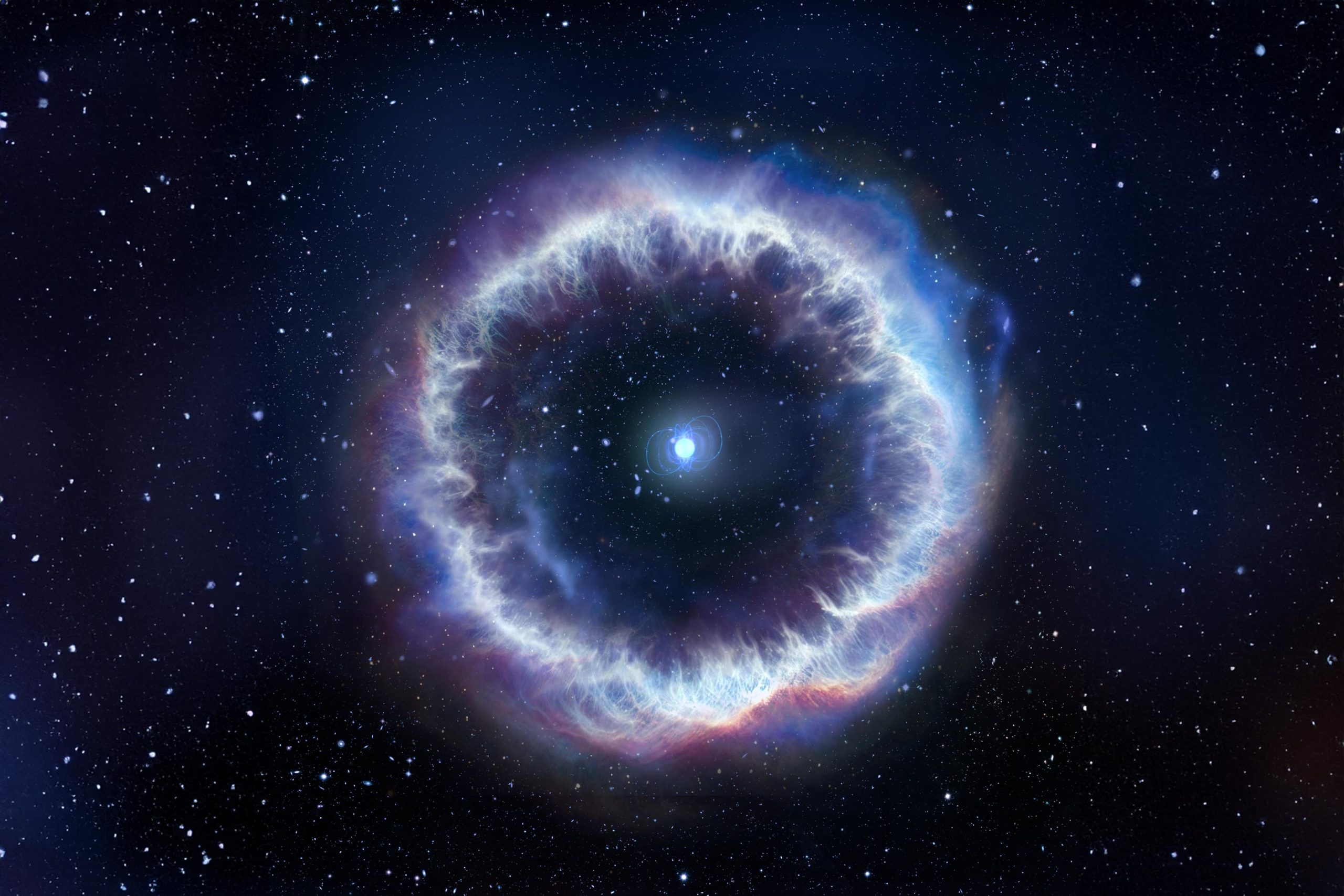
Astronomers have traced the persistent emissions of some fast radio bursts to plasma bubbles, advancing our understanding of these cosmic phenomena.
This new finding suggests these emissions could be driven by magnetars or binary star systems, marking a significant leap in deciphering the universe’s most mysterious signals.
Discovering the Mechanisms Behind Fast Radio Bursts
The US National Science Foundation (NSF) National Radio Astronomy Observatory (NRAO) and the Karl G. Jansky Very Large Array (VLA) have played a crucial role in identifying the origins of persistent emissions observed in some fast radio bursts (FRBs). An international team of astronomers has shown that this persistent radiation stems from a plasma bubble, providing new insights into the mysterious forces powering these cosmic events. These groundbreaking findings are detailed in the journal Nature.
Fast radio bursts, first discovered just over a decade ago, are among the most intense and enigmatic phenomena in the universe, releasing enormous amounts of energy within milliseconds. Despite considerable research, the exact processes that trigger these bursts are still not fully understood. However, occasionally, the quick flash of an FRB is followed by a weaker, sustained radio emission.
Unveiling the Origins of Persistent FRB Emissions
A new study, led by researchers from the Italian National Institute for Astrophysics (INAF) and involving collaborators from institutions worldwide, focused on FRB20201124A. This particular burst, located approximately 1.3 billion light-years from Earth, provided the team with unprecedented data, thanks to the NSF VLA, currently the most sensitive radio telescope in the world.
Observations from the NSF VLA enabled the team to verify that a plasma bubble was responsible for the persistent emission observed in conjunction with FRBs. This supports the theoretical model predicting such an origin.
The data suggest that the engine driving these FRBs could be a magnetar (a highly magnetized neutron star) or a high-accretion x-ray binary system, where intense winds from the magnetar or the binary system’s accretion process create this plasma bubble. The persistent emission associated with FRB20201124A is the weakest ever detected for an FRB, expanding the known range of these emissions by two orders of magnitude.
Insights From High-Resolution Observations
Gabriele Bruni, INAF researcher and lead author of the paper, explains, “Our observations confirm that the persistent radio emissions from FRBs behave as expected from the nebular emission model, indicating a bubble of ionized gas surrounding the central engine. This allows us to better understand the physical relationship between the engine of FRBs and the surrounding nebula.”
Luigi Piro, INAF researcher and co-author of the study, adds, “This research campaign, conducted at higher spatial resolution with the VLA, combined with observations in different bands from the NOEMA interferometer and the Gran Telescopio Canarias, has allowed us to reconstruct a comprehensive picture of the host galaxy and confirm the presence of a compact radio source— the FRB plasma bubble—within a star-forming region.”
The NSF VLA’s advanced capabilities were crucial in distinguishing the weak, compact emission from the surrounding diffuse emission, providing insights that previous studies could not achieve.
For more on this discovery:
- Weakest Signal Ever Detected Could Solve the Fast Radio Burst Mystery
- Plasma Bubbles and Magnetars Illuminate Fast Radio Burst Mysteries
Reference: “A nebular origin for the persistent radio emission of fast radio bursts” by Gabriele Bruni, Luigi Piro, Yuan-Pei Yang, Salvatore Quai, Bing Zhang, Eliana Palazzi, Luciano Nicastro, Chiara Feruglio, Roberta Tripodi, Brendan O’Connor, Angela Gardini, Sandra Savaglio, Andrea Rossi, Ana M. Nicuesa Guelbenzu and Rosita Paladino, 7 August 2024, Nature.
DOI: 10.1038/s41586-024-07782-6
Never miss a breakthrough: Join the SciTechDaily newsletter.
Follow us on Google and Google News.
3 Comments
Do they also produce radiation? Cause there was a LOT OF radiation a couple days ago in Hillsboro, KS. Im trying to get through to the federal government to make them aware.
If by radiation you mean massive light and/or solar wind protons, our nearest star is the only suspect (and only if the proton ejecta is energetic can it reach Earth’s surface). The radio sky is different of course, but here technological radio emissions tend to overpower.
“Radiation” is a wide concept and you don’t give any context. Hitchens’s razor: “What can be asserted without evidence can also be dismissed without evidence”.
“This new finding suggests these emissions could be driven by magnetars or binary star systems”.
More recent research:
“FRB emission characteristics favour highly magnetized neutron stars, or magnetars, as the sources1, as evidenced by FRB-like bursts from a galactic magnetar2,3, and the star-forming nature of FRB host galaxies4,5.”
“Here, we present the stellar population properties of 30 FRB host galaxies discovered by the Deep Synoptic Array (DSA-110). Our analysis shows a marked deficit of low-mass FRB hosts compared with the occurrence of star formation in the Universe, implying that FRBs are a biased tracer of star formation, preferentially selecting massive star-forming galaxies. This bias may be driven by galaxy metallicity, which is positively correlated with stellar mass8. Metal-rich environments may favour the formation of magnetar progenitors through stellar mergers9,10, as higher-metallicity stars are less compact and more likely to fill their Roche lobes, leading to unstable mass transfer. Although massive stars do not have convective interiors to generate strong magnetic fields by dynamo11, merger remnants are thought to have the requisite internal magnetic-field strengths to result in magnetars11,12. The preferential occurrence of FRBs in massive star-forming galaxies suggests that a core-collapse supernova of merger remnants preferentially forms magnetars.”
Sharma, K., Ravi, V., Connor, L. et al. Preferential occurrence of fast radio bursts in massive star-forming galaxies. Nature 635, 61–66 (2024).