

Lowering tyrosine concentrations in people with elevated levels could contribute to increased longevity, potentially with sex-specific effects.
Researchers from the University of Hong Kong and the University of Georgia, led by Jie V. Zhao, Yitang Sun, Junmeng Zhang, and Kaixiong Ye, examined whether two amino acids, phenylalanine and tyrosine, play a role in shaping how long people live (lifespan).
Their work, published in the journal Aging, indicates that higher concentrations of tyrosine in the bloodstream are associated with shorter life expectancy in men. This pattern points to the possibility that men and women may respond differently to the biological pathways influenced by these molecules.
Background on Amino Acids
Phenylalanine and tyrosine are essential components of human metabolism and brain signaling. Both are naturally present in foods that contain protein, including meat, dairy, eggs, and legumes, and they are common ingredients in nutritional supplements.
Tyrosine, in particular, attracts scientific interest because the body uses it to produce neurotransmitters such as dopamine, norepinephrine, and epinephrine. These chemicals support cognitive performance, stress responses, and mood regulation. As a result, tyrosine is frequently included in products marketed for mental focus, stress resilience, and energy support. Despite its popularity, relatively little is known about how long-term elevations in tyrosine may influence the aging process.
To explore this question, the researchers analyzed information from more than 270,000 people in the UK Biobank. They used observational data together with genetic techniques to investigate how blood levels of phenylalanine and tyrosine relate to mortality and estimated lifespan.
Key Findings
While initial results suggested that both amino acids might increase the risk of earlier death, only tyrosine continued to show a strong and potentially causal relationship when examined more closely. According to genetic estimates, men with elevated tyrosine levels may experience a reduction in lifespan of nearly one year. The study did not find a significant effect in women.
These findings remained consistent even after adjusting for related factors, including the role of phenylalanine. This suggests that tyrosine may independently influence aging. The researchers also observed that men tend to have higher tyrosine levels than women, which could partly explain the gender gap in lifespan.
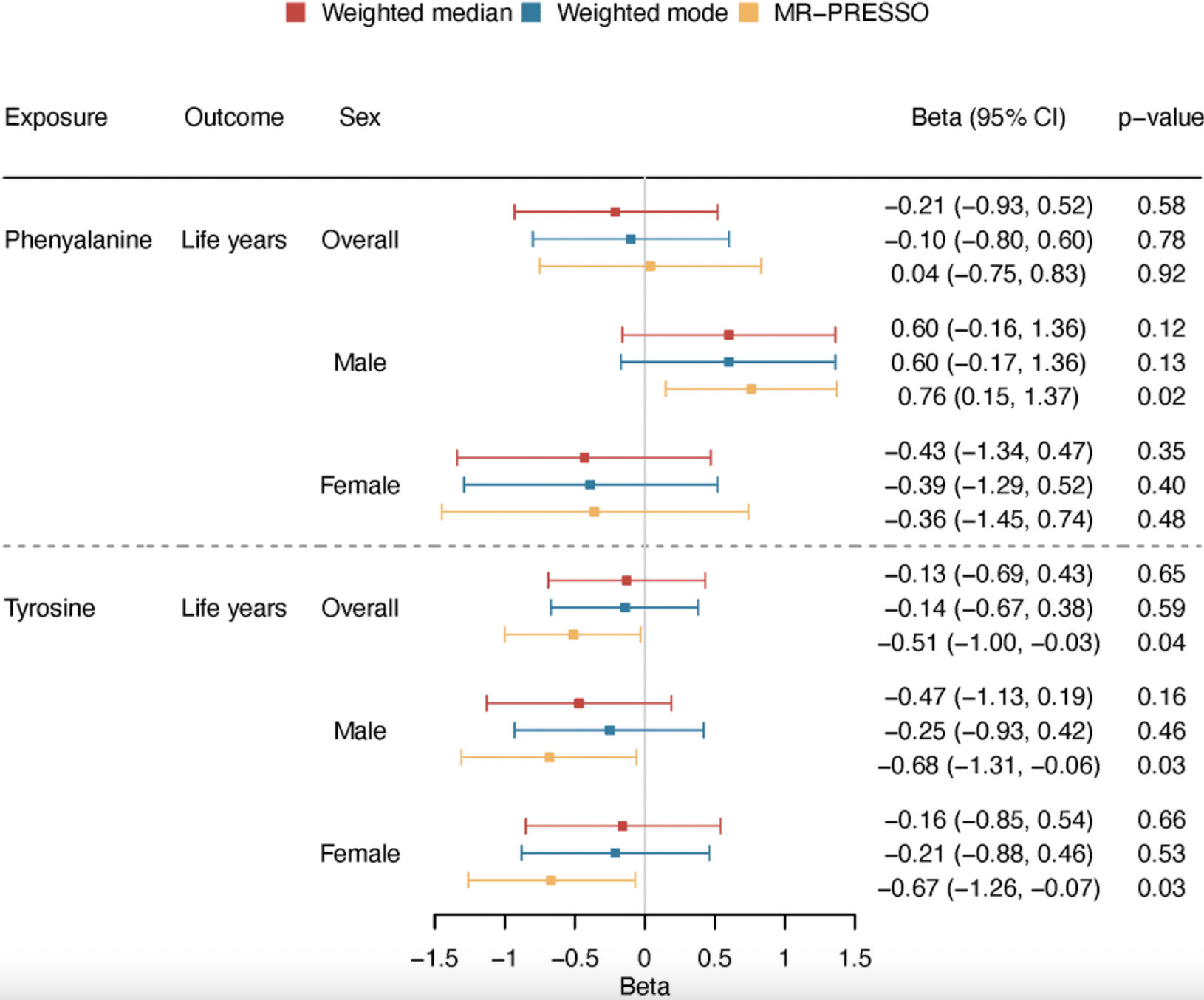
“Phenylalanine showed no association with lifespan in either men or women after controlling for tyrosine,” the authors state.
The exact mechanisms behind this effect are still under investigation. However, tyrosine’s involvement in insulin resistance and the production of stress-related neurotransmitters may be contributing factors. Insulin resistance is associated with many age-related diseases, and hormone-related pathways influenced by tyrosine may differ between men and women, potentially explaining the sex-specific outcomes.
Although tyrosine is commonly marketed as a supplement for enhancing focus and mental performance, the study raises concerns about its long-term impact on lifespan. While the researchers did not directly study tyrosine supplementation, their findings suggest that people with high tyrosine levels may benefit from dietary adjustments. Strategies such as protein restriction could help reduce tyrosine levels and support healthier aging.
Further studies are needed to confirm these findings and explore whether diet and lifestyle changes can safely lower tyrosine levels to promote longevity.
Reference: “The role of phenylalanine and tyrosine in longevity: a cohort and Mendelian randomization study” by Jie V. Zhao, Yitang Sun, Junmeng Zhang and Kaixiong Ye, 3 October 2025, Aging.
DOI: 10.18632/aging.206326
Never miss a breakthrough: Join the SciTechDaily newsletter.
Follow us on Google and Google News.
5 Comments
So it produces dopamine, epinephrine and noepinephrine, making my daily life way better, and only takes maybe 1 year off the tail end of life when I’m sickly and/or weaker and can’t do anything anyway? Count me in!
You,might be in good health when you go at any age.
“As a result, tyrosine is frequently included in products marketed for mental focus, stress resilience, and energy support” and you can probably guess what else is included in these products. An important factor might be the way they are consuming tyrosine to give you a valid cause and effect.
Phenylalanine gets to the brain more easily than tyrosine anyway due to taking a less congested pathwah through the blood-brain barrier. That then gets turned into tyrosine in the brain.
It would be interesting to see how this affects trans people since it seems to be influenced by hormones. Not that longevity is a high priority anyway.
“While the researchers did not directly study tyrosine supplementation…….” This article parading around as science is a joke. Do NOT listen to them! Alternative motives are amuck!