
Close Menu
    Facebook X (Twitter) Instagram
    SciTechDaily
    • Biology
    • Chemistry
    • Earth
    • Health
    • Physics
    • Science
    • Space
    • Technology
    Facebook X (Twitter) Pinterest YouTube RSS
    SciTechDaily
    Home»Earth»Precambrian Micro-Continent Hidden in the Indian Ocean
    Earth

    Precambrian Micro-Continent Hidden in the Indian Ocean

    By GFZ German Research Center for GeosciencesFebruary 25, 2013No Comments3 Mins Read
    Facebook Twitter Pinterest Telegram LinkedIn WhatsApp Email Reddit
    Share
    Facebook Twitter LinkedIn Pinterest Telegram Email Reddit
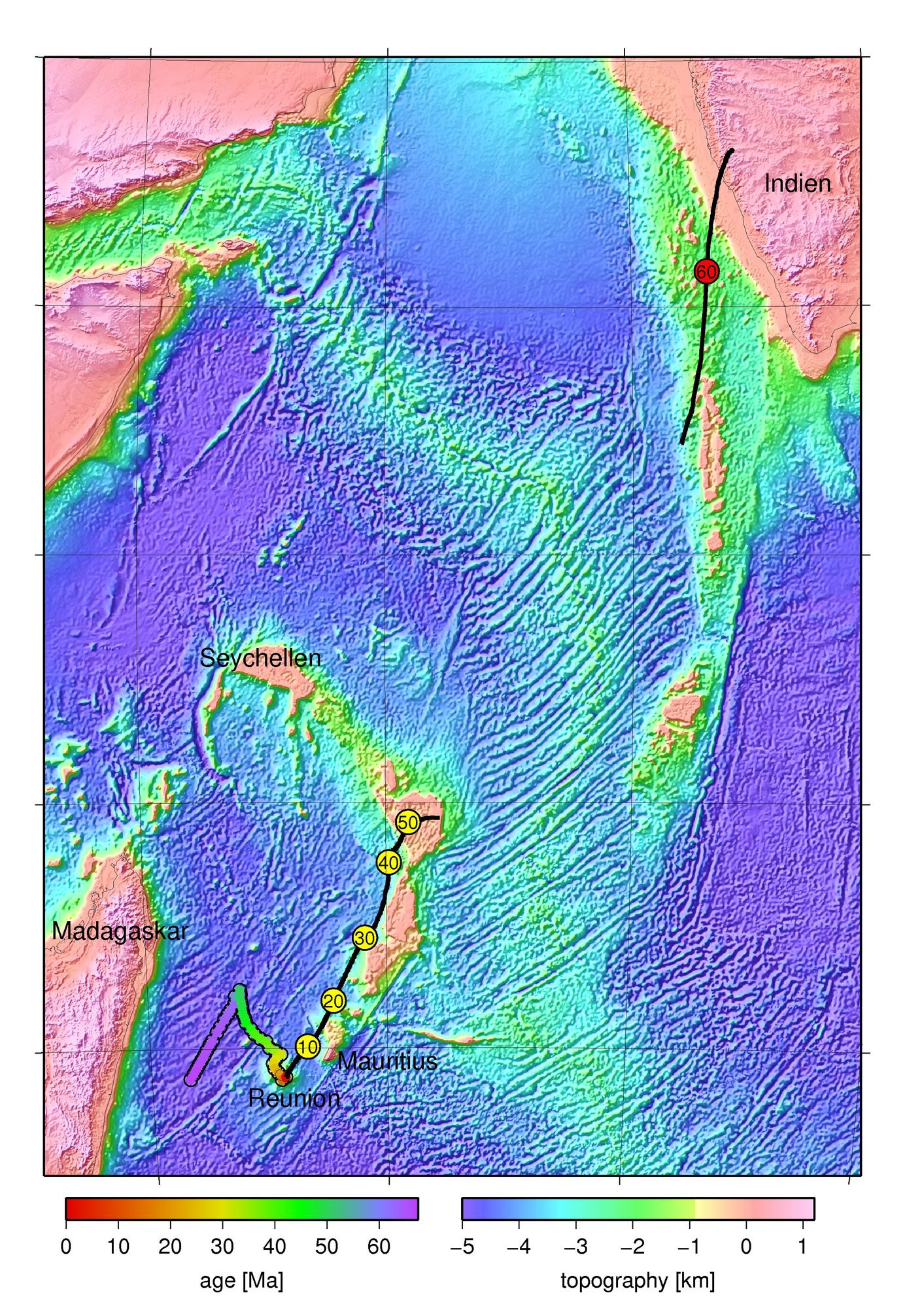
    Continents Hidden Under Lava in the Indian Ocean
    The colored track (left color scale) west of Reunion is the calculated movement of the Reunion hotspot. The black lines with yellow circles and the red circle indicate the corresponding calculated track on the African plate and the Indian plate, respectively. The numbers in the circles are ages in millions of years. The areas with topography just below the sea surface are now regarded as continental fragments. Credit: GFZ/Steinberger

    Based on the study of lava sand grains from the beach of Mauritius, a newly published study from a group of geoscientists suggests that a micro-continent is hidden under lava in the Indian Ocean.

    The islands Reunion and Mauritius, both well-known tourist destinations, are hiding a microcontinent, which has now been discovered. The continent fragment known as Mauritia detached about 60 million years ago while Madagascar and India drifted apart, and had been hidden under huge masses of lava. Such micro-continents in the oceans seem to occur more frequently than previously thought, says a study in the latest issue of Nature Geosciences (“A Precambrian microcontinent in the Indian Ocean”).

    The break-up of continents is often associated with mantle plumes: These giant bubbles of hot rock rise from the deep mantle and soften the tectonic plates from below, until the plates break apart at the hotspots. This is how Eastern Gondwana broke apart about 170 million years ago. At first, one part was separated, which in turn fragmented into Madagascar, India, Australia, and Antarctica, which then migrated to their present position.

    Plumes currently situated underneath the islands Marion and Reunion appear to have played a role in the emergence of the Indian Ocean. If the zone of the rupture lies at the edge of a land mass (in this case Madagascar / India), fragments of this land mass may be separated off. The Seychelles are a well-known example of such a continental fragment.

    A group of geoscientists from Norway, South Africa, Britain and Germany have now published a study that suggests, based on the study of lava sand grains from the beach of Mauritius, the existence of further fragments. The sand grains contain semi-precious zircons aged between 660 and 1970 million years, which is explained by the fact that the zircons were carried by the lava as it pushed through subjacent continental crust of this age.

    This dating method was supplemented by a recalculation of plate tectonics, which explains exactly how and where the fragments ended up in the Indian Ocean. Dr. Bernhard Steinberger of the GFZ German Research Center for Geosciences and Dr. Pavel Doubrovine of Oslo University calculated the hotspot trail: “On the one hand, it shows the position of the plates relative to the two hotspots at the time of the rupture, which points towards a causal relation,” says Steinberger. “On the other hand, we were able to show that the continent fragments continued to wander almost exactly over the Reunion plume, which explains how they were covered by volcanic rock.” So what was previously interpreted only as the trail of the Reunion hotspot, are continental fragments that were previously not recognized as such because they were covered by the volcanic rocks of the Reunion plume. It, therefore, appears that such micro-continents in the ocean occur more frequently than previously thought.

    Reference: “A Precambrian microcontinent in the Indian Ocean” by Trond H. Torsvik, Hans Amundsen, Ebbe H. Hartz, Fernando Corfu, Nick Kusznir, Carmen Gaina, Pavel V. Doubrovine, Bernhard Steinberger, Lewis D. Ashwal and Bjørn Jamtveit, 24 February 2013, Nature Geoscience.
    DOI: 10.1038/NGEO1736

    Never miss a breakthrough: Join the SciTechDaily newsletter.
    Follow us on Google and Google News.

    Geoscience GFZ German Research Center for Geosciences
    Share. Facebook Twitter Pinterest LinkedIn Email Reddit

    Related Articles

    Popular Myth Busted – New Findings Challenge Old Earthquake Models

    Antarctic Orca Submarine Volcano Blasted by Swarm of 85,000 Earthquakes

    Coral Reveals Lead Levels from Gasoline in the Ocean

    Ancient Antarctica Was Much Warmer and Wetter Than Previously Suspected

    Geological Record Shows Earth’s Oxygen Came from Mantle Cooling

    Earth Recovered 10 Million Years After Permian-Triassic Mass Extinction

    1930s Photos Reveal History of Greenland Glaciers

    Circumpolar Rivers are a Major Source of Mercury in the Arctic Ocean

    Billion Year Old Surface Water Found in Oceanic Plates

    Leave A Reply Cancel Reply

    • Facebook
    • Twitter
    • Pinterest
    • YouTube

    Don't Miss a Discovery

    Subscribe for the Latest in Science & Tech!

    Trending News

    Popular Sugar-Free Sweetener Linked to Liver Disease, Study Warns

    What Is Hantavirus? The Deadly Disease Raising Alarm Worldwide

    Scientists Just Discovered How the Universe Builds Monster Black Holes

    Scientists Unveil New Treatment Strategy That Could Outsmart Cancer

    A Simple Vitamin May Hold the Key to Treating Rare Genetic Diseases

    Scientists Think the Real Fountain of Youth May Be Hiding in Your Gut

    Ravens Don’t Follow Wolves, They Predict Them

    This Common Knee Surgery May Be Doing More Harm Than Good

    Follow SciTechDaily
    • Facebook
    • Twitter
    • YouTube
    • Pinterest
    • Newsletter
    • RSS
    SciTech News
    • Biology News
    • Chemistry News
    • Earth News
    • Health News
    • Physics News
    • Science News
    • Space News
    • Technology News
    Recent Posts
    • This Dazzling Green Snake Was Hiding in Plain Sight for Decades
    • Scientists Discover That a Single Dose of Psilocybin Changes the Human Brain
    • “Totally Unexpected” – Scientists Discover Pancreatic Cancer’s Fatal Addiction
    • A Strange Quantum Effect May Explain One of Biology’s Greatest Mysteries
    • NASA’s Psyche Spacecraft Is About To Fly Shockingly Close to Mars
    Copyright © 1998 - 2026 SciTechDaily. All Rights Reserved.
    • Science News
    • About
    • Contact
    • Editorial Board
    • Privacy Policy
    • Terms of Use

    Type above and press Enter to search. Press Esc to cancel.