
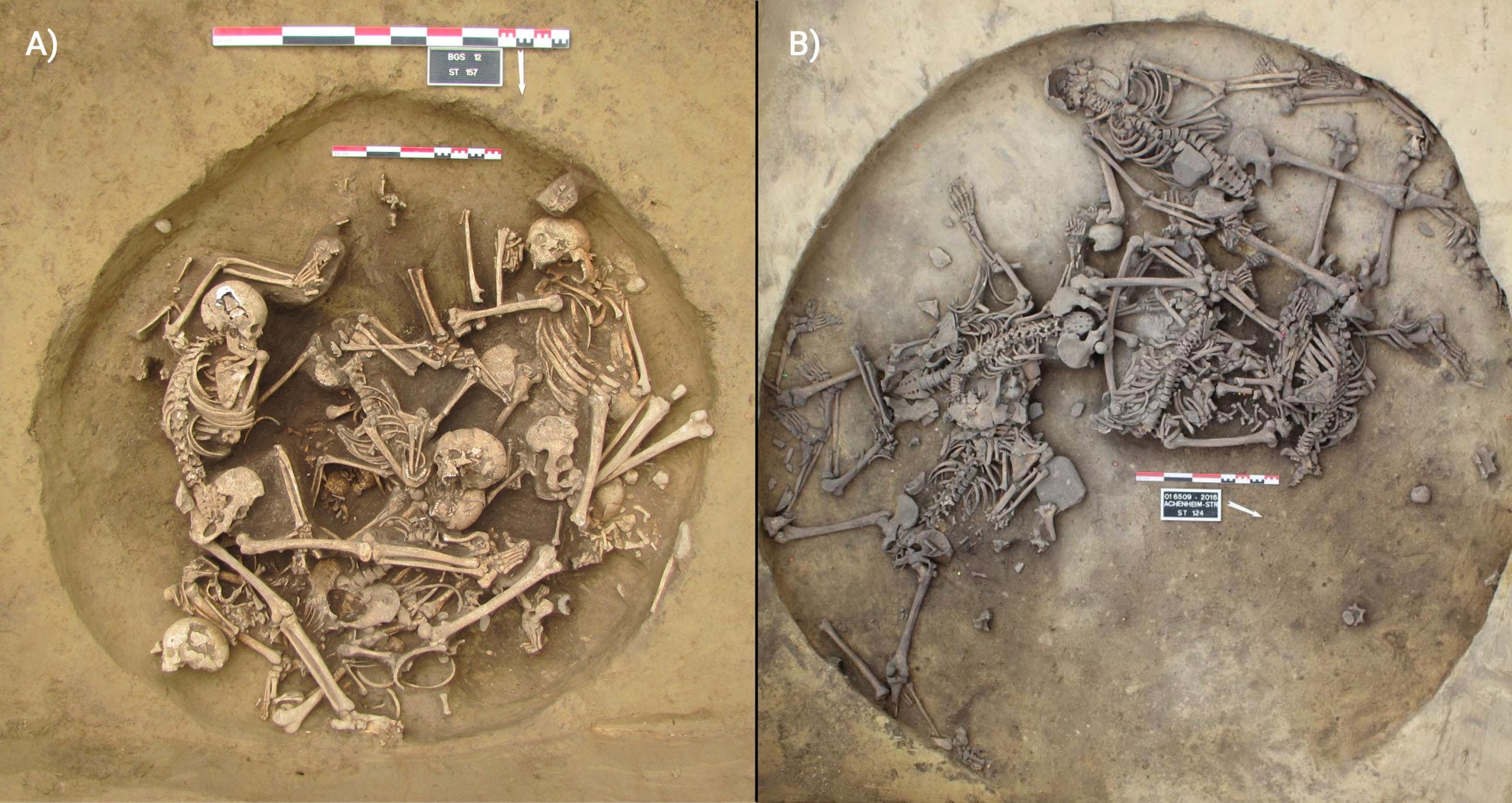
Ancient bones from France reveal that Neolithic wars may have ended in ritualized executions and trophy-taking. The evidence suggests violence was staged to display dominance and unite communities.
A new study in Science Advances is reshaping ideas about prehistoric conflict. By closely examining the remains of people buried in mass graves, researchers have reconstructed the identities and life histories of individuals who may have died during one of the earliest known victory celebrations in Europe.
The study, “Multi-isotope biographies and identities of victims of martial victory celebrations in Neolithic Europe,” was published in Science Advances and co-authored by Dr. Teresa Fernández-Crespo and Professor Rick Schulting. The team applied advanced multi-isotope analysis to human remains discovered in Alsace in northeastern France. The graves date to approximately 4300–4150 BCE.
Rethinking Prehistoric Violence
The results challenge the long-standing view that violence in the Neolithic period was random or purely practical. Instead, the evidence suggests that some acts of brutality carried social and symbolic meaning.
Excavations at Achenheim and Bergheim uncovered disturbing scenes. Archaeologists found full skeletons bearing signs of intense and repeated violence, along with pits filled with severed left upper limbs. This combination of extreme force and removed body parts differed from what is typically seen in known Neolithic massacres or executions. The researchers argue that these deaths were likely part of organized post-conflict rituals designed to disgrace defeated enemies and strengthen bonds within the victorious group.
Isotope Analysis Reveals Outsiders
To determine who these individuals were, scientists compared isotopic markers in the victims’ bones and teeth with those from people given standard burials. These chemical signatures provide insight into diet, movement, and physical stress throughout a person’s life.
The analysis showed clear contrasts. The victims had different dietary habits and signs of greater mobility and physiological strain, indicating they were probably not local residents.
Evidence of a Two-Tiered Ritual
The isotope data also revealed an important distinction. The severed limbs, believed to have come from fallen fighters, carried local isotopic signatures. In contrast, the individuals whose complete skeletons showed signs of torture appeared to originate from more distant regions.
This pattern supports the idea of a two-level ritual. Local enemies killed in battle were dismembered, and their limbs were likely taken as trophies. Others, probably captives from outside the region, were subjected to violent executions. Researchers interpret these acts as a form of Neolithic political theatre meant to send a powerful message.
Professor Schulting said: “These findings speak to a deeply embedded social practice -one that used violence not just as warfare, but as spectacle, memory, and assertion of dominance.”
War, Ritual, and Social Identity in the Neolithic
By shedding light on the social and cultural roles of violence during the Neolithic period, the study adds an important dimension to our understanding of early European societies. It suggests that warfare was closely tied to ritual and public display, shaping how communities defined themselves and their enemies.
Reference: “Multi-isotope biographies and identities of victims of martial victory celebrations in Neolithic Europe” by Teresa Fernández-Crespo, Christophe Snoeck, Javier Ordoño, Philippe Lefranc, Bertrand Perrin, Fanny Chenal, Hélène Barrand-Emam, Rick J. Schulting and Gwenaëlle Goude, 20 August 2025, Science Advances.
DOI: 10.1126/sciadv.adv3162
The research was supported by a Marie Skłodowska-Curie Actions individual grant from the European Union’s Horizon 2020 research and innovation program, awarded to Dr. Fernández-Crespo. The project involved collaboration among multiple institutions, including the CNRS, Aix Marseille University, and Minist Culture, LAMPEA in Aix-en-Provence, France; the School of Archaeology at the University of Oxford, UK; the Department of Chemistry at Vrije Universiteit Brussel, Belgium; the Department of Archaeology and New Technologies at Arkikus, Spain; ANTEA-Archéologie, France; the University of Strasbourg, France; UMR 7044 Archimède, University of Strasbourg, France; and Inrap Grand Est, France.
Never miss a breakthrough: Join the SciTechDaily newsletter.
Follow us on Google and Google News.
5 Comments
Why wouldn’t it? If the Aztec culture was extremely violent, why earlier should be any less?
Steven Pinker has shown how violence in the past was more common than today
Woodland Indians in the now US would roast prisoners. They’d erect a post, bind the prisoner’s upper body, place a thong around his neck tied to the post long enough to allow him to walk around, and build a fire hot enough to torture the prisoner and slowly burn the man to death.
They did it to Indian prisoners as well. Really noble those savages.
This makes sense. When you look at the customs of Celts and Germans, as chronicled by Greeks and Romans, this type of celebratory or ritual execution was common, as many Roman legionaries discovered to their grief. The question I’ve always had was where did this wide-spread behavior come from. This study clearly indicates it existed for millennia before these people’s behavior was noted by ancient historians. The real question is, and I suspect I know the answer, do we all have this type of behavior coded into our primitive brain? This type of behavior is not unknown to modern man. Perhaps it developed from our more primate ancestors (do modern primates engage in post combat ritual dismemberment?) and was successfully passed down from generation to generation as a useful tool?
What do you expect from cultured Animals. Wouldn’t take a genius to figure it happens quite frequently throughout history:))
Only nine meals stand between civilization and anarchy. This tells you everything you need to know about humanity.