
Close Menu
    Facebook X (Twitter) Instagram
    SciTechDaily
    • Biology
    • Chemistry
    • Earth
    • Health
    • Physics
    • Science
    • Space
    • Technology
    Facebook X (Twitter) Pinterest YouTube RSS
    SciTechDaily
    Home»Science»Pterosaur Rhamphorhynchus Being Eaten by Ganoid Fish Aspidorhynchus Fossilized
    Science

    Pterosaur Rhamphorhynchus Being Eaten by Ganoid Fish Aspidorhynchus Fossilized

    By SciTechDailyMarch 12, 2012No Comments3 Mins Read
    Facebook Twitter Pinterest Telegram LinkedIn WhatsApp Email Reddit
    Share
    Facebook Twitter LinkedIn Pinterest Telegram Email Reddit
    pterosaur-eaten-ganoid-fish
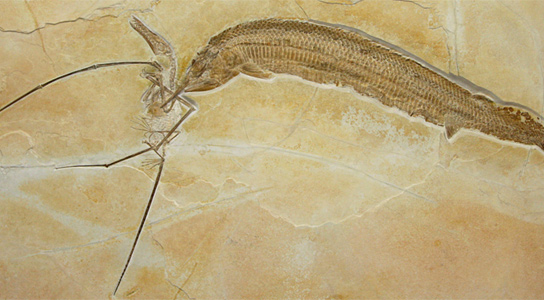
     A pterosaur in the process of being devoured by a ganoid fish.

    This incredible fossil, depicting a pterosaur in the process of being devoured by a ganoid fish, was recently showcased in a new study published in PLoS ONE. Pterosaurs aren’t dinosaurs, but flying reptiles of the Mesozoic era. Most of the fossilized specimens come from the Middle Jurassic to the Early Cretaceous periods.

    Many of the soft tissue features of pterosaurs can be reconstructed today, but the food and feeding habits of these vertebrate flying animals remain speculative because fossilized intestinal contents are exceedingly rare. For the first time, the study reports the unusual association of the predatory fish Aspidorhynchus and the long-tailed pterosaur Rhamphorhychus from the Late Jurassic which was preserved in Solnhofen Limestone, in Bavaria, Southern Germany.
    pterosaur-leptolepides-ganoid-fish
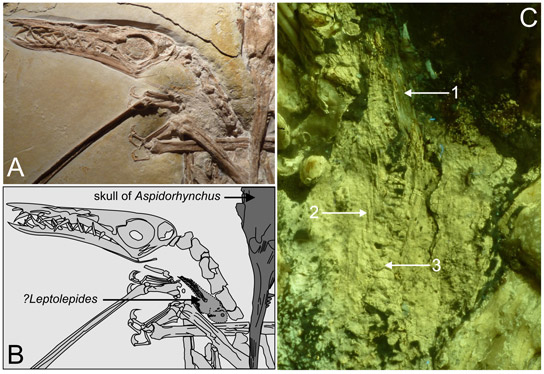
    Predator and prey; the final meal of a Rhamphorhynchus is still sticking in the pharynx. The straight vertebral column and the closed tail fin, which is orientated towards the mouth cavity suggests that the Leptolepides was not regurgitated during the agony of the pterosaur. Furthermore, the prey does not show any trace of digestion. A) photograph of the specimen WDC CSG 255 showing the position of the Leptolepides in the throat of the Rhamyphorhychus. To the right-hand side the skull of the Aspidorhynchus is visible. B) line drawing of (A), C) close-up of Leptolepides under filtered UV light: 1 caudal fin, 2 neural spines, 3 vertebral columns.

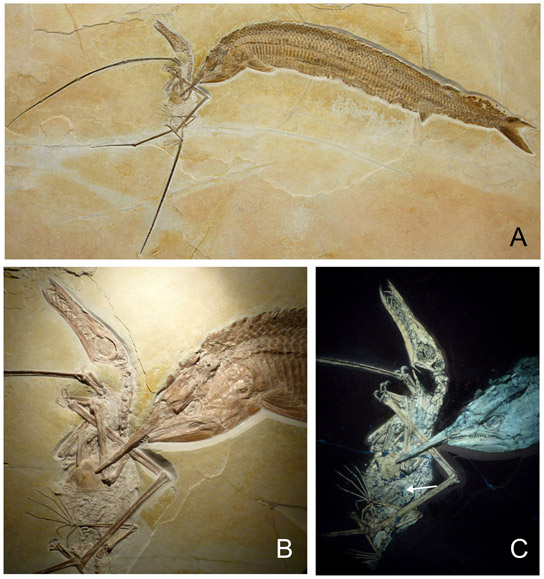
    The fossil proves that Rhamphorhynchus was the prey of Aspidorhynchus, and because of lethal accidental interaction, both perished. Four additional Rhamphorhynchus specimens have been found entangled with large Aspidorhynchus. None of them proved that Rhamphorhynchus was alive at the time of capture, which is what this fossil proves.

    This behavior of the Aspidorhynchus is supposed to be typical of that era and it is somewhat reminiscent of great white sharks jumping out of the depths to catch sea-birds in South African waters.
    composite-pterosaur-ganoid
    Fossilized hunting scene; A) specimen WDC CSG 255: an Aspidorhynchus and a Rhamphorhynchus in fatal encounter, B) section of the specimen showing the way both animals are entangled. Note that the jaws of the Aspidorhynchus did not get hold of a bone, but apparently of the flight membrane of the left wing. The distorted left wing finger is suggestive for this. C) A similar section under UV light, the arrow marks intestinal contents consisting of digested fish remains.

    Reference: “The Late Jurassic Pterosaur Rhamphorhynchus, a Frequent Victim of the Ganoid Fish Aspidorhynchus?” by Eberhard Frey and Helmut Tischlinger, 7 March 2012, PLoS ONE.
    DOI: 10.1371/journal.pone.0031945

    Never miss a breakthrough: Join the SciTechDaily newsletter.
    Follow us on Google and Google News.

    Cretaceous Period Fish Ganoid Fish Late Jurassic Middle Jurassic Paleontology Predator Pterosaur
    Share. Facebook Twitter Pinterest LinkedIn Email Reddit

    Related Articles

    Agile Fliers: Newly-Hatched Pterosaurs May Have Been Able To Fly

    “Monkeydactyl” – Strange New Jurassic Flying Reptile Reveals the Oldest Opposable Thumbs

    Enormous Ancient Fish Discovered by Accident – Bizarre-Looking and “Absolutely Massive!”

    Scientists Trace the Origin of Our Teeth to Primitive Fish More Than 400 Million Years Back in Time

    Paleontologists Discover Never-Before-Seen Ancient Fish Species

    Scientists Discover a New Kind of Extinct Flying Reptile

    New Insight on Pterosaur Specimen, Istiodactylus Latidens

    Cretaceous Period Pterosaur Discovered in Northeast China

    Jurassic Period Super-Sized Fleas Had Armored Mouthparts to Attack the Thick Hide of Dinosaurs

    Leave A Reply Cancel Reply

    • Facebook
    • Twitter
    • Pinterest
    • YouTube

    Don't Miss a Discovery

    Subscribe for the Latest in Science & Tech!

    Trending News

    The Universe Is Expanding Too Fast and Scientists Can’t Explain Why

    “Like Liquid Metal”: Scientists Create Strange Shape-Shifting Material

    Early Warning Signals of Esophageal Cancer May Be Hiding in Plain Sight

    Common Blood Pressure Drug Shows Surprising Power Against Deadly Antibiotic-Resistant Superbug

    Scientists Uncover Dangerous Connection Between Serotonin and Heart Valve Disease

    Scientists Discover a “Protector” Protein That Could Help Reverse Hair Loss

    Bone-Strengthening Discovery Could Reverse Osteoporosis

    Scientists Uncover Hidden Trigger Behind Stem Cell Aging

    Follow SciTechDaily
    • Facebook
    • Twitter
    • YouTube
    • Pinterest
    • Newsletter
    • RSS
    SciTech News
    • Biology News
    • Chemistry News
    • Earth News
    • Health News
    • Physics News
    • Science News
    • Space News
    • Technology News
    Recent Posts
    • Scientists Overcome Major Quantum Bottleneck, Potentially Transforming Teleportation and Computing
    • Quantum Physics’ Strangest Problem May Hold the Key to Time Itself
    • Scientists Create “Liquid Gears” That Spin Without Touching
    • The Simple Habit That Could Help Prevent Cancer
    • Forgotten Medicinal Plant Shows Promise in Fighting Dangerous Superbugs
    Copyright © 1998 - 2026 SciTechDaily. All Rights Reserved.
    • Science News
    • About
    • Contact
    • Editorial Board
    • Privacy Policy
    • Terms of Use

    Type above and press Enter to search. Press Esc to cancel.