

A team of scientists at the University of Utah has designed a flat lens that matches the power of traditional curved lenses while eliminating color distortions.
Using microscopic rings to manipulate light, this breakthrough could make space telescopes and astrophotography equipment much lighter and more practical.
Rethinking Traditional Lenses
For centuries, lenses have relied on curved glass or plastic to bend light and bring images into focus. However, the more powerful a lens needs to be, the larger and heavier it becomes. Scientists have long sought a way to create lightweight lenses without compromising performance. While some thinner alternatives exist, they often come with limitations and are difficult and expensive to produce.
A New Kind of Flat Lens
A research team led by University of Utah engineering professor Rajesh Menon has developed a promising new solution: a large-aperture flat lens that focuses light as effectively as traditional curved lenses while maintaining accurate color. This breakthrough could revolutionize astrophotography and telescope design, particularly for applications where minimizing size and weight is critical, such as on aircraft, satellites, and space-based telescopes.
Their latest study, featured on the cover of the journal Applied Physics Letters, was led by Menon Lab member Apratim Majumder, a research assistant professor in the Department of Electrical & Computer Engineering. Coauthors include fellow Menon Lab members Alexander Ingold and Monjurul Meem, Department of Physics & Astronomy’s Tanner Obray and Paul Ricketts, and Nicole Brimhall of Oblate Optics.
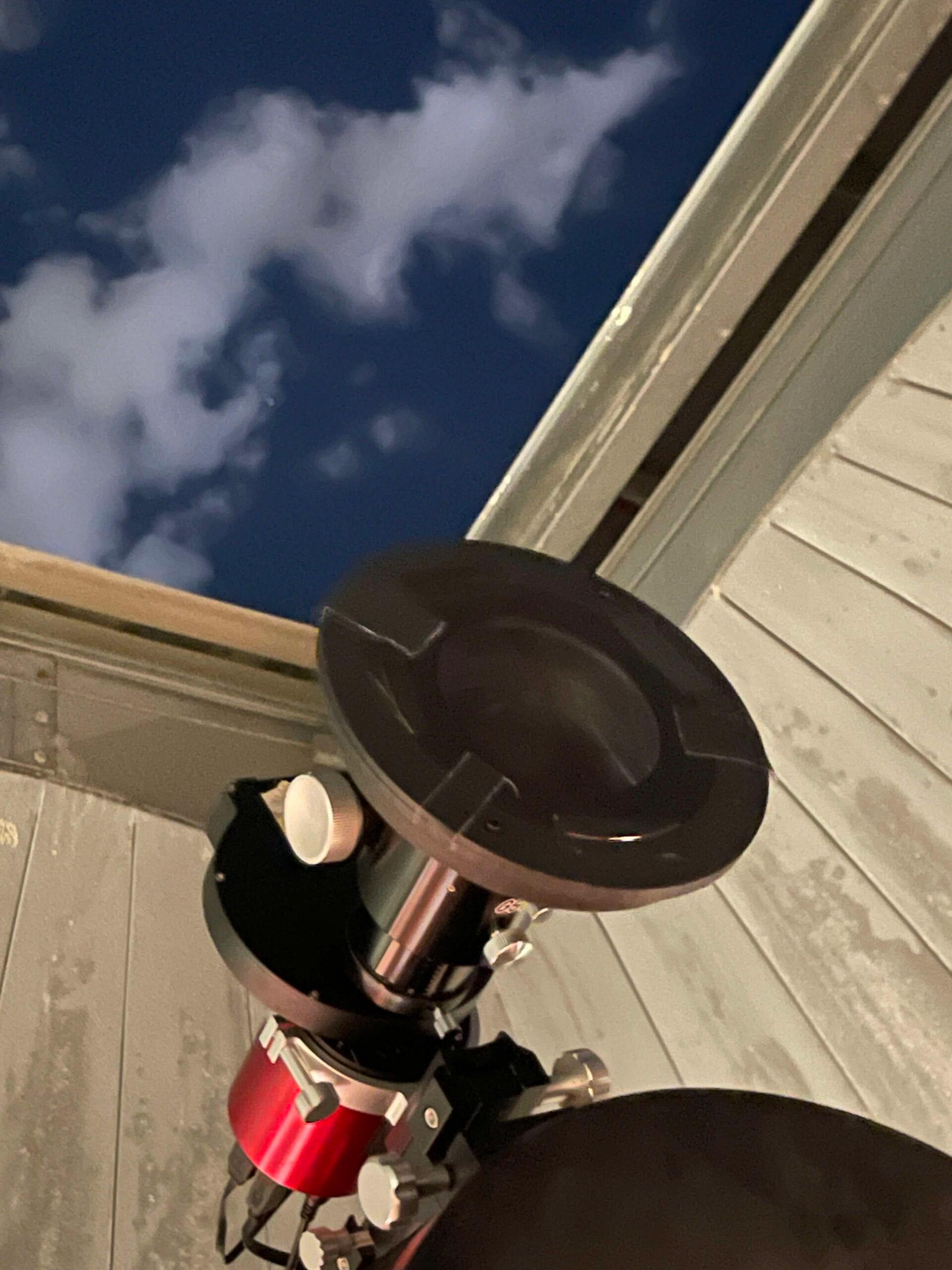
Breaking the Bulk Barrier
If you’ve ever used a magnifying glass, you know that lenses bend light to make objects appear larger. The thicker and heavier the lens, the more it bends the light, and the stronger the magnification. For everyday cameras and backyard telescopes, lens thickness isn’t a huge problem. But when telescopes must focus light from galaxies millions of light-years away, the bulk of their lenses become impractical. That’s why observatory and space-based telescopes rely on massive, curved mirrors instead to achieve the same light-bending effect since they can be made much thinner and lighter than lenses.
The Limitations of Flat Lenses
Scientists have also tried to solve the bulkiness problem by designing flat lenses, which manipulate light in a different way. One existing type, called a Fresnel zone plate (FZP), uses concentric ridges to focus light, rather than a thick, curved surface. While this method does create a lightweight and compact lens, it comes with a tradeoff: it can’t produce true colors. Rather than bending all of the wavelengths of visible light at the same angle, the ridges of an FZP diffract them at different angles, resulting in an image with chromatic aberrations, or color distortions.

A Revolutionary Approach to Light Bending
Enter Rajesh Menon and his team at the U. Their new flat lens offers the same light-bending power as traditional curved lenses while avoiding the color distortions of FZPs.
“Our computational techniques suggested we could design multi-level diffractive flat lenses with large apertures that could focus light across the visible spectrum and we have the resources in the Utah Nanofab to actually make them,” said Menon, who directs the U’s Laboratory for Optical Nanotechnologies.
Engineering a High-Precision Optical Solution
The key innovation lies in the microscopically small concentric rings that the researchers can pattern on the substrate. Unlike the ridges of FZPs, which are optimized for a single wavelength, the size and spacing of the flat lens’ indentations keep the diffracted wavelengths of light close enough together to produce a full-color, in-focus image.
“Simulating the performance of these lenses over a very large bandwidth, from visible to near-infrared, involved solving complex computational problems involving very large datasets,” Majumder said. “Once we optimized the design of the lens’ microstructures, the manufacturing process required very stringent process control and environmental stability.”
Transforming Astronomy and Beyond
A large, flat, color-accurate lens could have massive implications across industries, but its most immediate application is in astronomy. The researchers demonstrated the capabilities of their flat lens with test images of the sun and moon.
“Our demonstration is a stepping stone towards creating very large aperture lightweight flat lenses with the capability of capturing full-color images for use in air-and-space-based telescopes,” Majumder said.
Reference: “Color astrophotography with a 100 mm-diameter f/2 polymer flat lens” by Apratim Majumder, Monjurul Meem, Alexander Ingold, Paul Ricketts, Tanner Obray, Nicole Brimhall and Rajesh Menon, 3 February 2025, Applied Physics Letters.
DOI: 10.1063/5.0242208
This research was supported by the Defense Advanced Research Projects Agency, or DARPA, (FA8650-20-C-7020 P00001), the Office of Naval Research (N00014-22-1-2014), and NASA (NNL16AA05C). This content is solely the responsibility of the authors and does not necessarily represent the official views of these funding agencies. Monjurul Meem is now a process engineer at Intel.
Never miss a breakthrough: Join the SciTechDaily newsletter.
Follow us on Google and Google News.