
Close Menu
    Facebook X (Twitter) Instagram
    SciTechDaily
    • Biology
    • Chemistry
    • Earth
    • Health
    • Physics
    • Science
    • Space
    • Technology
    Facebook X (Twitter) Pinterest YouTube RSS
    SciTechDaily
    Home»Science»Researchers Discover “Unusually Well-Preserved” Mummy in Church Crypt
    Science

    Researchers Discover “Unusually Well-Preserved” Mummy in Church Crypt

    By FrontiersMay 18, 20253 Comments5 Mins Read
    Facebook Twitter Pinterest Telegram LinkedIn WhatsApp Email Reddit
    Share
    Facebook Twitter LinkedIn Pinterest Telegram Email Reddit
    The ‘Air Dried Chaplain’
    The mummy of the ‘air-dried chaplain’ in his coffin in the church crypt of St. Thomas am Blasenstein, Austria. Credit: Andreas Nerlich. Credit: Andreas Nerlich

    Researchers discovered a centuries-old mummy in Austria that was exceptionally well preserved, likely due to a previously undocumented embalming technique involving wood chips, twigs, fabric, and zinc chloride.

    For centuries, cultures around the world have practiced embalming, often for religious purposes. While embalming methods vary widely, not all have been equally studied.

    In a first-of-its-kind report, an international team of researchers examined a mummy from a small village in Austria. Their detailed analysis revealed previously undocumented mummification techniques and led to the identification of the individual.

    “The unusually well-preserved mummy in the church crypt of St Thomas am Blasenstein is the corps of a local parish vicar, Franz Xaver Sidler von Rosenegg, who died in 1746,” said Dr Andreas Nerlich, a pathologist at Ludwig-Maximilians-Universität and first author of the Frontiers in Medicine article. “Our investigation uncovered that the excellent preservation status came from an unusual type of embalming, achieved by stuffing the abdomen through the rectal canal with wood chips, twigs, and fabric, and the addition of zinc chloride for internal drying.”
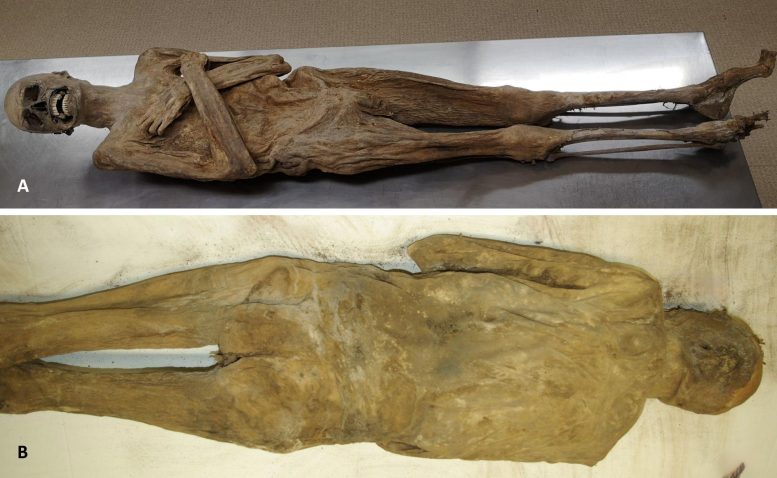
    External Appearance of the Mummy
    External appearance of the mummy from the ventral (A) and dorsal side (B) showing a completely intact body wall. Credit: Andreas Nerlich

    A different type of embalming

    The team carried out extensive analyses, including CT scans, a focal autopsy, and radiocarbon dating. They found the mummy’s upper body to be fully intact, while the lower limbs and head showed significant post-mortem decay.

    During their investigation, the researchers found a variety of foreign material packed in the abdominal and pelvic cavity. Upon opening the body, the team identified wood chips from fir and spruce, fragments of branches, as well as different fabrics, including linen, hemp, and flax. All these materials were easily available at that time and in that region.
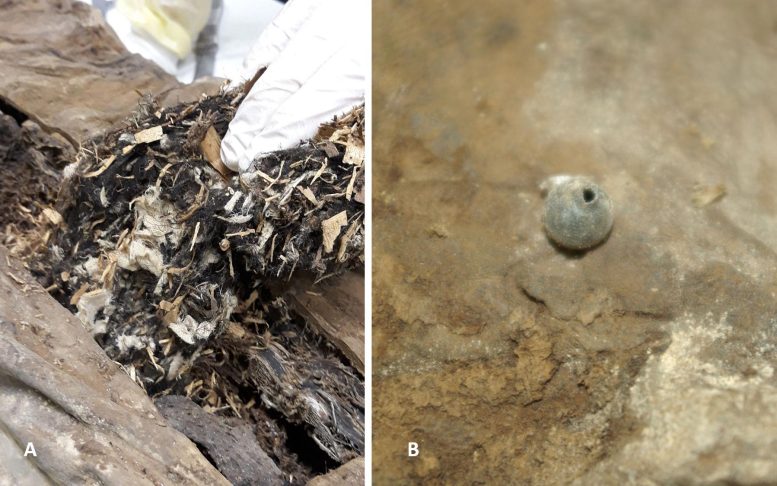
    Foreign Material Found in Mummy
    Left: Removal of parts of the foreign material from the dorsal abdominal wall revealed a mixture of fragmented white fabric, small wood chips, and plant material along with some brownish amorphous tissue residues. Right: The round foreign sphere detected in the left pelvis had a small hole with a raised lip. Credit: Andreas Nerlich

    The researchers believe it is this mixture of materials that kept the mummy in such good condition. “Clearly, the wood chips, twigs, and dry fabric absorbed much of the fluid inside the abdominal cavity,” said Nerlich. Next to these absorbents, a toxicological analysis showed traces of zinc chloride, which has a strong drying effect.

    This way of embalming is different to better-known methods where the body is opened to prepare it. Here, however, the embalming materials were inserted via the rectum. “This type of preservation may have been much more widespread but unrecognized in cases where ongoing postmortal decay processes may have damaged the body wall so that the manipulations would not have been realized as they were,” Nerlich pointed out.
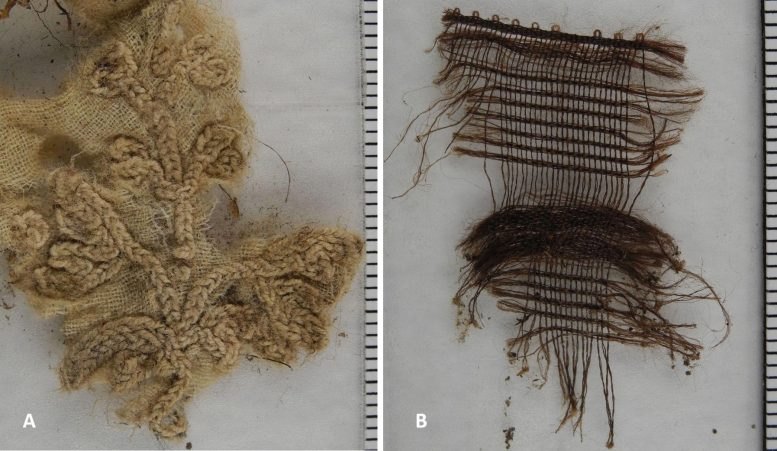
    Fabric Found in the Mummy’s Abdominal Cave
    Further findings of special fabric tissue from the material detected in the mummy’s abdominal cave: Left: A piece of cotton with an elaborate floral pattern. Right: Fragment of a silk fabric such as used for the mummy’s cross. Credit: Andreas Nerlich

    Inside the mummy, the researchers also found a small glass sphere with holes on both ends – perhaps an application to fabric of monastic origin. Since only a single bead was found, it might have been lost during the preparation of the body.

    Tracing a life

    The mummy was long rumored to belong to Sidler, but the origin of these rumors is unknown. It was, however, only the current investigation that provided certainty as to its identity. “The identification of the mummy comes from our interdisciplinary analysis, especially with the radiocarbon dating, his body activity pattern, and the stable isotope pattern,” Nerlich said.
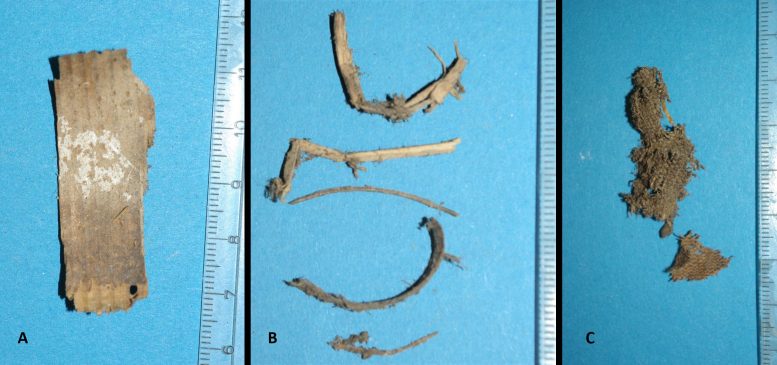
    Packing Material
    Analysis of the packing material obtained during the partial autopsy of the abdomen revealed A: Typical wood chip. B: Twigs of various plants. C: Small fragment of a simple fabric made of hemp or flax. Credit: Andreas Nerlich

    These analyses showed that the mummy died most likely aged between 35 and 45 years old and most probably between 1734 and 1780. These dates match Sidler’s life. In addition, they suggested Sidler ate a high-quality diet based on central European grains, animal products, and possibly inland fish. Towards the end of his life, he may have experienced food shortages, likely due to the War of the Austrian Succession. The lack of major signs of stress on the skeleton fits the life of a priest without hard physical activity. There was also evidence of a long-term smoking habit, and lung tuberculosis towards the end of his life.

    “We have some written evidence that cadavers were ‘prepared’ for transport or elongated laying-out of the dead – although no report provides any precise description,” Nerlich concluded. “Possibly, the vicar was planned for transportation to his home abbey, which might have failed for unknown reasons.”

    Reference: “The mystery of the “air-dried chaplain” solved: the life and “afterlife” of an unusual human mummy from eighteenth century Austria” by Andreas G. Nerlich, Peter Hofer, Stephanie Panzer, Christine Lehn, Judith Wimmer, Oskar Nowak, Frank Musshoff and Oliver K. Peschel, 14 March 2025, Frontiers in Medicine.
    DOI: 10.3389/fmed.2025.1560050

    Never miss a breakthrough: Join the SciTechDaily newsletter.
    Follow us on Google and Google News.

    Archaeology Forensics Frontiers Mummy
    Share. Facebook Twitter Pinterest LinkedIn Email Reddit

    Related Articles

    What Do Mummies Smell Like? Researchers Finally Have the Answer

    Why Did She Scream? Scientists Unveil New Insights Into Mysterious 2,500-Year-Old Screaming Mummy

    Scientists Uncover a Brutal Murder From a Millennium Ago

    Mummy of Pharaoh Amenhotep I “Unwrapped” for the First Time in 3,000 Years – Here’s What Scientists Found

    Capuchin Catacombs: Solving the Mysteries of Palermo’s Child Mummies

    DNA Analysis Identifies First Member of Ill-Fated 1845 Franklin Expedition

    Unique Snapshot of Ancient Animal Mummification Through Advanced X-ray Imaging

    Scientists Use X-Rays and Infrared Light to Explore Egyptian Mummy Bones [Video]

    DNA Sequencing Solves 4,000-Year-Old Egyptian Mummy Mystery

    3 Comments

    1. Boba on May 18, 2025 5:13 pm

      He looks like he doesn’t get out much.

      Reply
    2. Ron on May 19, 2025 6:14 am

      Corpse is not spelled corps.

      Reply
    3. Eric M. Jones on May 19, 2025 8:20 am

      Let’s not put religious crap on this site. I don’t care about church mummies, the pope, or any of that stuff.

      Reply
    Leave A Reply Cancel Reply

    • Facebook
    • Twitter
    • Pinterest
    • YouTube

    Don't Miss a Discovery

    Subscribe for the Latest in Science & Tech!

    Trending News

    Scientists Warn That This Common Pet Fish Can Wreck Entire Ecosystems

    Scientists Make Breakthrough in Turning Plastic Trash Into Clean Fuel Using Sunlight

    This Popular Supplement May Interfere With Cancer Treatment, Scientists Warn

    Scientists Finally Solved One of Water’s Biggest Mysteries

    Could This New Weight-Loss Pill Disrupt the Entire Market? Here’s What You Should Know About Orforglipron

    Earth’s Crust Is Tearing Open in Africa, and It Could Form a New Ocean

    Breakthrough Bowel Cancer Trial Leaves Patients Cancer-Free for Nearly 3 Years

    Natural Compound Shows Powerful Potential Against Rheumatoid Arthritis

    Follow SciTechDaily
    • Facebook
    • Twitter
    • YouTube
    • Pinterest
    • Newsletter
    • RSS
    SciTech News
    • Biology News
    • Chemistry News
    • Earth News
    • Health News
    • Physics News
    • Science News
    • Space News
    • Technology News
    Recent Posts
    • Kratom Use Explodes in the US, With Life-Changing Consequences
    • Scientists Uncover Fatal Weakness in “Zombie Cells” Linked to Cancer
    • World-First Study Reveals Human Hearts Can Regenerate After a Heart Attack
    • Why Your Dreams Feel So Real Sometimes and So Strange Other Times
    • Scientists Debunk 100-Year-Old Belief About Brain Cells, Rewriting Textbooks
    Copyright © 1998 - 2026 SciTechDaily. All Rights Reserved.
    • Science News
    • About
    • Contact
    • Editorial Board
    • Privacy Policy
    • Terms of Use

    Type above and press Enter to search. Press Esc to cancel.