
The First Major Clinical Trial Is a Success for an App That Detects Jaundice in Infants.
According to a study co-authored by scientists at UCL (University College London) and the University of Ghana, a smartphone app that detects severe jaundice in newborn babies by scanning their eyes might save lives in places without access to costly screening tools.
Following a preliminary pilot trial on 37 infants at University College London Hospital (UCLH) in 2020, the neoSCB app, created by clinicians and engineers from UCL, was used to test for jaundice in almost 300 newborns in Ghana.
The researchers evaluated almost 300 infants using the app for the large-scale study, which was published in Pediatrics. The program analyzes pictures taken with a smartphone camera to measure the yellowness of the white area of the eye (sclera), an indication of newborn jaundice. It is inaccurate to judge the yellowness of the eye just by looking, but the neoSCB app may provide an early diagnosis of neonatal jaundice that has to be treated.
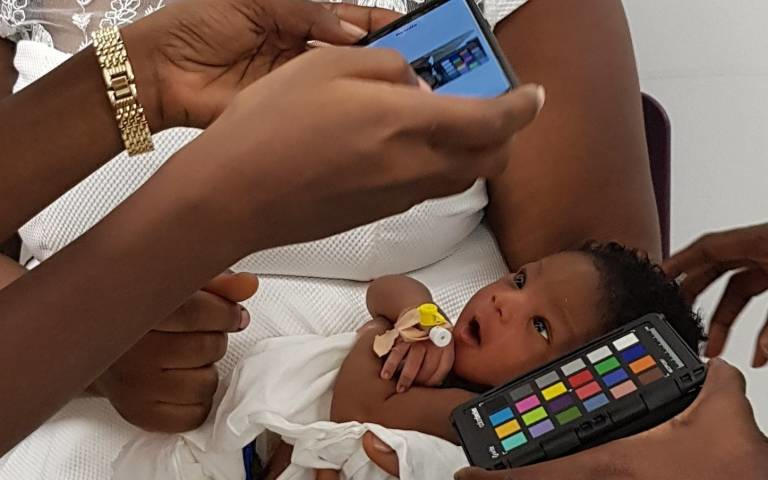
The study compared the effectiveness of the neoSCB app with conventional screening methods. Of the 336 babies tested by the app, 79 were severely jaundiced newborns, and the app correctly identified 74 of them. This is in line with the accuracy of the most common conventional screening method, a non-invasive device known as a transcutaneous bilirubinometer, which correctly identified 76.
The transcutaneous bilirubinometer works by measuring the yellow pigment under the newborn’s skin to give a measure of jaundice levels. All screening results are then followed up by blood tests to determine the type of treatment required.
Cost-Effective Alternative to Commercial Devices
Dr. Terence Leung (UCL Medical Physics & Biomedical Engineering) who developed the technology behind the app, said: “The study shows that the neoSCB app is as good as commercial devices currently recommended to screen for severely jaundiced newborns, but the app only requires a smartphone which costs less than a tenth of the commercial device. We hope that once rolled out widely, our technology can be used to save the lives of newborns in parts of the world that lack access to expensive screening devices.”
Study lead Dr. Christabel Enweronu-Laryea (University of Ghana Medical School) said: “The neoSCB method was acceptable to mothers in urban and rural communities where the study was conducted. Mothers easily devised ways to keep the baby’s eye open, most often by initiating breastfeeding.”
Jaundice, where the skin and whites of the eye turn yellow, is common in newborns and is usually harmless. The yellowness is caused by a substance called bilirubin, which in severe cases can enter the brain, leading to death or disabilities such as hearing loss, neurological conditions such as athetoid cerebral palsy, and developmental delays.
Every year severe jaundice causes about 114,000 newborn deaths and 178,000 cases of disability worldwide, despite it being a treatable condition. Most cases of neonatal jaundice occur in the first week after birth, and routine screening for early diagnosis in higher-income countries has reduced the risks of severe complications.
High Risk of Jaundice in Low-Income Regions
Newborns in low- and middle-income countries are typically at a greater risk of severe jaundice, or neonatal hyperbilirubinemia, because of the lack of resources required for screening. A commercial transcutaneous bilirubinometer typically costs around £4,000 ($4900) per device, and blood tests require a large amount of capacity. Additional factors such as a higher prevalence of home births and early postnatal discharge can contribute to fewer newborns going through screening.
Babies in sub-Saharan Africa are also at a greater risk because of a high prevalence of glucose-6-phosphate dehydrogenase (G6PD) deficiency, which is an inherited genetic disorder associated with an increased risk of hemolysis – where red blood cells break down at a faster rate than they are made – and hyperbilirubinemia.
Senior author Dr. Judith Meek (UCLH) added: “This app has the potential to prevent death and disability worldwide in many different settings. It will reduce unnecessary hospital visits and potentially empower community health workers and parents to care for newborn babies safely.”
In total, 724 newborns aged between 0 and 28 days were initially considered for the study. The 336 whose datasets were used for the paper had had no prior treatment for jaundice. Babies who were born at less than 35 weeks, were critically ill, or had a very low birth weight were excluded from the final study. The app was tested with frontline healthcare workers and the babies’ mothers, who provided feedback on the usability of the app.
Reference: “Validating a Sclera-Based Smartphone Application for Screening Jaundiced Newborns in Ghana” by Christabel Enweronu-Laryea, Terence Leung, Felix Outlaw, Nana Okai Brako, Genevieve Insaidoo, Nana Ayegua Hagan-Seneadza, Mary Ani-Amponsah, Miranda Nixon-Hill and Judith Meek, 1 July 2022, Pediatrics.
DOI: 10.1542/peds.2021-053600
The study was funded by the Saving Lives at Birth consortium and the EPSRC UCL Centre for Doctoral Training in Intelligent Integrated Imaging in Healthcare.
Never miss a breakthrough: Join the SciTechDaily newsletter.
Follow us on Google and Google News.