
Scientists have developed a groundbreaking atom interferometer capable of amplifying faint signals by 1,000 times — making it 50 times more sensitive than previous models.
This tool, which uses laser pulses to manipulate atoms, corrects for imperfections that have long hindered precision. With this innovation, researchers hope to detect ultra-weak forces from dark matter, dark energy, and gravitational waves.
Unlocking the Secrets of Dark Matter
If dark matter exists, its interactions with ordinary matter are so weak that even the most advanced instruments struggle to detect them.
Now, physicists at Northwestern University have developed a groundbreaking tool that amplifies extremely faint signals by 1,000 times — a 50-fold improvement over previous technology.
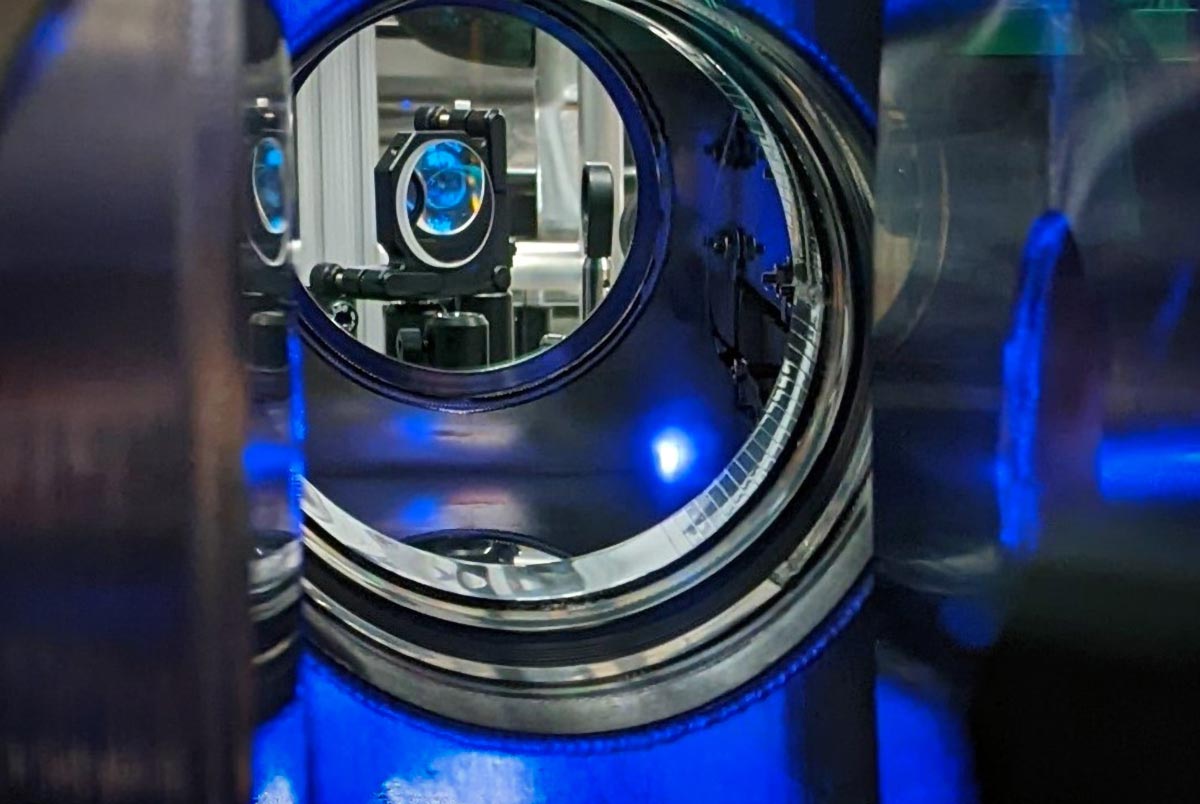
This device, known as an atom interferometer, uses light to manipulate atoms and measure incredibly small forces. Unlike earlier versions, which suffer from imperfections in the light itself, this new interferometer self-corrects for these flaws, achieving unprecedented precision.
A Game Changer for Dark Matter and More
By making previously undetectable signals measurable, this breakthrough could aid scientists in their search for ultra-weak forces linked to elusive phenomena such as dark matter, dark energy, and gravitational waves at unexplored frequencies.
“Dark matter is somewhat of an embarrassing problem,” said Northwestern’s Timothy L. Kovachy, who led the work, which was published in Physical Review Letters. “It’s a weird dichotomy because the ordinary matter that we encounter in everyday life, we understand extremely well. But that only makes up 15% of the matter in the universe. We don’t know the nature of the rest, which makes up most of the matter in the universe. So, it’s just a big incompleteness. Atom interferometers could potentially have a big impact in searching for this kind of dark matter.”
Kovachy is an assistant professor of physics and astronomy at Northwestern’s Weinberg College of Arts and Sciences and a member of the Center for Fundamental Physics.
What Is an Atom Interferometer?
Invented in 1991, atom interferometers take advantage of superposition, a fundamental principle in quantum mechanics that a particle can exist in multiple states simultaneously. In this case, an atom behaves like a wave that exists along two paths at once. In an atom interferometer, lasers split a wave-like atom into two waves, send those waves on two different paths, and then recombine them.
When the waves recombine, they create a pattern, which is like a fingerprint that reveals forces acting on the atoms. By studying this pattern, scientists can measure tiny, invisible forces and accelerations.
“Atom interferometers are really good at measuring small oscillations in distances,” Kovachy said. “We don’t know how strong dark matter is, so we want our instruments to be as sensitive as they can be. Because we haven’t ‘seen’ dark matter yet, we know its effects must be pretty weak.”
Challenges of Current Instruments
When working with waves this tiny, however, it doesn’t take much to disrupt the entire experiment. Even the tiniest imperfection can lead to errors in the interference pattern. A single photon, for example, can derail the wave-like atom’s path — kicking it off-course with a velocity of one centimeter per second.
“Photons can’t carry that much momentum, but atoms also don’t have that much mass,” Kovachy explained. “If we lose one atom, that doesn’t seem like the end of the world. But if we apply many laser pulses of light to boost the atom interferometer’s ability to amplify small signals, those errors will compound. And they will compound fast. In practice, we saw that after about 10 pulses, the signal was just gone.”
A ‘Self-Correcting’ System for Greater Precisionsystem
To overcome this challenge, Kovachy and his team developed a new technique to carefully orchestrate the sequence of laser pulses. Leveraging machine-learning approaches, the method “self-corrects” for the imperfections in individual pulses of light. By controlling the waveforms of laser pulses, the researchers reduced the overall effect of errors caused by imperfections in the experimental setup.
After testing the model in simulations, Kovachy’s team built the experiment in the lab. The experiments verified the signal was amplified by 1,000 times.
A New Era for Atom Interferometry
“Before, we could only do 10 laser pulses; now we can do 500,” Kovachy said. “This could be game-changing for many applications. The atom interferometer as an entire entity ‘self-corrects’ for the imperfections in each laser pulse. We can’t make each laser pulse perfect, but we can optimize the global sequence of pulses to correct for imperfections in each one. That could allow us to unlock the full potential of atom interferometry.”
Reference: “Robust Quantum Control via Multipath Interference for Thousandfold Phase Amplification in a Resonant Atom Interferometer” by Yiping Wang, Jonah Glick, Tejas Deshpande, Kenneth DeRose, Sharika Saraf, Natasha Sachdeva, Kefeng Jiang, Zilin Chen and Tim Kovachy, 11 December 2024, Physical Review Letters.
DOI: 10.1103/PhysRevLett.133.243403
Never miss a breakthrough: Join the SciTechDaily newsletter.
Follow us on Google and Google News.
17 Comments
Zero-mass vacuum quanta made of +/- mass dipoles carrying a “dark matter” effect face and a “dark energy” effect face is an overlooked explanation discussed by Lieu (“gravity without mass”).
The preference here is to visualize gravity quanta as radiated dipole particles, but maybe it’s simpler to explain gravity with radiated vacuum dipole state excitations, so it’s clearer there is no need to entertain the idea of collisions of vacuum quanta. Vacuum gravitational quanta/excitations naturally appear as unit-spin field vector particles (bosons) in any case.
It’s part of my response to the idea that it’s possible to marshal sufficient energy in one small place to make a graviton pop out of space there. Maybe it’s imagined in an ocean spray scenario, but it makes no sense to me because reality is either bound within some conceptual surface or it is on that surface.
If reality is on such a surface, then a quantum of space/gravity popping out would manifest as a practically invisible region of space/gravity disappearing, probably temporarily. It’s an interesting scenario, maybe more interesting than the alternative wherein the idea is meaningless.
So, where the quantum gravity rubber meets the road, a quantum of gravity/space showing a pull-phase adjacent a nucleus could conceivably collapse at that side of the nucleus and be replaced with a new quantum of gravity/space created on the other side.
A useful modification is to split the negative energy into two parts, creating a spin-2 quantum bi-pole that is basically a double-faced multi-pole. This cuts the stationary wavelength in half, effectively a squaring of a dot product between the path of gravity propagation and the angle of gravity carrier field rotation. A 90-degree rotation can impart no net gravitational pull.
The Sombrero galaxy is supposed to be about half the size of the Milky Way. That is part of what prompted in my mind the idea of spin-1 and spin-2 bosons as field vector energy di-poles and bi-poles.
For whatever reason, with flat galaxies it seems to me it’s a lot like snow-flakes and snow flurries for ellipticals, in that their sizes/masses tend to cluster around a few values, so often that one can get an idea of distance differences by looking at size differences between basic spiral galaxies.
“distance differences by looking at size differences”
This refers to apparent sizes of multiple flat galaxies in the same image.
In accordance with the Topological Vortex Theory (TVT), the microscopic domain unveils a labyrinthine intricacy and opulence that rivals the boundless cosmos.
A view of String Theory presents a nice description of why Dark Matter hasn’t (and won’t) be seen. You can see a YouTube explaining all this by looking up “Dark Matter – A String Theory Way”
Dark matter does not exist. JWST has proven that. Stop the nonsense and admit the truth.
Please excuse my ignorance but Could you provide me with where I can see the proof. Please and thank you.
ASK Howard Jeffrey Bender, Ph.D.
Where does your String come from? Was it created by God?
String Theory is pseudoscience.
Scientific research guided by correct theories can enable researchers to think more.
A topological vortex is a concept in physics that describes the natural gravitational field or the fluid-body coupled system. A topological vortex is formed by the interaction and balance of vortex and anti-vortex field pairs, which can be set into resonance by the body motion and interaction. Topological Vortex Theory (TVT) treats space as an ideal fluid, posits that the topological vortex gravitational field is fundamental to the structure of the universe, and emphasizes the importance of topological phase transitions in understanding mass, inertia, and energy.
According to the Topological Vortex Theory (TVT), spins create everything, spins shape the world. There are substantial distinctions between Topological Vortex Theory (TVT) and traditional physical theories. Grounded in the inviscid, incompressible, and isotropic spaces, TVT introduces the concept of topological phase transitions and employs topological principles to elucidate the formation and evolution of matter in the universe, as well as the impact of interactions between topological vortices and anti-vortices on spacetime dynamics and thermodynamics.
Within TVT, low-dimensional spacetime matter serves as the foundation for high-dimensional spacetime matter, and the hierarchical structure of matter and its interaction mechanisms challenge conventional macroscopic and microscopic interpretations. The conflict between Quantum Physics and Classical Physics can be attributed to their differing focuses: Quantum Physics emphasizes low-dimensional spacetime matter, whereas Classical Physics centers on high-dimensional spacetime matter.
Subatomic particles in the quantum world often defy the familiar rules of the physical world. The fact repeatedly suggests that the familiar rules of the physical world are pseudoscience. In the familiar rules of the physical world, two sets of cobalt-60 can form the mirror image of each other by rotating in opposite directions, and should receive the Nobel Prize for physics.
Please witness the grand performance of some so-called peer review publications (including PRL, PNAS, Nature, Science, etc.). https://scitechdaily.com/microscope-spacecrafts-most-precise-test-of-key-component-of-the-theory-of-general-relativity/#comment-854286. Some so-called academic publications (including PRL, PNAS, Nature, Science, etc.) are addicted to their own small circles and have deviated from science for a long time.
As the background of various material interactions and movements, space exhibits inviscid, absolutely incompressible and isotropic physical characteristics. It may form various forms of spacetime vortices through topological phase transitions. Hence, vortex phenomena are ubiquitous in cosmic space, from vortices of quantum particles and living cells to tornados and black holes.
Under the topological vortex architecture, science and pseudoscience are clear at a glance. Topological Vortex Theory (TVT) can play a crucial role in elucidating the foundations of physics, establishing its principles, and combating pseudoscience. Therefore, TVT has been strongly opposed and boycotted by traditional so-called peer review publications (such as PRL, PNAS, Nature, Science, etc.).
These so-called peer review publications (including PRL, PNAS, Nature, Science, etc.) mislead the direction of science and are known for their various absurdities and wonders. They collude together, reference each other, and use so-called Impact Factor (IF) or the Nobel Prize to deceive people around.
Ask the so-called peer review publications (including PRL, PNAS, Nature, Science, etc.):
1. What are your criteria for distinguishing science from pseudoscience?
2. Is your Impact Factor (IF) the standard for distinguishing science from pseudoscience?
3. Is the Nobel Prize the standard for distinguishing science from pseudoscience?
4. What is the most important aspect of academic publications?
5. Is the most important aspect of academic publications being flashy and impractical articles?
Pseudo academic publications (including PRL, PNAS, Nature, Science, etc.) are neither inclusivity nor openness, nor transparency and fairness, and have already had a serious negative impact on the progress of science and technology. Some so-called peer review publications (including PRL, PNAS, Nature, Science, etc.) are addicted to their own small circle and no longer know what science is. They hardly know what is dirty and ugly.
Publications that mislead the public under the guise of scholarship are more reprehensible than ordinary publications. The field of physics faces an ongoing challenge in maintaining scientific rigor and integrity in the face of pervasive pseudoscientific claims. Fighting against rampant pseudoscience, physics still has a long way to go.
While my comments may be lengthy, they are necessary to combat the proliferation of rampant pseudoscience and to promote the advancement of science and technology, and also is all I can do.
Appreciate the SciTechDaily for its inclusivity, openness, transparency, and fairness. If the researchers are truly interested in cosmic matter, please read: A Brief History of the Evolution of Cosmic Matter (https://scitechdaily.com/microscope-spacecrafts-most-precise-test-of-key-component-of-the-theory-of-general-relativity/#comment-873523).
Is there really such a thing as dark matter.????
As a raw sky watcher I simply cannot understand this concept.
Surely if it exists it can only be Dark Dust!! Which is floating around in space.
I think we are reasonably sure about dark matter. If it was dust, telescopes would not see nearly as much as they do.
At one end you have very large numbers of tiny black holes, at the other, ungraspable numbers of near mass less axions. Everything else is getting ruled out.
It is only wise to look at all views of theory.and when you see the big picture, you will have your answers
Dark matter is the theory they came up with an explanation for their mathematical flaws In understanding the universe and is based on previous flaws in that understanding. It doesn’t exist.