
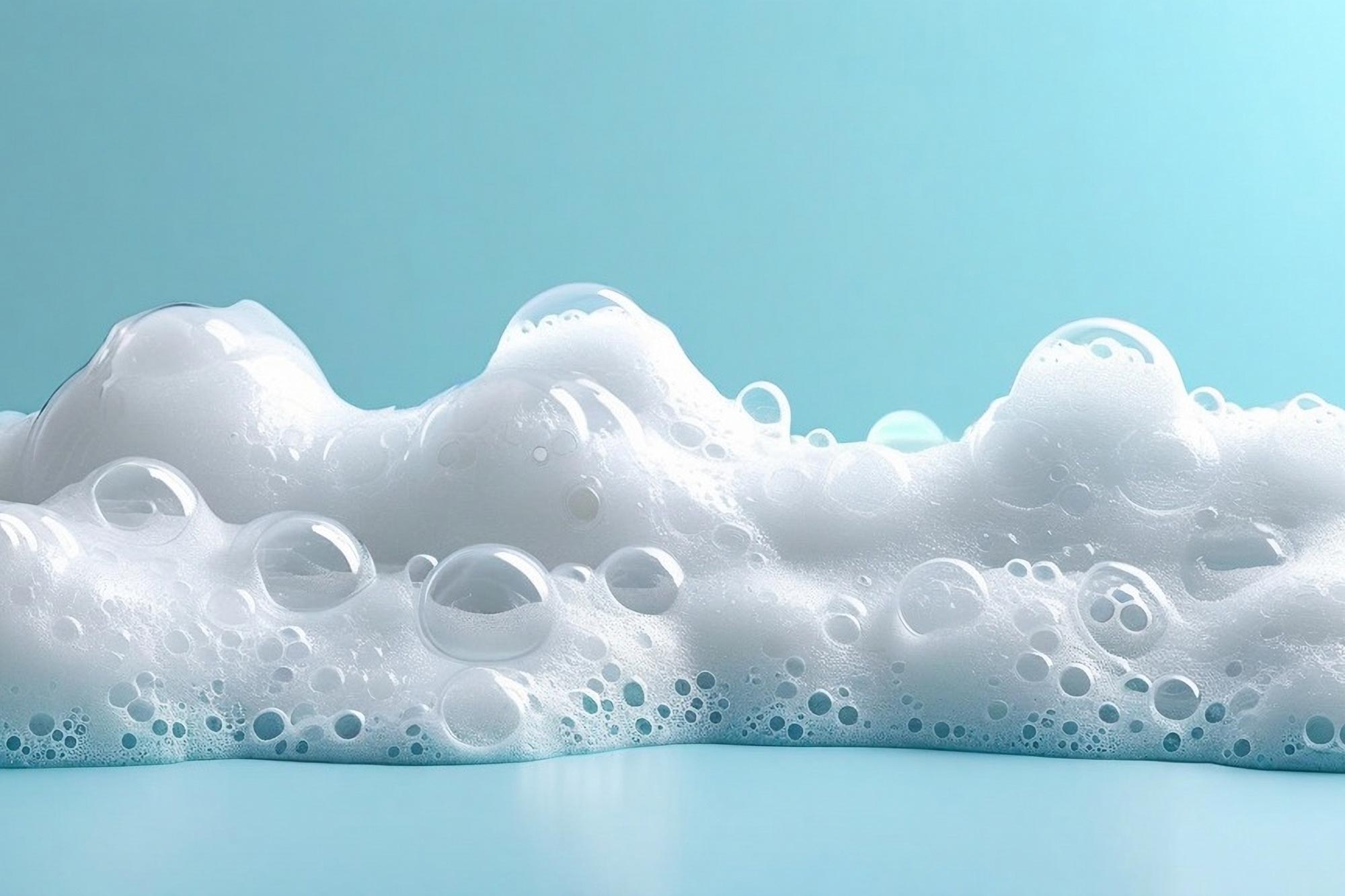
New observations show that foam drainage is controlled by bubble rearrangement, not traditional surface-tension models.
Researchers at Tokyo Metropolitan University have uncovered the solution to a long-standing question about how liquid escapes from foams. Traditional physics models predict that foams must be far taller before any liquid can drain from the bottom, but real-world behavior contradicts those estimates.
By closely examining how foams behave, the team discovered that drainage begins when the pressure is high enough to force bubbles to shift position rather than simply push liquid through a fixed network. Their findings show that the movement of bubbles plays a key role in understanding how soft materials function.
When foam is sprayed onto a surface, droplets often appear below it. This happens because foams consist of tightly packed bubbles separated by thin liquid films, creating a complex network of channels. Liquid can flow through these passages, allowing it either to leave the foam or to draw in additional liquid when new fluid touches the surface. The point at which this occurs, known as the “absorptive limit”, has traditionally been linked to “osmotic pressure”, which describes the energy change that occurs when bubbles are compressed and their liquid-gas contact areas shift.
The Problem With Existing Models
Or so it was believed. For many years, scientists have struggled with calculations that predict how tall a foam must be for this limit to take effect. Estimates based on osmotic pressure, which depends on bubble size and surface tension, suggest that a foam should reach roughly a meter in height before drainage begins. Yet in practice, even foams only a few tens of centimeters tall can lose liquid with ease.
Foams play a major role in everyday products, from household cleaners to pharmaceutical formulations. To develop materials tailored for specific purposes, such as foams that hold liquid more effectively, it is essential to understand the underlying physical processes that govern how they behave.
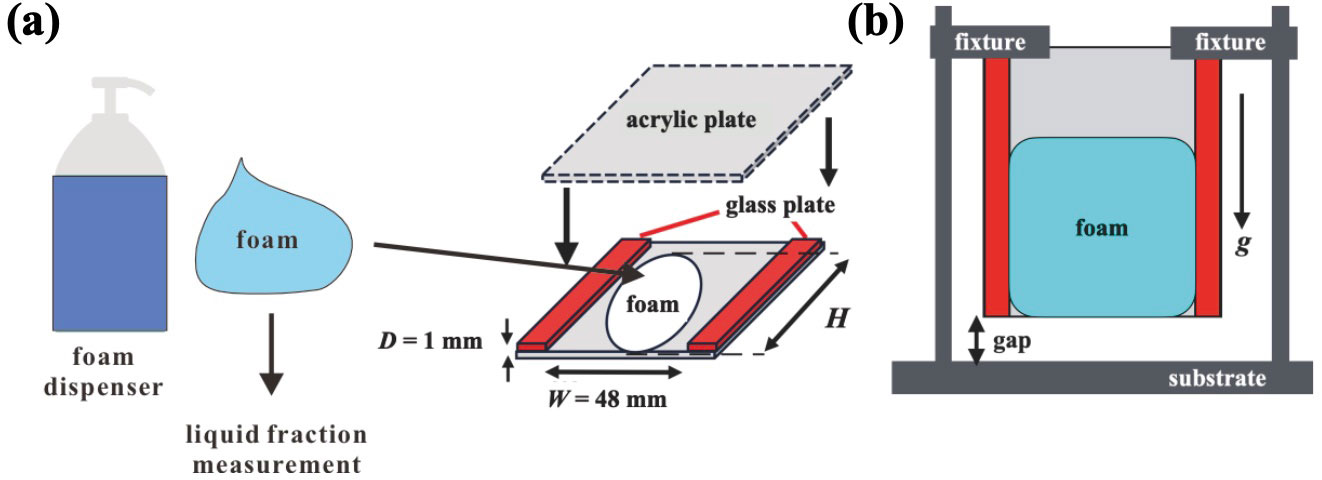
A team led by Professor Rei Kurita of Tokyo Metropolitan University has been looking at drainage in simple foams. The team used various surfactants to create a library of different foams with different properties, sandwich them between transparent plates, and stand them upright to reveal what is going on inside while they drain, if at all.
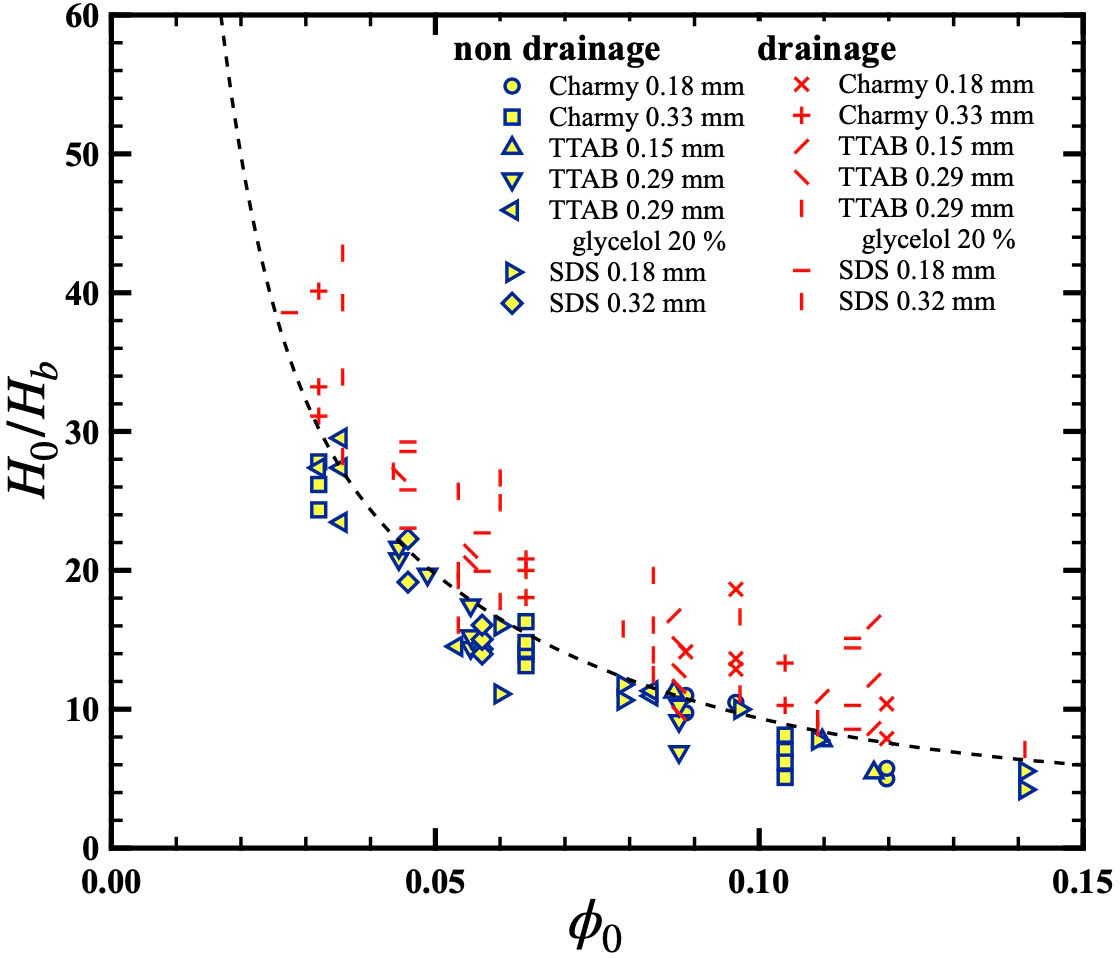
Firstly, they discovered a universal behavior where the height at which drainage starts is inversely proportional to the liquid fraction of the foam, independent of surfactant type or bubble size. Their analysis of the limit yields an “effective osmotic pressure” at which the absorptive limit is met significantly lower than what is expected from bubble sizes and surface tension.
Discovering the Real Limiting Factor
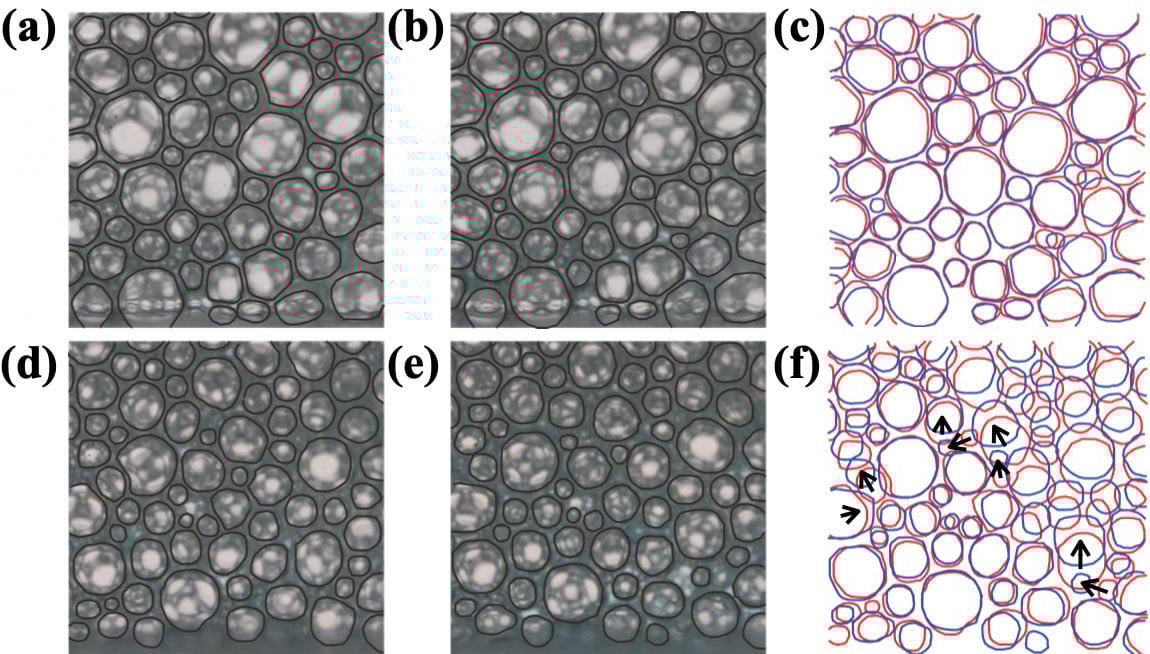
Going back to the drawing board, the team looked directly inside the foam with a video camera. For foams that have just made it to the drainage point, they discovered that liquid wasn’t simply pushing through the maze of connections but causing the bubbles themselves to rearrange. They found that the limit where drainage occurs is determined not by surface tension but “yield stress,” the amount of pressure required to rearrange bubbles. Importantly, this model gives heights for draining foams that match up with reality.
This result upends the fundamental picture of how we look at foam drainage, from a static picture of liquid moving through gaps, to a dynamic one where the gaps themselves can move. The team hopes their findings inspire new insights into the behavior of soft materials, as well as approaches to designing better foam products.
Reference: “Absorptive limits of foams governed by kinematic coupling between solution and bubbles” by Aoi Kaneda and Rei Kurita, 5 May 2025, Journal of Colloid and Interface Science.
DOI: 10.1016/j.jcis.2025.137746
This work was supported by JSPS KAKENHI Grant Number 20H01874.
Never miss a breakthrough: Join the SciTechDaily newsletter.
Follow us on Google and Google News.
3 Comments
Researchers found that the limit where drainage occurs is determined not by surface tension but “yield stress,” the amount of pressure required to rearrange bubbles.
VERY GOOD.
Please ask researchers to think deeply:
1. Is the flow of liquid on the surface of arranged bubbles affected by the gravitational force of the Earth or other objects?
2. How do you understand the spacetime background in which bubbles are located?
When we pursue the ultimate truth of all things, the space in which our bodies and all things exist may itself be the final and deepest puzzle we need to explore. This is not only the pursuit of physics, but also the most magnificent exploration of the origin of the universe by human reason.
Based on the Topological Vortex Theory (TVT), space is an uniformly incompressible physical entity. Space-time vortices are the products of topological phase transitions of the tipping points in space, are the point defects in spacetime. Point defects do not only impact the thermodynamic properties, but are also central to kinetic processes. They create all things and shape the world through spin and self-organization.
In today’s physics, some so-called peer-reviewed journals—including Physical Review Letters, Nature, Science, and others—stubbornly insist on and promote the following:
1. Even though θ and τ particles exhibit differences in experiments, physics can claim they are the same particle. This is science.
2. Even though topological vortices and antivortices have identical structures and opposite rotational directions, physics can define their structures and directions as entirely different. This is science.
3. Even though two sets of cobalt-60 rotate in opposite directions and experiments reveal asymmetry, physics can still define them as mirror images of each other. This is science.
4. Even though vortex structures are ubiquitous—from cosmic accretion disks to particle spins—physics must insist that vortex structures do not exist and require verification. Only the particles that like God, Demonic, or Angelic are the most fundamental structures of the universe. This is science.
5. Even though everything occupies space and maintains its existence in time, physics must still debate and insist on whether space exists and whether time is a figment of the human mind. This is science.
6. Even though space, with its non-stick, incompressible, and isotropic characteristics, provides a solid foundation for the development of physics, physics must still insist that the ideal fluid properties of space do not exist. This is science.
and go on.
Is this the counterintuitive science they widely promote? Compromising with pseudo academic publications and peer review by pseudo scholars is an insult to science and public intelligence. Some so-called scholars no longer understand what shame is. The study of Topological Vortex Theory (TVT) reminds us that the most profound problems in physics often lie at the intersection of different theories. By exploring these border regions, we can not only resolve contradictions in existing theories but also discover new physical phenomena and application possibilities.
Under the topological vortex architecture, it is highly challenging for even two hydrogen atoms or two quarks to be perfectly symmetrical, let alone counter-rotating two sets of cobalt-60. Contemporary physics and so-called peer-reviewed publications (including Physical Review Letters, Science, Nature, etc.) stubbornly believe that two sets of counter rotating cobalt-60 are two mirror images of each other, constructing a more shocking pseudoscientific theoretical framework in the history of science than the “geocentric model”. This pseudo scientific framework and system have seriously hindered scientific progress and social development.
For nearly a century, physics has been manipulated by this pseudo scientific theoretical system and the interest groups behind it, wasting a lot of manpower, funds, and time. A large amount of pseudo scientific research has been conducted, and countless pseudo scientific papers have been published, causing serious negative impacts on scientific and social progress, as well as humanistic development.
Complexity does not necessarily mean that there is no logical and architectural framework to follow. Mathematics is the language and tool that reveals the motion of spacetime, rather than the motion itself. Although the physical form of spacetime vortices is extremely simple, their interaction patterns are highly complex, and we must develop more and richer mathematical languages to describe and understand them.
The development of the Topological Vortex Theory (TVT) reflects a progression from concrete physical phenomena to abstract mathematical modeling and, ultimately, to interdisciplinary unification. Its core innovation lies in forging the continuous spacetime geometry of general relativity with the discrete interactions of quantum field theory within the same topological dynamical system.
——Excerpted from https://scitechdaily.com/microscope-spacecrafts-most-precise-test-of-key-component-of-the-theory-of-general-relativity/#comment-909171.
Topological Vortex Theory (TVT) is far from an unverified speculation; it is a scientific theory with profound mathematical foundations [1], broad explanatory power, and accumulating empirical support [1-4].
——Excerpted from https://t.pineal.cn/blogs/5837/Analyzing-the-Scientific-Nature-and-Verifiability-of-Topological-Vortex-Theory.