
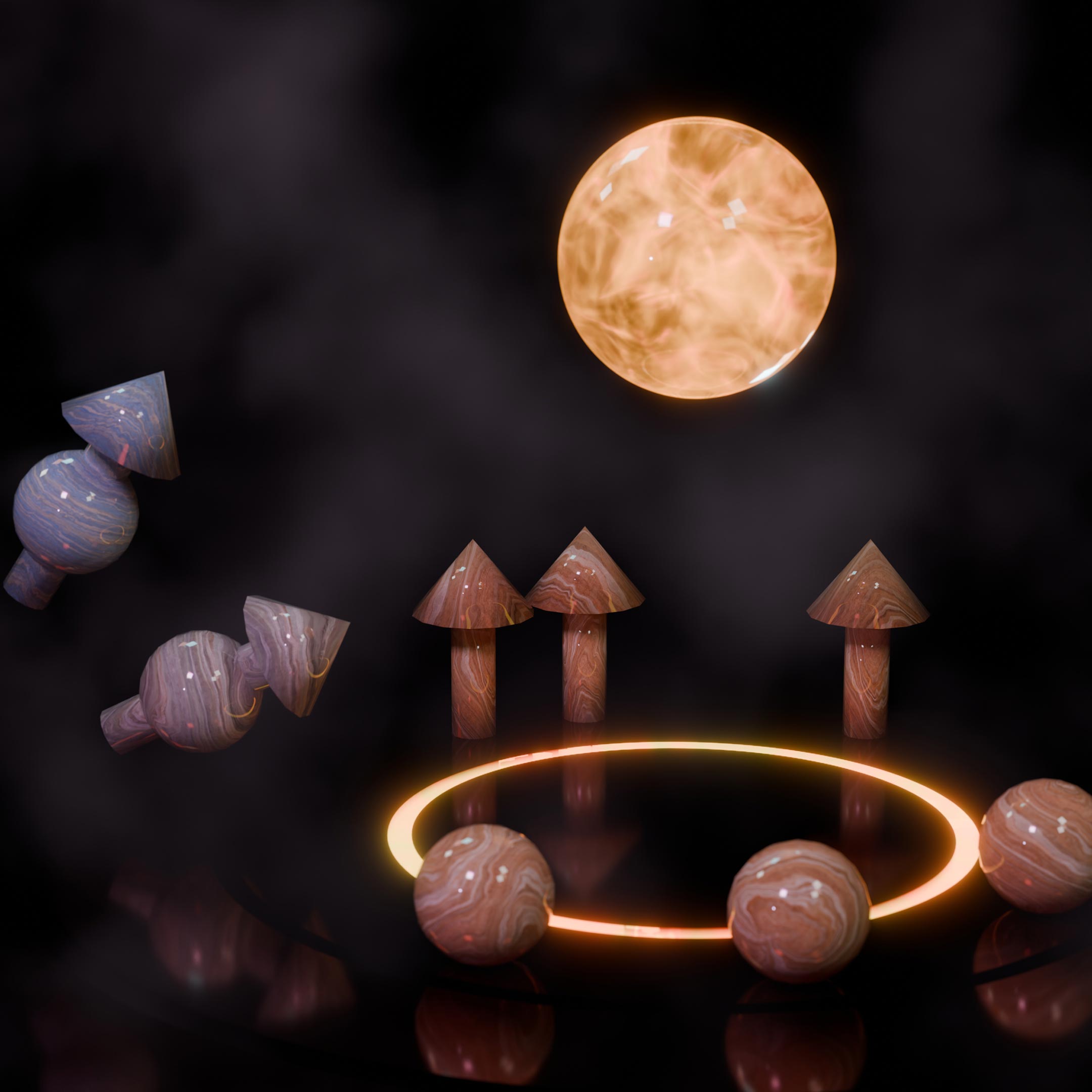
In a stunning first, scientists observed anyons—exotic particles with in-between statistics—in a 1D ultracold gas. This discovery could pave the way for advanced quantum states and potentially transform quantum computing.
In the universe, everything is built from just two fundamental types of particles: fermions and bosons. Fermions, like electrons and quarks, are the building blocks of matter. Bosons, on the other hand, are the messengers of nature’s forces. For example, photons carry light and electromagnetic interactions, while gluons hold atomic nuclei together through the strong force.
These particles don’t just differ in what they do — they also follow different rules of behavior. When two fermions swap places, their shared quantum wave changes in a very specific way, picking up a mathematical twist called a phase of pi. Bosons don’t do this. Their phase remains unchanged. These quantum rules help explain everything from how the periodic table is organized to how superconductors work.
Enter the Anyons: Exotic Particles in Between
Now, researchers have discovered a new kind of particle that doesn’t fit neatly into either category. These are anyons, and they’re unlike anything else in physics. Anyons have quantum behavior that falls somewhere between that of fermions and bosons. Their phase shift isn’t fixed at zero or pi, but somewhere in between.
Anyons don’t exist as standalone particles. Instead, they emerge as excitations within exotic quantum states of matter, a bit like how phonons arise as vibrations in solids and act like “particles of sound.” Scientists have spotted anyons before, but only in two-dimensional systems. For years, physicists wondered: Could anyons exist in one dimension?
Breakthrough in 1D: Anyons Detected in Ultracold Gas
The answer, it turns out, is yes. In a breakthrough experiment, scientists have observed signs of anyons in a one-dimensional ultracold gas for the first time. The research, published in Nature, involved teams from the University of Innsbruck, Université Paris-Saclay, and Université Libre de Bruxelles.
To reveal the presence of anyons, the scientists carefully injected and accelerated a mobile impurity into a tightly controlled gas of bosons at near absolute zero. By tracking how the impurity interacted with the gas, they detected unmistakable signs of anyonic behavior.
“What’s remarkable is that we can dial in the statistical phase continuously, allowing us to smoothly transition from bosonic to fermionic behavior,” says Sudipta Dhar, one of the leading authors of the study. “This represents a fundamental advance in our ability to engineer exotic quantum states.” The theorist Botao Wang agrees: “Our modeling directly reflects this phase and allows us to capture the experimental results very well in our computer simulations.”
Toward the Future of Quantum Technology
This elegantly simple experimental framework opens new avenues for studying anyons in highly controlled quantum gases. Beyond fundamental research, such studies are particularly exciting because certain types of anyons are predicted to enable topological quantum computing—a revolutionary approach that could overcome key limitations of today’s quantum processors.
This discovery marks a pivotal step in the exploration of quantum matter, shedding new light on the behavior of exotic particles that may shape the future of quantum technologies.
Reference: “Observing anyonization of bosons in a quantum gas” by Sudipta Dhar, Botao Wang, Milena Horvath, Amit Vashisht, Yi Zeng, Mikhail B. Zvonarev, Nathan Goldman, Yanliang Guo, Manuele Landini and Hanns-Christoph Nägerl, 28 May 2025, Nature.
DOI: 10.1038/s41586-025-09016-9
Never miss a breakthrough: Join the SciTechDaily newsletter.
Follow us on Google and Google News.
1 Comment
Scientists Create Exotic “Anyons” in One-Dimensional Quantum Gas.
VERY GOOD!
Please ask scientists to think deeply:
Where does your one-dimensional quantum gas come from? Does it come from the dynamic evolution of space itself, or does it come from God?
If scientists are interested in this, please browse https://zhuanlan.zhihu.com/p/1917878197971816654.