

USC biomedical engineers have developed a novel, ocean-safe biocompatible material that eliminates the risk of microplastic pollution.
Plastic pollution continues to pose a major threat to marine ecosystems, with UNESCO reporting that it accounts for 80 percent of all ocean pollution. Each year, an estimated 8 to 10 million metric tons of plastic end up in the sea. In a promising development, researchers from the USC Viterbi School of Engineering have identified a natural substance found in seashells that may help create a safer and more sustainable alternative to conventional plastic.
The study is led by Eun Ji Chung, who holds the Dr. Karl Jacob Jr. and Karl Jacob III Early-Career Chair at USC Viterbi. Chung is recognized for her expertise in engineered nanoparticles for medical use. Drawing from her background in biomaterials, she and her research team recently created a new type of biodegradable plastic alternative. By incorporating calcium carbonate, a mineral found in seashells, into poly (1,8-octanediol-co-citrate) (POC), a biodegradable polymer approved by the FDA for orthopedic fixation, the team engineered a material that may help reduce reliance on traditional plastics. The results were published in MRS Communications.
From Biomedical Polymers to Sustainable Plastics
Chung’s current work revisits ideas she explored during her time as a graduate researcher. At that time, she investigated a polymer made from citric acid, a natural compound found in citrus fruits like oranges. Her goal then was to develop biodegradable polymers for medical uses such as sutures and devices for tendon repair.
“In graduate school, we added hydroxyapatite, which are these calcium particles that are in your bone, and I fabricated them together, and they are now biodegradable materials that are already. FDA approved.”
“I started thinking that seashells have calcium, too. That’s why they’re stiff like bone. But they have a different kind of calcium particle. So, I basically adapted what I did and replicated it to be more suitable for an alternative plastic material.”
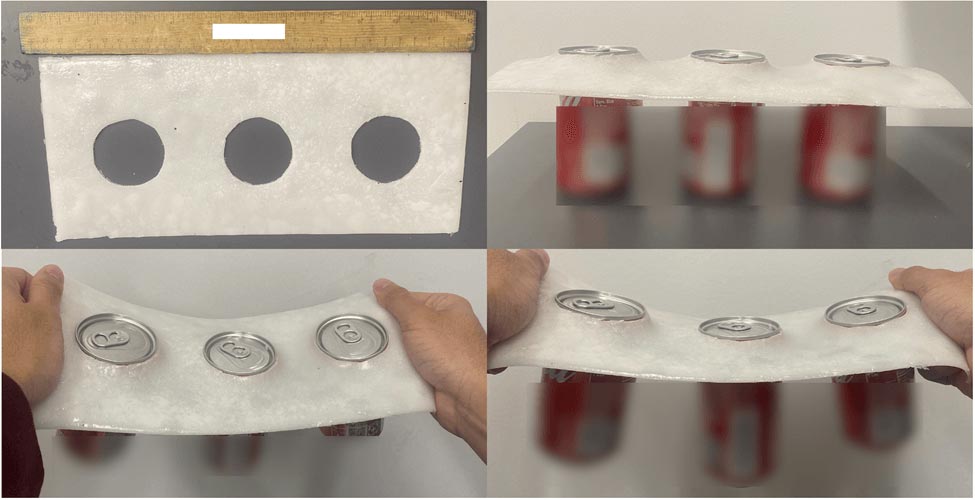
Chung said the citric acid polymer’s texture is sticky, like a gum. When the calcium particles are added and it is heated and cured in an oven, it forms a plastic-like material. The resulting material, POC-CC, was developed into a prototype and cut into the formation of soda can beverage holder rings that were robust enough to hold cans.
Testing Durability and Marine Degradation
The team hypothesized that the POC-CC material would be a biocompatible plastic substitute that could degrade in marine environments while maintaining sufficient strength for industrial applications.
To test this, POC-CC was synthesized with varying concentrations of calcium carbonate. Over six months, they observed various factors including the weight degradation rate in ocean water and the effect the material had on the pH of the water after long-term incubation.
“Our results show the degradation rate increases with increased POC content, and the addition of CC maintains the pH of ocean water,” Chung said.
Another benefit of the material is its biocompatibility — it doesn’t cause harm to marine life in the way that introduced microplastics do. The research team incubated a type of green algae (Scenedesmus sp.) alongside the POC-CC material, housing them in simulated ocean water for six months. The team noted high cell viability, confirming the fact that the POC-CC plastic substitute was biocompatible with marine microorganisms.
Chung and her team are now planning an improved second-generation version of the material to help it degrade faster.
Chung added that the material had many potential applications, such as in the production of biodegradable straws that were stronger than bamboo or paper straws and safer than reusable metal ones.
Reference: “Calcium carbonate-based biodegradable composites as an alternative material to industrial plastics” by Nathan Ho, Yi Huang and Eun Ji Chung, 25 February 2025, MRS Communications.
DOI: 10.1557/s43579-025-00695-z
Funding: National Oceanic and Atmospheric Administration, USC Sea Grant Program
Never miss a breakthrough: Join the SciTechDaily newsletter.
Follow us on Google and Google News.
2 Comments
This was a good article thanks
Before reading; it’s called hemp…😒