
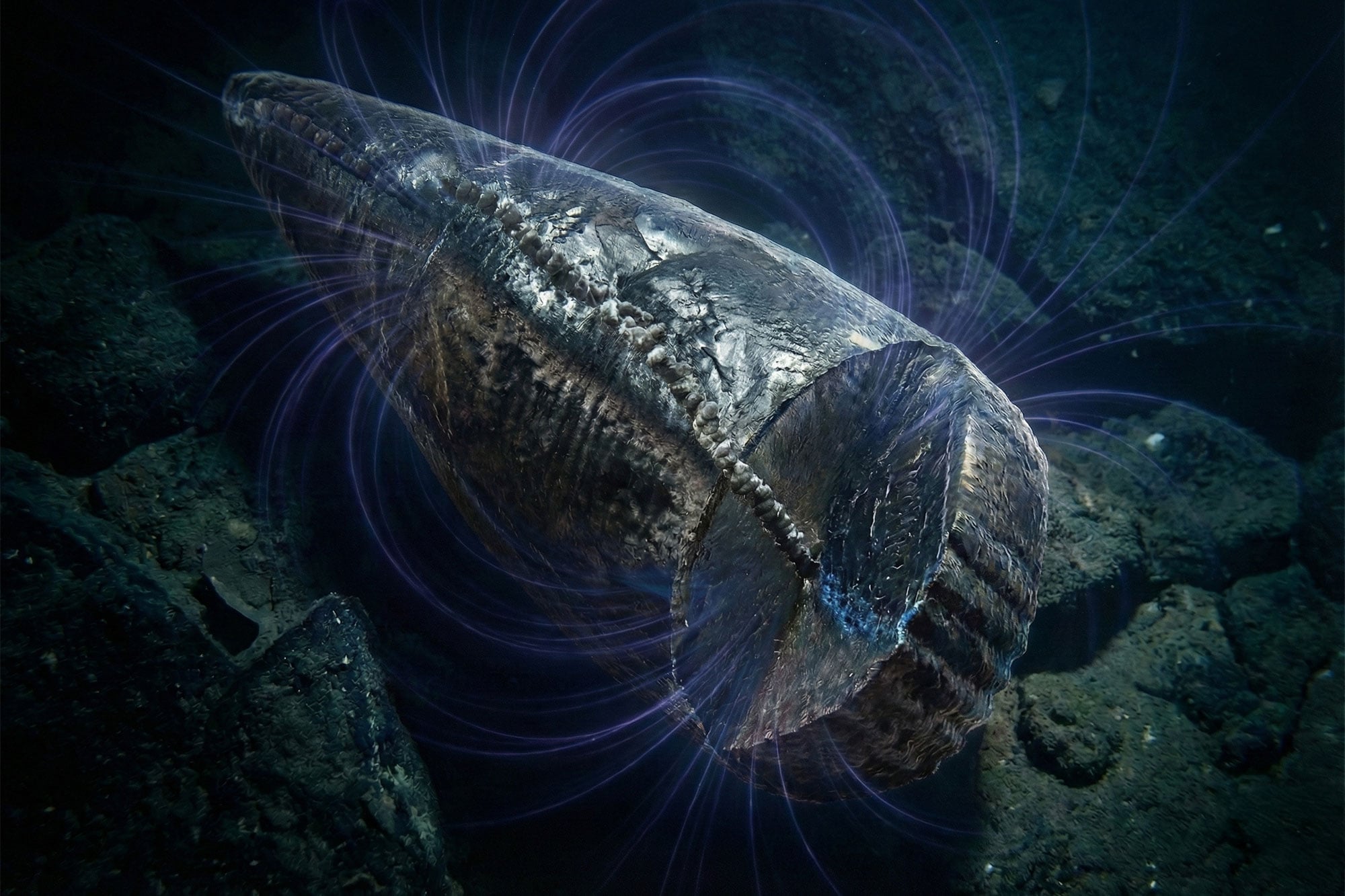
Ancient magnetic fossils reveal that animal navigation using Earth’s magnetic field may have evolved far earlier than previously known.
Researchers have uncovered what appears to be the oldest known evidence of an internal navigation system in an animal, a finding that may help explain how modern birds and fish developed the ability to orient themselves using the Earth’s magnetic field over long distances.
The evidence comes from microscopic magnetic fossils that are about 97 million years old. These remains were preserved in ancient seafloor sediments and are thought to have been produced by an unknown organism whose identity is still unclear.
The fossils take on a range of distinctive forms, including shapes resembling spearheads, spindles, bullets, and needles. Each one is no larger than a bacterial cell. Scientists are confident that these structures are biological in origin, yet they have not been able to determine what kind of animal created them or what purpose they originally served.
New analysis has now clarified part of that mystery. The research suggests that these magnetofossils functioned as a kind of internal GPS, allowing early animals to sense and interpret the Earth’s magnetic field as a guide for movement and orientation.
Fossils reveal ancient magnetic navigation
To reach this conclusion, a team from the University of Cambridge and the Helmholtz-Zentrum Berlin produced the first three-dimensional images of the fossils’ internal magnetic structure. Their work revealed features specifically suited to detecting both the direction and the strength of the Earth’s magnetic field, properties that would have supported precise navigation.
“Whatever creature made these magnetofossils, we now know it was most likely capable of accurate navigation,” said Professor Rich Harrison from Cambridge’s Department of Earth Sciences, who co-led the research.
The findings represent the earliest direct evidence that animals were using the Earth’s magnetic field to navigate at least 97 million years ago. They also shed light on the evolutionary origins of this ability, known as ‘magnetoreception’. The results are reported in the journal Communications Earth & Environment.
Magnetoreception remains poorly understood
Life has evolved a range of extraordinary senses, and magnetoreception is one of the most poorly understood. Birds, fish, and insects use the Earth’s magnetic field to navigate vast distances, but how they do this is still unclear. One theory is that tiny crystals of magnetite within the body align with the Earth’s magnetic field, acting like microscopic compass needles.
Certain bacteria found in lakes and other bodies of water possess a primitive form of magnetoreception. Chains of tiny magnetic particles inside the bacteria allow them to line up with the magnetic field, helping them swim to their preferred depth in the water column.
“At just 50–100 nanometers wide, these particles are the perfect compass needles,” said Harrison. “If you want to create the most efficient magnetic sense, smaller is better.”
Giant magnetofossils challenge existing ideas
But the magnetofossils the team studied for the current study are 10 to 20 times larger than the magnetic particles used by bacteria, and were retrieved from a site in the North Atlantic Ocean. Previously, some researchers had argued that ‘giant’ magnetofossils may have served as protective spines.
However, model simulations have suggested that they might also possess advanced magnetic properties, something Harrison wanted to explore further. “It looks like this creature was carefully controlling the shape and structure of these fossils, and we wanted to know why,” he said.
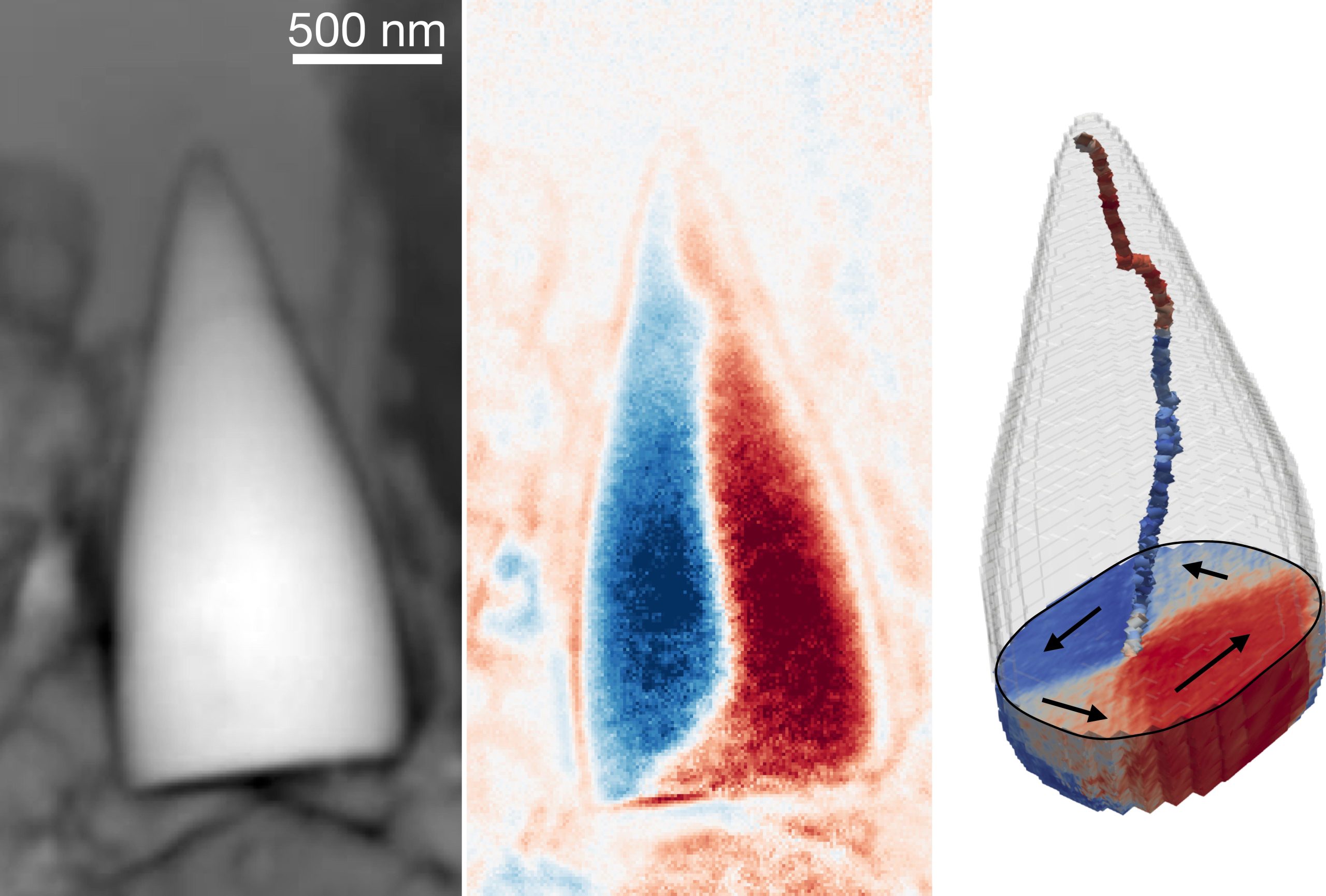
The researchers applied a new technique to visualize the fossil’s internal structure, revealing how magnetic moments (tiny magnetic fields generated by spinning electrons) are arranged inside the magnetofossil.
Until now, scientists had been unable to capture 3D magnetic images of larger particles, such as giant magnetofossils, because X-rays couldn’t penetrate them.
The research was made possible using a technique developed by co-author Claire Donnelly at the Max Planck Institute in Germany and carried out at the Diamond X-ray facility in Oxford.
“That we were able to map the internal magnetic structure with magnetic tomography was already a great result, but the fact that the results provide insight into the navigation of creatures millions of years ago is really exciting,” said Donnelly.
A magnetic design built for precision
Their images revealed an intricate magnetic configuration, with magnetic moments swirling around a central line running through the fossil’s interior, forming a tornado-like vortex pattern.
This vortex magnetism provides ideal properties for navigation, said Harrison, generating a ‘wobble’ in response to tiny changes in the strength of the magnetic field that translate into detailed map information. “This magnetic particle not only detects latitude by sensing the tilt of Earth’s magnetic field but also measures its strength, which can change with longitude,” he said.
The geometry of this vortex structure is highly stable, meaning it can resist small environmental disturbances that may otherwise disrupt navigation. “If nature developed a GPS, a particle that can be relied upon to navigate thousands of kilometers across the ocean, then it would be something like this,” he said.
Searching for the animal behind the signal
In solving the enduring mystery over the fossils’ function, the work also helps narrow the search for the animal that made them. “The next question is what made these fossils,” said Harrison. “This tells us we need to look for a migratory animal that was common enough in the oceans to leave abundant fossil remains.”
Harrison suggests that eels could be a potential candidate, since they evolved around 100 million years ago and remain one of the least understood and elusive animals. European and American eels travel thousands of kilometers from freshwater rivers to spawn in the Sargasso Sea. Though they can sense Earth’s magnetic field, how they do so is unclear. Magnetite particles have been detected in eels but not yet imaged directly in their cells and tissues, partly because of their tiny size and the fact they could be hidden anywhere in the body.
Harrison worked closely with Sergio Valencia from Helmholtz-Zentrum Berlin in designing the research. “This was a truly international collaboration involving experts from different fields, all working together to shed light on the possible functionality of these magnetofossils,” said Valencia.
Despite their as-yet-unknown host, “giant magnetofossils mark a key step in tracing how animals evolved basic bacterial magnetoreception into highly-specialized, GPS-like navigation systems,” Harrison said.
Reference: “Magnetic vector tomography reveals giant magnetofossils are optimised for magnetointensity reception” by Richard J. Harrison, Jeffrey Neethirajan, Zhaowen Pei, Pengfei Xue, Lourdes Marcano, Radu Abrudan, Emilie Ringe, Po-Yen Tung, Venkata S. C. Kuppili, Burkhard Kaulich, Benedikt J. Daurer, Luis Carlos Colocho Hurtarte, Majid Kazemian, Liao Chang, Claire Donnelly and Sergio Valencia, 20 October 2025, Communications Earth & Environment.
DOI: 10.1038/s43247-025-02721-3
The research was supported in part by the European Union, the European Research Council and the Royal Society.
Never miss a breakthrough: Join the SciTechDaily newsletter.
Follow us on Google and Google News.