
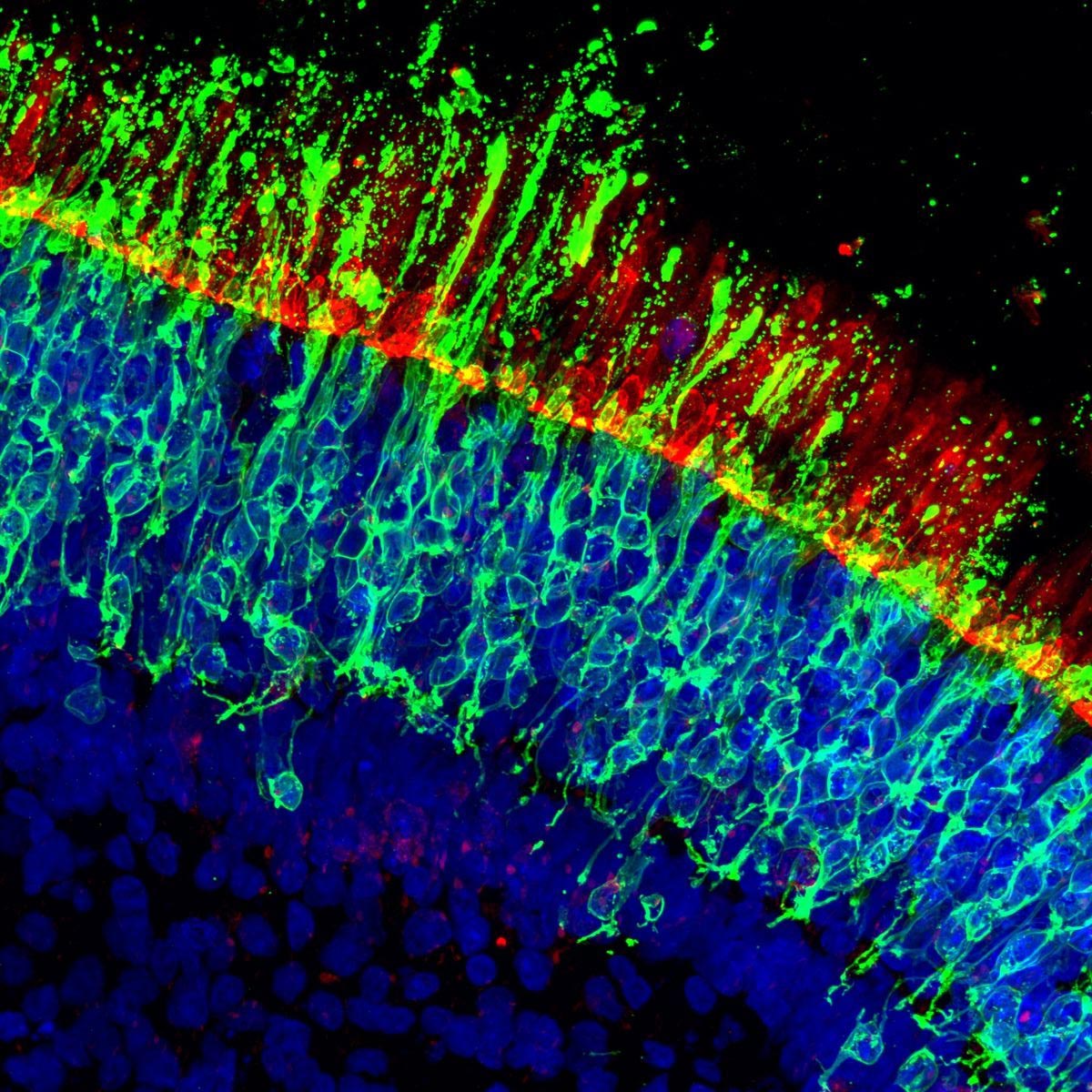
Scientists have identified molecules that can protect the eye’s cone cells from degeneration, a major cause of vision loss. The discovery points to new drug targets—and even uncovers compounds that may be harmful.
Researchers led by Botond Roska at the Institute of Molecular and Clinical Ophthalmology Basel (IOB), along with an international team, have uncovered genetic pathways and chemical compounds that can help protect cone photoreceptors. These cells are damaged in diseases such as age-related macular degeneration, a leading cause of vision loss.
Why Cone Cells Matter for Sight
Cone photoreceptors are located in the macula and play a crucial role in everyday vision tasks like reading, recognizing faces, and seeing color. When these cells die, as they do in many inherited retinal disorders and macular degeneration, central vision begins to fade. Despite years of research, there are still no approved treatments that can stop this process. This study, led by first authors Stefan Spirig, Alvaro Herrero Navarro, and colleagues, tackles that challenge using a human-based experimental model.
Large-Scale Screening Reveals Risks and Protective Compounds
The team tested more than 2,700 compounds across 20,000 human retinal organoids. Their findings revealed both promise and caution:
- Certain classes of compounds were found to harm cone cells, raising important safety concerns.
- Several molecules were identified that help protect cones from degeneration.
- Blocking casein kinase 1 emerged as a key mechanism for preserving these cells.
To carry out the study, scientists labeled cone photoreceptors so they could track their survival over time under stress conditions designed to mimic disease. This allowed for a systematic analysis of compounds with known molecular targets.
Key Mechanism Identified for Cone Survival
The researchers observed clear trends. Two kinase inhibitors repeatedly showed strong protective effects, keeping cone cells alive over extended periods. These benefits were consistent across different stress conditions and were also confirmed in a mouse model of retinal degeneration, suggesting the findings could apply more broadly.
Open Dataset to Accelerate Vision Research
In addition to identifying protective strategies, the team has made a detailed dataset publicly available. It includes information on all tested compounds, their molecular targets, and how they affect cone survival in human tissue. This resource is expected to support the development of new treatments aimed at preserving central vision and help researchers better evaluate potential retinal toxicity.
A Step Closer to Preventing Vision Loss
By combining advances in retinal biology, organoid technology, and large-scale drug screening, this work provides a strong foundation for future therapies. It brings scientists closer to a long-standing goal in eye research: protecting the cells that make clear vision possible.
Reference: “Cell-type-focused compound screen in human organoids reveals CK1 inhibition protects cone photoreceptors from death” by Stefan E. Spirig, Álvaro Herrero-Navarro, Larissa Utz, Valeria J. Arteaga-Moreta, Zoltan Raics, Susana Posada-Céspedes, Stephanie Chreng, Olaf Galuba, Inga Galuba, Isabelle Claerr, Steffen Renner, Miklos Boldogkoi, Verónica Moreno-Juan, P. Timo Kleindienst, Adrienn Volak, Jannick Imbach, Svitlana Malysheva, Rebecca A. Siwicki, Vincent Hahaut, Yanyan Hou, Tiago M. Rodrigues, Simone Picelli, Marco Cattaneo, Josephine Jüttner, Cameron S. Cowan, Myriam Duckely, Daniel K. Baeschlin, Magdalena Renner, Vincent Unterreiner and Botond Roska, 30 March 2026, Neuron.
DOI: 10.1016/j.neuron.2026.02.024
Funding: EMBO Postdoctoral Fellowship, European Research Council advanced grant, Swiss National Science Foundation | Synergia grant, Swiss National Science Foundation Grant, Louis-Jeantet Foundation Award, Körber-Stiftung, NCCR Molecular Systems Engineering
Never miss a breakthrough: Join the SciTechDaily newsletter.
Follow us on Google and Google News.
2 Comments
Anne amphibia
As someone who has two siblings with retinitis pigmentosa , this research is great and gives hope where there is none at the moment.