

A recent study investigated the impact of disrupting the circadian rhythm on adult neurogenesis.
Researchers at the University of Massachusetts Amherst have zeroed in on the primary cause of negative health consequences stemming from disruptions to the body’s circadian rhythms, commonly experienced during jet lag or shift work.
The study, published recently in the journal eNeuro, reveals that the circadian clock gene Cryptochrome 1 (Cry 1) plays a crucial role in regulating adult neurogenesis — the continuous creation of neurons in the hippocampus region of the brain. Adult neurogenesis is vital for learning and memory, and disturbances in this process have been associated with dementia and mental health disorders.
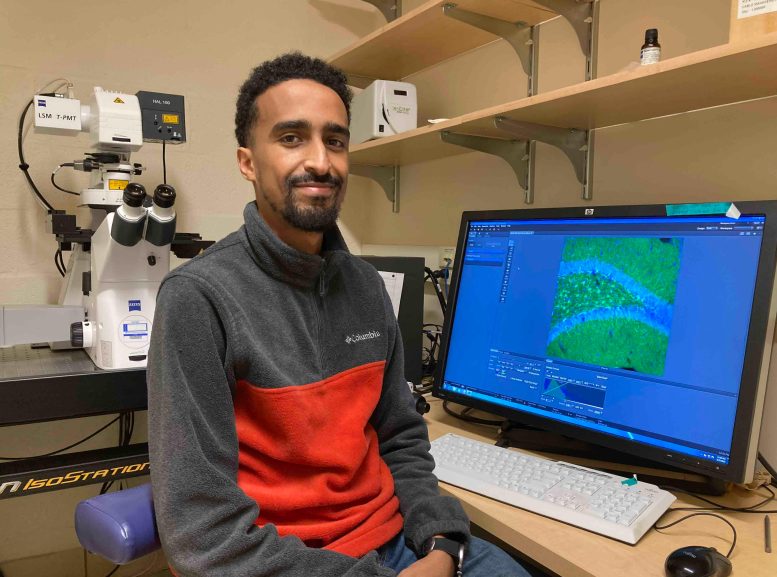
“Circadian disruption impacts a lot of things,” says lead author Michael Seifu Bahiru, a Ph.D. candidate in the lab of Eric Bittman, Professor Emeritus of Biology. “There are links to cancer, diabetes, and hypertension, as well as adverse impacts on neurogenesis.”
Cell birth and survival in the adult hippocampus are regulated by a circadian clock, so its disruption may throw off the process of neurogenesis. In the U.S. alone, some 30 million people experience phase shifts in their circadian rhythms as they work rotating schedules.
Jet Lag vs. Light Cycle Shifts
Until recently, the researchers have faced a sort of chicken-or-egg question. “We always wondered what actually is the root cause of the ailments from circadian disruption?” Bahiru says. “Does the problem come from the act of shifting or the shift itself?”
Bittman explains further, “It’s possible it’s just changing the light cycle that affects neurogenesis, that jerking your clock around is bad for you, as opposed to the jet lag, which is the time delay that it takes for all circadian-dependent systems in your body to adjust to this change in daylight.”
Their findings support the hypothesis that it’s this internal misalignment, this state of desynchrony between and within organs that occurs during jet lag, that is responsible for the adverse impact on neurogenesis – and, they suspect, other adverse health effects from circadian disruption.
To test their hypothesis, they studied cell birth and differentiation in Syrian hamsters with a recessive mutation in the Cry 1 gene that speeds up the clock in constant conditions and dramatically accelerates its ability to shift in response to light. Bittman named the mutation, discovered in previous research, duper. The research team also tested a control group of hamsters without the duper mutation. Both underwent the same sequence of changes in the light cycle.
Circadian Misalignment and Neurogenesis
They simulated jet lag in the form of eight-hour advances and delays at eight 16-day intervals. A cell birth marker was given in the middle of the experiment. Results showed that jet lag has little effect on cell birth but steers the fate of newborn cells away from becoming neurons. Dupers are immune to this effect of phase shifts. “As predicted, the duper animals re-entrained quicker, but also were resistant to the negative effects of the jet lag protocol, whereas the control – the wild type hamsters – had reduced neurogenesis,” Bahiju says.
“The findings indicate that circadian misalignment is critical in jet lag,” the paper concludes.
The ultimate goal of Bittman’s lab is to advance understanding of the pathways involved in human biological clocks, which could lead to the prevention of or treatment for the effects of jet lag, shift work, and circadian rhythm disorders. This latest research is the next step toward that goal.
Now the team will turn to “a big unanswered question,” Bittman says – “whether it’s the operation of circadian clocks in the hippocampus that is being directly regulated by shifts of the light-dark cycle, or whether neurogenesis is controlled by biological clocks running in cells elsewhere in the body.”
Another possibility, which Bittman thinks is more likely, is that the master pacemaker in the suprachiasmatic nucleus of the hypothalamus in the brain detects the light shift and then relays it to the stem cell population that has to divide and differentiate in the hippocampus.
Reference: “Adult Neurogenesis Is Altered by Circadian Phase Shifts and the Duper Mutation in Female Syrian Hamsters” by Michael Seifu Bahiru and Eric L. Bittman, 6 March 2023, eNeuro.
DOI: 10.1523/ENEURO.0359-22.2023
The study was funded by the National Institutes of Health.
Never miss a breakthrough: Join the SciTechDaily newsletter.
Follow us on Google and Google News.