
Close Menu
    Facebook X (Twitter) Instagram
    SciTechDaily
    • Biology
    • Chemistry
    • Earth
    • Health
    • Physics
    • Science
    • Space
    • Technology
    Facebook X (Twitter) Pinterest YouTube RSS
    SciTechDaily
    Home»Space»Scientists Find Speed Key to Protecting Astronauts and Satellites From Space Storms
    Space

    Scientists Find Speed Key to Protecting Astronauts and Satellites From Space Storms

    By University of ReadingJune 10, 2020No Comments4 Mins Read
    Facebook Twitter Pinterest Telegram LinkedIn WhatsApp Email Reddit
    Share
    Facebook Twitter LinkedIn Pinterest Telegram Email Reddit
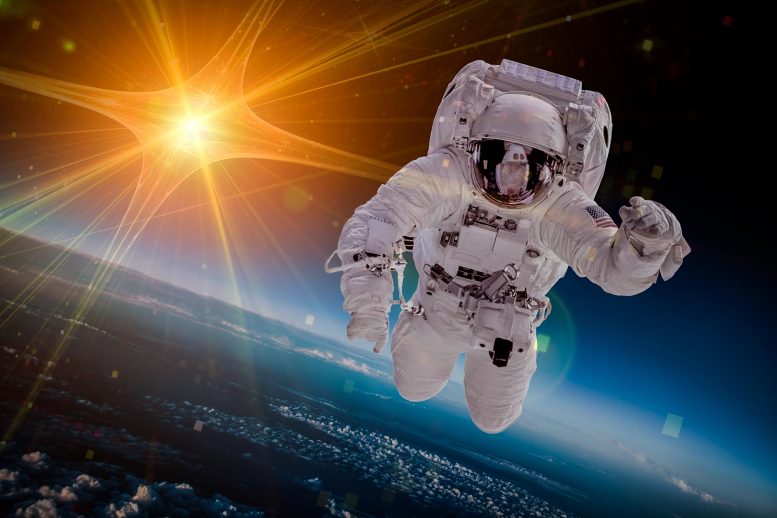
    Astronaut CME Outer Space
    Researchers propose using the speed of coronal mass ejections (CMEs) at Earth as an extra parameter to improve forecasts and reduce false alarms.

    Speed as important as size in predicting potentially damaging impacts of coronal mass ejections.

    Space weather forecasters need to predict the speed of solar eruptions, as much as their size, to protect satellites and the health of astronauts, scientists have found.

    Scientists at the University of Reading found that by calculating the speed of coronal mass ejections (CMEs) when they hit Earth, forecasters could provide more useful early warnings. This would help operators of critical infrastructure such as satellites know if they need to take evasive action or switch off systems to protect them, and warn astronauts when they need to shelter inside shielded parts of the International Space Station.

    Coronal mass ejections are caused by huge eruptions of material from the sun, traveling through interplanetary space and disturbing the Earth’s own magnetic field system. Using solar images to measure the speed of CMEs close to the Sun, it is possible to forecast the arrival time of a CME at Earth.
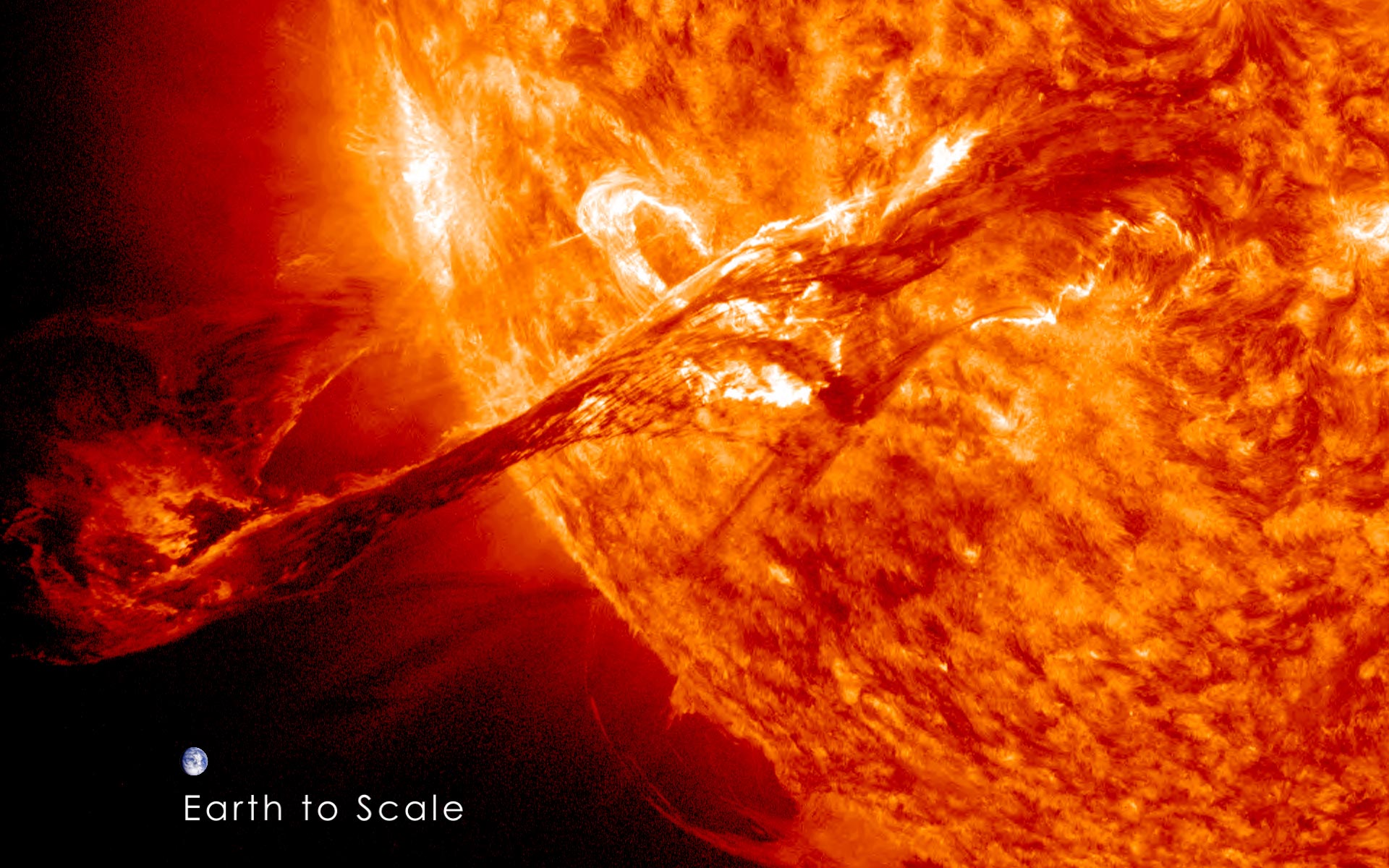
    Coronal Mass Ejection Earth Scale
    On August 31, 2012, a long filament of solar material that had been hovering in the sun’s atmosphere, the corona, erupted out into space at 4:36 p.m. EDT. The coronal mass ejection, or CME, traveled at over 900 miles per second. This image shows the Earth to scale with the filament eruption. Note: the Earth is not this close to the sun, this image is for scale purposes only. Credit: NASA/Goddard Space Flight Center

    Operators of technological systems, such as satellites, which are vulnerable to space weather then have the opportunity to take action to limit the damage. However, scientists say such warnings could be more useful if combined with more sophisticated information about the severity of a storm when it hits Earth.

    Professor Mathew Owens, space scientist at the University of Reading’s Department of Meteorology, said: “Not all coronal mass ejections trigger a severe storm, which means just by looking at the sun for activity, we get a lot of `false alarms’ where action is taken that isn’t needed.

    “While it is better to be safe than sorry, especially with the health of astronauts, sometimes the costs of repeatedly taking unnecessary action to protect a satellite network could prove more costly than the potential space-weather damage itself.”


    This movie shows a massive coronal mass ejection from a variety of viewpoints as captured by NASA’s Solar Dynamics Observatory (SDO), NASA’s Solar Terrestrial Relations Observatory (STEREO), and the joint ESA/NASA Solar Heliospheric Observatory (SOHO). Credit: NASA/Goddard Space Flight Center

    Space weather is listed as one of the biggest threats to the UK and many other countries, due to the possibility that computers, communication networks, and electricity systems could be disrupted. Billions of dollars are currently being spent on new spacecraft and systems to better forecast and measure eruptions when they occur.

    In the new study, published today [Wednesday 10 June] in the scientific journal Space Weather, the researchers outline a new way to quantify the value of knowing CME arrival time. They show that the speed of the CME at Earth is a useful extra piece of information that can be used to reduce the number of false alarms and make forecasts more valuable.

    The scientists say their new finding should help to guide future efforts to improve space weather forecasts, helping to protect critical infrastructure and the health of astronauts in the future.

    Reference: “The value of CME arrival‐time forecasts for space weather mitigation” by M. J. Owens, M. Lockwood and L. A. Barnard, 10 June 2020, Space Weather.
    DOI: 10.1029/2020SW002507

    Never miss a breakthrough: Join the SciTechDaily newsletter.
    Follow us on Google and Google News.

    Astronaut Sun University of Reading
    Share. Facebook Twitter Pinterest LinkedIn Email Reddit

    Related Articles

    An Unparalleled View: The Annular Solar Eclipse From the International Space Station

    Improved Solar Storm Forecasts for Earth With Help From the Public

    NASA Requests $17.7 Billion Budget for Fiscal Year 2013

    Researchers Believe Molecular Hydrogen Has Role in Formation and Evolution of Sunspots

    NASA’s NuSTAR is One Step Closer to Launching

    Strong Geomagnetic Storms a Possibility After Active Sunspot 1401 Erupted

    Solar Dynamics Observatory Measures Magnetic Fields on Sun’s Surface

    Comet Survives after Close Brush With the Sun

    Japanese Astronaut Plays A One-Man Game Of Baseball In Space

    Leave A Reply Cancel Reply

    • Facebook
    • Twitter
    • Pinterest
    • YouTube

    Don't Miss a Discovery

    Subscribe for the Latest in Science & Tech!

    Trending News

    Artificial Sweeteners May Harm Future Generations, Study Suggests

    Splashdown! NASA Artemis II Returns From Record-Breaking Moon Mission

    What If Consciousness Exists Beyond Your Brain

    Scientists Finally Crack the 100-Million-Year Evolutionary Mystery of Squid and Cuttlefish

    Beyond “Safe Levels”: Study Challenges What We Know About Pesticides and Cancer

    Researchers Have Found a Dietary Compound That Increases Longevity

    Scientists Baffled by Bizarre “Living Fossil” From 275 Million Years Ago

    Your IQ at 23 Could Predict Your Wealth at 27, Study Finds

    Follow SciTechDaily
    • Facebook
    • Twitter
    • YouTube
    • Pinterest
    • Newsletter
    • RSS
    SciTech News
    • Biology News
    • Chemistry News
    • Earth News
    • Health News
    • Physics News
    • Science News
    • Space News
    • Technology News
    Recent Posts
    • What if Dark Matter Has Two Forms? Bold New Hypothesis Could Explain a Cosmic Mystery
    • Researchers Expose Hidden Chemistry of “Ore-Forming” Elements in Biology
    • Geologists Reveal the Americas Collided Earlier Than We Thought
    • 20x Difference: Study Reveals True Source of Airborne Microplastics
    • Scientists Uncover Hidden Force Powering Yellowstone’s Supervolcano
    Copyright © 1998 - 2026 SciTechDaily. All Rights Reserved.
    • Science News
    • About
    • Contact
    • Editorial Board
    • Privacy Policy
    • Terms of Use

    Type above and press Enter to search. Press Esc to cancel.