
Close Menu
    Facebook X (Twitter) Instagram
    SciTechDaily
    • Biology
    • Chemistry
    • Earth
    • Health
    • Physics
    • Science
    • Space
    • Technology
    Facebook X (Twitter) Pinterest YouTube RSS
    SciTechDaily
    Home»Science»Scientists Identify 240-Million-Year-Old Mystery Ancient Marine Reptile
    Science

    Scientists Identify 240-Million-Year-Old Mystery Ancient Marine Reptile

    By PLOSJune 4, 2023No Comments3 Mins Read
    Facebook Twitter Pinterest Telegram LinkedIn WhatsApp Email Reddit
    Share
    Facebook Twitter LinkedIn Pinterest Telegram Email Reddit
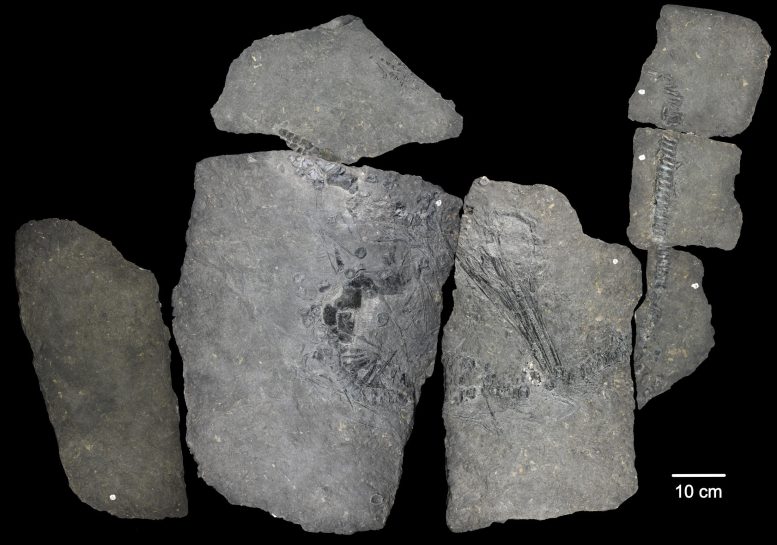
    Radiography Imaging of a Middle Triassic Mixosaurid From Svalbard
    Photograph of specimen PMO 219.250. Credit: Engelschiøn et al. PLOS ONE, CC-BY 4.0

    New research reveals that sulfur minerals that make fossils in the Norwegian archipelago are especially well-suited to radiography.

    X-ray analysis has led to the categorization of a previously unidentified marine reptile fossil discovered in Edgeøya, Svalbard. The research was recently published in the journal PLOS ONE.  The study, conducted by Victoria S. Engelschiøn of the University of Oslo and her team, suggests that this method could reveal fresh insights about ancient life in the future.

    The effectiveness of X-ray techniques in investigating well-conserved fossil remains is often dependent on the condition of preservation, which can vary greatly across different sites. Through this study, Engelschiøn and her team showed that fossils from the Middle Triassic Botneheia Formation in Svalbard, Norway, are particularly suitable for radiographic imaging.
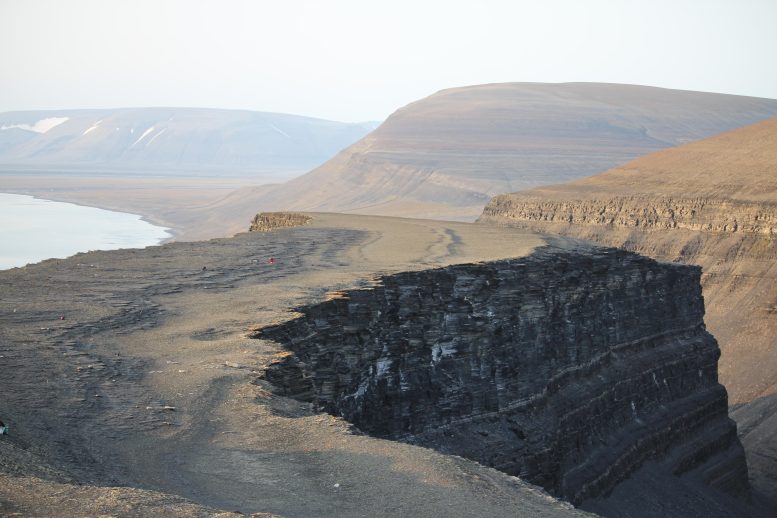
    Muen Plateau
    An overlook of the Muen plateau as seen from the Muen mountain on Edgeøya, Svalbard. Marine reptiles are spread out across the plateau. Author VSE in red jacket for scale. Credit: Sofie Bernhardsen, CC-BY 4.0

    The focus of this study is a fossil marine reptile whose remains are compressed and encased in shale. It lived around 240 million years ago, when Svalbard was covered by an ocean. After it died, it sank to the seafloor and was buried in the mud, then became extremely flattened over time. Originally excavated in 2008, the identity of this fossil has since been debated. X-ray imaging of the specimen revealed new details, including features of the skull and teeth that allowed researchers to conclude that this reptile most likely belongs to the ichthyosaur species Phalarodon atavus.

    The authors also examined the mineralogy of fossils from this formation, identifying multiple forms of sulfate minerals, notably including sulfate baryte, which gives the fossils very high X-ray contrast, allowing for the high quality of radiographic imaging. The formation of these minerals is little understood but could be linked to conditions created by ancient volcanic activity. Thus, this study not only demonstrates the utility of X-ray techniques for studying these fossils, but also identifies conditions that can form fossils well-suited for these techniques, in Svalbard and potentially elsewhere.

    The authors add: “The rocks from Svalbard are full of flattened marine reptiles. Our discovery of the exceptional X-Ray contrast means that we can learn much more about these ancient predators than we previously thought.”

    Reference: “Exceptional X-Ray contrast: Radiography imaging of a Middle Triassic mixosaurid from Svalbard” by Victoria S. Engelschiøn, Aubrey J. Roberts, Ruben With and Øyvind Hammer, 31 May 2023, PLOS ONE.
    DOI: 10.1371/journal.pone.0285939

    Never miss a breakthrough: Join the SciTechDaily newsletter.
    Follow us on Google and Google News.

    Fossils Paleontology PLOS Popular University of Oslo
    Share. Facebook Twitter Pinterest LinkedIn Email Reddit

    Related Articles

    Massive Dinosaur Footprints Reveal Secrets of Scotland’s Ancient Lagoons

    Forgotten Fossils: Mysterious Tusked Creature Unearthed in Rock Art

    Dinosaur “Mummies” Might Not Be Unusual – Unhealed Carnivore Damage on Dinosaur Skin

    Fossils Reveal Headbutts May Have Been Used as a Dinosaur Courtship Behavior

    Jaw Structures of Fossils Seems to Suggest That Three Homo Species Roamed Africa Concurrently

    Prehistoric Fossilized Eocene Epoch Turtles Died Locked In Coitus

    Cretaceous Period Sankofa Pyrenaica Fossilized Eggs Are Unusually Shaped

    Microraptor Feathers Were Black With Iridescent Sheen

    Hundreds of Lost Fossils From the Darwin Collection Rediscovered by the British Geological Survey

    Leave A Reply Cancel Reply

    • Facebook
    • Twitter
    • Pinterest
    • YouTube

    Don't Miss a Discovery

    Subscribe for the Latest in Science & Tech!

    Trending News

    Scientists Uncover Potential Brain Risks of Popular Fish Oil Supplements

    Scientists Discover a Surprising Way To Make Bread Healthier and More Nutritious

    After 60 Years, Scientists Uncover Unexpected Brain Effects of Popular Diabetes Drug Metformin

    New Research Uncovers Hidden Side Effects of Popular Weight-Loss Drugs

    Scientists Rethink Extreme Warming After Surprising Ocean Discovery

    Landmark Study Links Never Marrying to Significantly Higher Cancer Risk

    Researchers Discover Unknown Beetle Species Just Steps From Their Lab

    Largest-Ever Study Finds Medicinal Cannabis Ineffective for Anxiety, Depression, PTSD

    Follow SciTechDaily
    • Facebook
    • Twitter
    • YouTube
    • Pinterest
    • Newsletter
    • RSS
    SciTech News
    • Biology News
    • Chemistry News
    • Earth News
    • Health News
    • Physics News
    • Science News
    • Space News
    • Technology News
    Recent Posts
    • Early Warning Signals of Esophageal Cancer May Be Hiding in Plain Sight
    • Researchers Have Discovered a THC-Free Cannabis Compound That May Replace Opioids
    • Common Blood Pressure Drug Shows Surprising Power Against Deadly Antibiotic-Resistant Superbug
    • Students Build Dark Matter Detector and Set New Experimental Limits
    • Scientists Discover Caffeine Can Repair Key Memory Circuits After Sleep Loss
    Copyright © 1998 - 2026 SciTechDaily. All Rights Reserved.
    • Science News
    • About
    • Contact
    • Editorial Board
    • Privacy Policy
    • Terms of Use

    Type above and press Enter to search. Press Esc to cancel.