
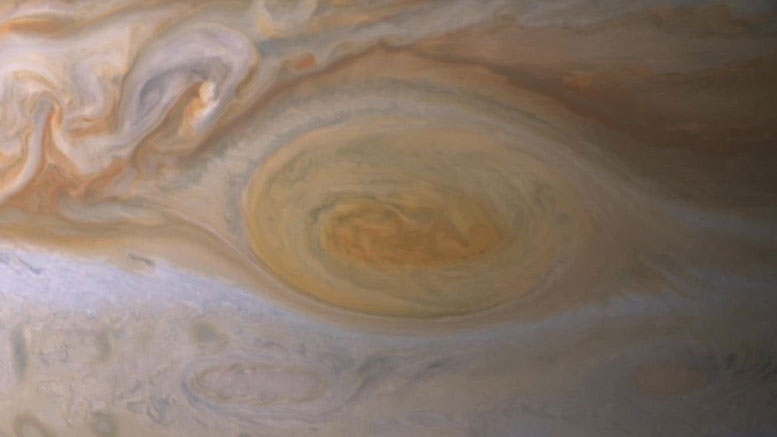
Though once big enough to swallow three Earths with room to spare, Jupiter’s Great Red Spot has been shrinking for a century and a half. Nobody is sure how long the storm will continue to contract or whether it will disappear altogether.
A new study suggests that it hasn’t all been downhill, though. The storm seems to have increased in area at least once along the way, and it’s growing taller as it gets smaller.
“Storms are dynamic, and that’s what we see with the Great Red Spot. It’s constantly changing in size and shape, and its winds shift, as well,” said Amy Simon, an expert in planetary atmospheres at NASA’s Goddard Space Flight Center in Greenbelt, Maryland, and lead author of the new paper, published in the Astronomical Journal.
Scientists have noticed that Jupiter’s Great Red Spot has been getting smaller over time. Now, there’s evidence the storm is actually growing taller as it shrinks. Credit: NASA’s Goddard Space Flight Center
Observations of Jupiter date back centuries, but the first confirmed sighting of the Great Red Spot was in 1831. (Researchers aren’t certain whether earlier observers who saw a red spot on Jupiter were looking at the same storm.)
Keen observers have long been able to measure the size and drift of the Great Red Spot by fitting their telescopes with an eyepiece scored with crosshairs. A continuous record of at least one observation of this kind per year dates back to 1878.
Simon and her colleagues drew on this rich archive of historical observations and combined them with data from NASA spacecraft, starting with the two Voyager missions in 1979. In particular, the group relied on a series of annual observations of Jupiter that team members have been conducting with NASA’s Hubble Space Telescope as part of the Outer Planets Atmospheres Legacy, or OPAL, project. The OPAL team scientists are based at Goddard, the University of California at Berkeley, and NASA’s Jet Propulsion Laboratory in Pasadena, California,
The team traced the evolution of the Great Red Spot, analyzing its size, shape, color, and drift rate. They also looked at the storm’s internal wind speeds, when that information was available from the spacecraft.
The new findings indicate that the Great Red Spot recently started to drift westward faster than before. The storm always stays at the same latitude, held there by jet streams to the north and south, but it circles the globe in the opposite direction relative to the planet’s eastward rotation. Historically, it’s been assumed that this drift is more or less constant, but in recent observations, the team found the spot is zooming along much faster.
The study confirms that the storm has been decreasing in length overall since 1878 and is big enough to accommodate just over one Earth at this point. But the historical record indicates the area of the spot grew temporarily in the 1920s.
“There is evidence in the archived observations that the Great Red Spot has grown and shrunk over time,” said co-author Reta Beebe, an emeritus professor at New Mexico State University in Las Cruces. “However, the storm is quite small now, and it’s been a long time since it last grew.”
Because the storm has been contracting, the researchers expected to find the already-powerful internal winds becoming even stronger, like an ice skater who spins faster as she pulls in her arms.
Instead of spinning faster, the storm appears to be forced to stretch up. It’s almost like clay being shaped on a potter’s wheel. As the wheel spins, an artist can transform a short, round lump into a tall, thin vase by pushing inward with his hands. The smaller he makes the base, the taller the vessel will grow.
In the case of the Great Red Spot, the change in height is small relative to the area that the storm covers, but it’s still noticeable.
The Great Red Spot’s color has been deepening, too, becoming intensely orange since 2014. Researchers aren’t sure why that’s happening, but it’s possible that the chemicals which color the storm are being carried higher into the atmosphere as the spot stretches up. At higher altitudes, the chemicals would be subjected to more UV radiation and would take on a deeper color.
In some ways, the mystery of the Great Red Spot only seems to deepen as the iconic storm contracts. Researchers don’t know whether the spot will shrink a bit more and then stabilize, or break apart completely.
“If the trends we see in the Great Red Spot continue, the next five to 10 years could be very interesting from a dynamical point of view,” said Goddard co-author Rick Cosentino. “We could see rapid changes in the storm’s physical appearance and behavior, and maybe the red spot will end up being not so great after all.”
Reference: “Historical and Contemporary Trends in the Size, Drift, and Color of Jupiter’s Great Red Spot” by Amy A. Simon, Fachreddin Tabataba-Vakili, Richard Cosentino, Reta F. Beebe, Michael H. Wong and Glenn S. Orton, 13 March 2018, The Astrophysical Journal.
DOI: 10.3847/1538-3881/aaae01
Never miss a breakthrough: Join the SciTechDaily newsletter.
Follow us on Google and Google News.