
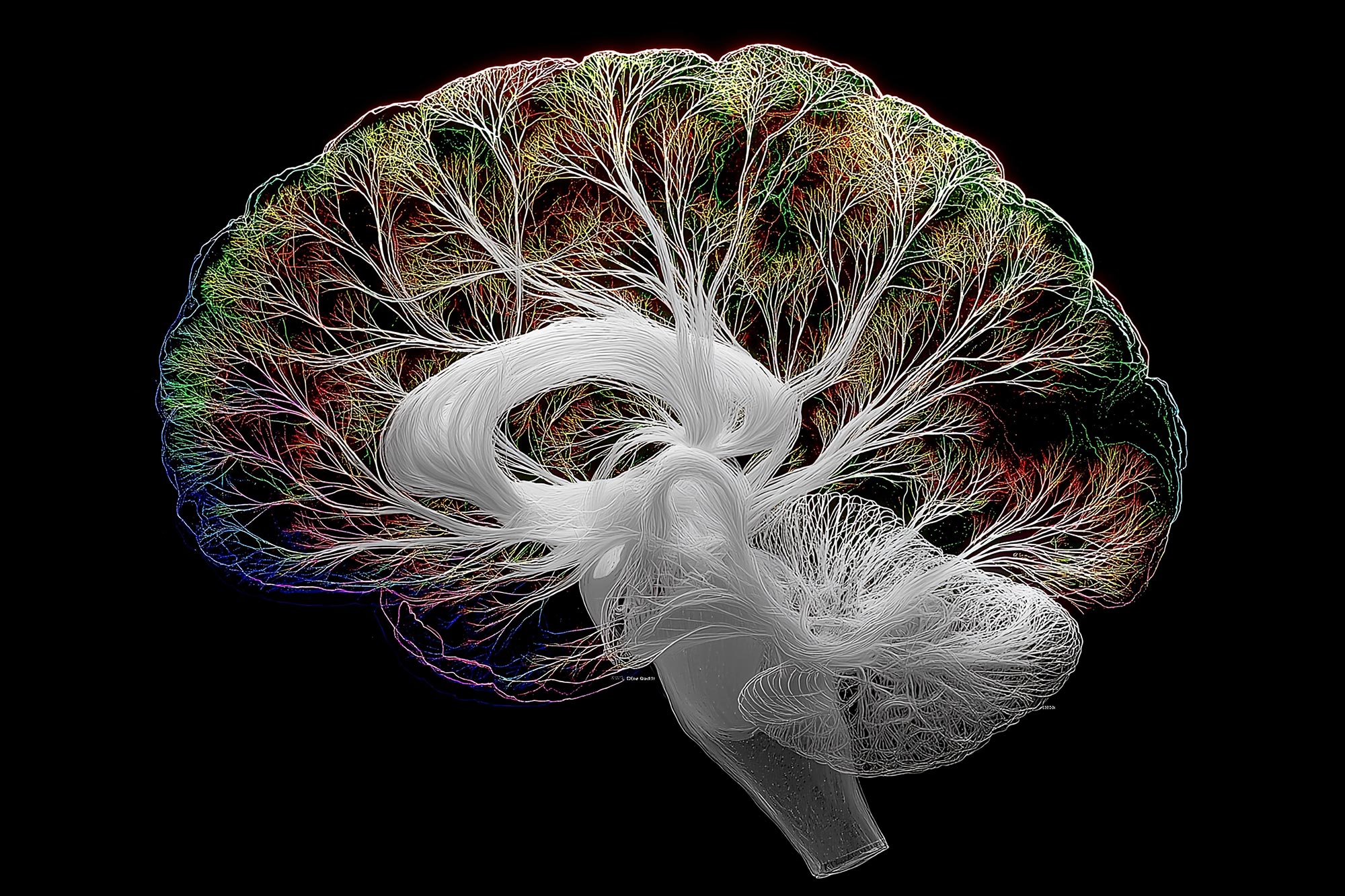
The brain’s wiring forms a unique fingerprint that reveals how we think, remember, and make decisions.
A new study offers the strongest evidence so far that the way different parts of the brain are wired together can reveal what each region is designed to do. By analyzing large-scale brain data, researchers found that connection patterns themselves hold clues about specialized functions across the brain.
Earlier work had linked connectivity to individual abilities such as perception or social behavior. This new research expands that view, examining how connectivity relates to many mental functions across the entire brain. Lead author Kelly Hiersche, a doctoral student in psychology at The Ohio State University, described the approach as providing a “bird’s eye view” of how brain structure supports a wide range of cognitive abilities.
“We found evidence suggesting that connectivity is a fundamental organizational principle governing brain function, which has implications for understanding what happens when things go wrong in the brain,” Hiersche said.
The Brain’s Unique Connectivity Fingerprints
The researchers report that each brain region carries its own distinctive “connectivity fingerprint.” These fingerprints reflect how a region is linked to other parts of the brain and correspond to the mental tasks it performs.
“Just like how everyone’s fingerprint is unique, we find that different brain regions have uniquely identifying connectivity fingerprints based on what mental function they perform,” said co-author Zeynep Saygin, associate professor of psychology at Ohio State.
Senior author David Osher, assistant professor of psychology at Ohio State, explained that scientists can use these fingerprints to predict what a region does. “Our findings help us understand the connectivity pattern that makes a language area unique, for example, and what makes it different from adjacent areas in the brain,” Osher said.
The results were published in the journal Network Neuroscience.
Combining MRI Brain Scans and Cognitive Maps
To conduct the study, the team used data from the Human Connectome Project, which includes MRI scans from 1,018 participants. These scans capture how brain regions are connected.
The researchers also relied on NeuroQuery, an online meta-analysis tool that generates brain maps for specific cognitive processes. NeuroQuery estimates how the brain activates across 33 mental functions, including speech, decision-making, listening to music, and face perception. Hiersche and her colleagues then developed computational models that linked the connectivity data from MRI scans with the activity patterns identified by NeuroQuery.
Connectivity Predicts Brain Activity
The findings revealed a strong and reliable relationship between connectivity patterns and brain activation across nearly all regions and cognitive domains. Specific wiring patterns could predict whether a region would be active—or inactive—during different tasks, from recognizing a face to having a conversation or making a choice.
“It supports a broadly held hypothesis among neuroscientists, that brain connectivity determines brain function, but this has not been explicitly shown until now, and not across such a large breadth of cognitive domains,” Osher said.
Stronger Links in Higher Level Skills
Although the connection between wiring and function appeared throughout the brain, the tightest relationships were found in areas responsible for higher-level abilities such as executive function and memory. These regions showed stronger connectivity function alignment than areas involved in sensory processing or social skills, Hiersche said.
“These higher-level skills take many years to develop in people, much longer than sensory or social skills,” she said.
“It may be that as you continually use these regions of the brain for them to develop, it results in this very tight link between connectivity and function for these higher-order skills.”
A Baseline for Understanding Brain Disorders
Because the study examined the whole brain at once, it provides a reference point for how healthy young adult brains are typically organized, Hiersche said.
Researchers can now compare this baseline to brain data from people with neurological or psychiatric conditions to better understand how connectivity and function differ in those cases.
“Knowing that connectivity is a general organizational principle of brain function across the entire brain provides a foundation for future work in this area.”
Reference: “Connectivity and function are coupled across cognitive domains throughout the brain” by Kelly J. Hiersche, Zeynep M. Saygin and David E. Osher, 8 January 2026, Network Neuroscience.
DOI: 10.1162/NETN.a.504
Never miss a breakthrough: Join the SciTechDaily newsletter.
Follow us on Google and Google News.
1 Comment
I’d like to know about what’s happening in the brain when we have original or creative thinking—connecting the dots, suddenly thinking something new, a door opening, the thrill of a cognitive leap, etc.