

Researchers find multiple important biomarkers in people with Hikikomori (pathological social withdrawal), and they demonstrate their potential for predicting the severity of the disorder.
Key blood biomarkers for the pathological social withdrawal disorder called Hikikomori have been discovered by researchers at Kyushu University. The team’s research enabled them to distinguish between healthy people and hikikomori sufferers, as well as to gauge the severity of the disease.
Hikikomori is a condition in which people isolate themselves from society and family for a time longer than six months, according to the Ministry of Health, Labour, and Welfare of Japan. Hikikomori, also called “pathological social withdrawal,” is said to affect over a million individuals in Japan as of 2022. Although it has traditionally been thought of as a syndrome specific to the Japanese culture, evidence over the past few decades has shown that it is increasingly becoming a global phenomenon. Some fear that the COVID-19 pandemic will cause a wave of hikikomori patients to spread throughout the world.
The Kyushu University Hospital opened the first outpatient clinic in the world for hikikomori research in 2013 with the goal of creating patient support systems through biological, psychological, and social understanding of the condition.
Biological Aspects of Hikikomori
In a report published in Dialogues in Clinical Neuroscience, lead researcher Takahiro A. Kato of Kyushu University’s Faculty of Medical Sciences explains that while the sociological underpinnings of the condition are carefully studied, major gaps remain in the understanding of the biological aspects of hikikomori.
“Mental illnesses such as depression, schizophrenia, and social anxiety disorder are occasionally observed in hikikomori individuals. However, our past research shows that it is not that simple, and that it is a complex condition with overlaps of different psychiatric and non-psychiatric elements,” explains Kato. “Understanding what happens biologically will help us greatly in identifying and treating hikikomori.”
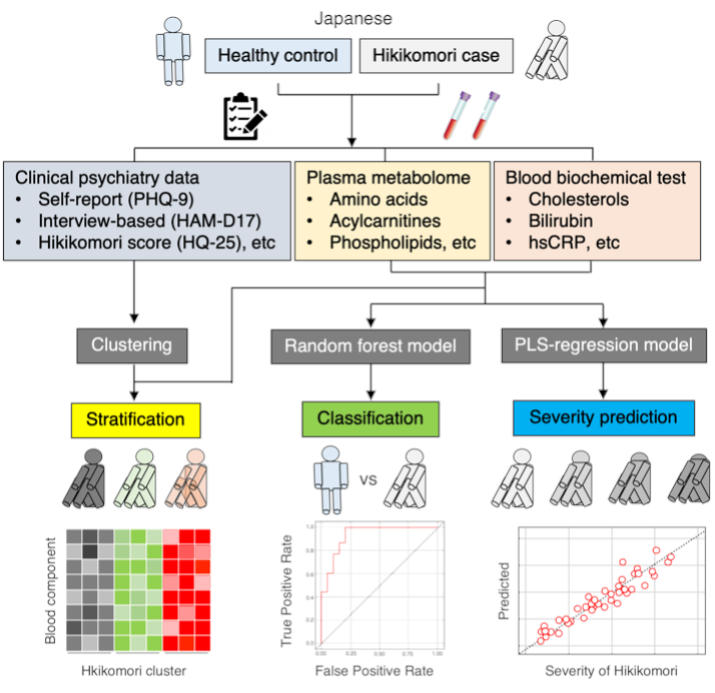
The team conducted blood biochemical tests and collected data on the plasma metabolome—small molecules found in the blood such as sugars, amino acids, and proteins—from 42 unmedicated hikikomori individuals and compared it with data from 41 healthy volunteers. In total, data for 127 molecules were analyzed.
Elevated Ornithine, Acylcarnitine, and Disturbed Arginine Metabolism
“Some of our key findings showed that in the blood of men with hikikomori, ornithine levels, and serum arginase activity were higher while bilirubin and arginine levels were lower,” states first author of the paper Daiki Setoyama. “In both men and women patients, long-chain acylcarnitine levels were higher. Moreover, when this data was further analyzed and categorized, we were able to distinguish between healthy and hikikomori individuals, and even predict its severity.”
Ornithine is an amino acid produced from the amino acid arginine with the help of the enzyme arginase. These molecules are vital in many bodily functions, including blood pressure regulation and the urea cycle.
Bilirubin is made when the liver breaks down red blood cells and is often used as a marker for proper liver function. Patients with major depression and seasonal affective disorder have been reported to have lower blood bilirubin levels.
Differences in Acylcarnitines Between Hikikomori and Depression
Finally, acylcarnitines play an important role in supplying energy to the brain. Its levels decrease when patients with depression take selective serotonin reuptake inhibitors. However, patients with hikikomori differ from patients with depression in that only the long-chain acylcarnitines are elevated in hikikomori whereas short-chain acylcarnitines remain the same.
Says Kato, “Identifying the biomarkers of hikikomori is the first step in uncovering the biological roots of the condition and connecting them to its severity. We hope these findings will lead to better-specialized treatments and support for hikikomori.”
“Many questions remain, including understanding the root causes behind these biomarkers. Today, hikikomori is spreading worldwide, thus, we must conduct international investigations to understand the similarities and differences between patients with hikikomori globally,” he concludes.
Reference: “Blood metabolic signatures of hikikomori, pathological social withdrawal” by Daiki Setoyamaa, Toshio Matsushima, Kohei Hayakawa, Tomohiro Nakao, Shigenobu Kanba, Dongchon Kang and Takahiro A. Kato, 1 June 2022, Dialogues in Clinical Neuroscience.
DOI: 10.1080/19585969.2022.2046978
The study was funded by the Japan Society for the Promotion of Science and the Japan Agency for Medical Research and Development.
Never miss a breakthrough: Join the SciTechDaily newsletter.
Follow us on Google and Google News.
1 Comment
This new mental health issue with a cool name is looking for biomarkers that could or could not identify a mental illness. Hikikomori effects who the most? Males between what age group? Or women between what age? I seems this is a antisocial behavior brought on by stress and the lack of pussy. Get them dudes some pussy and watch them strut back into normal adult male behavior. This is what I want a doctor scrip for pussy , 4 to 5 times a week, in the morning or afternoon, best taken with a red or white wine. A fine whisky well.all so.do. no cannabis or beer. Scrip is for 30 days and you have 2 refills. Yo big brains, get it right , it’s all about the nookie. Man haven’t learned that yet. Please hurry with this research so I can me a pussy scrip too. Peace all.