
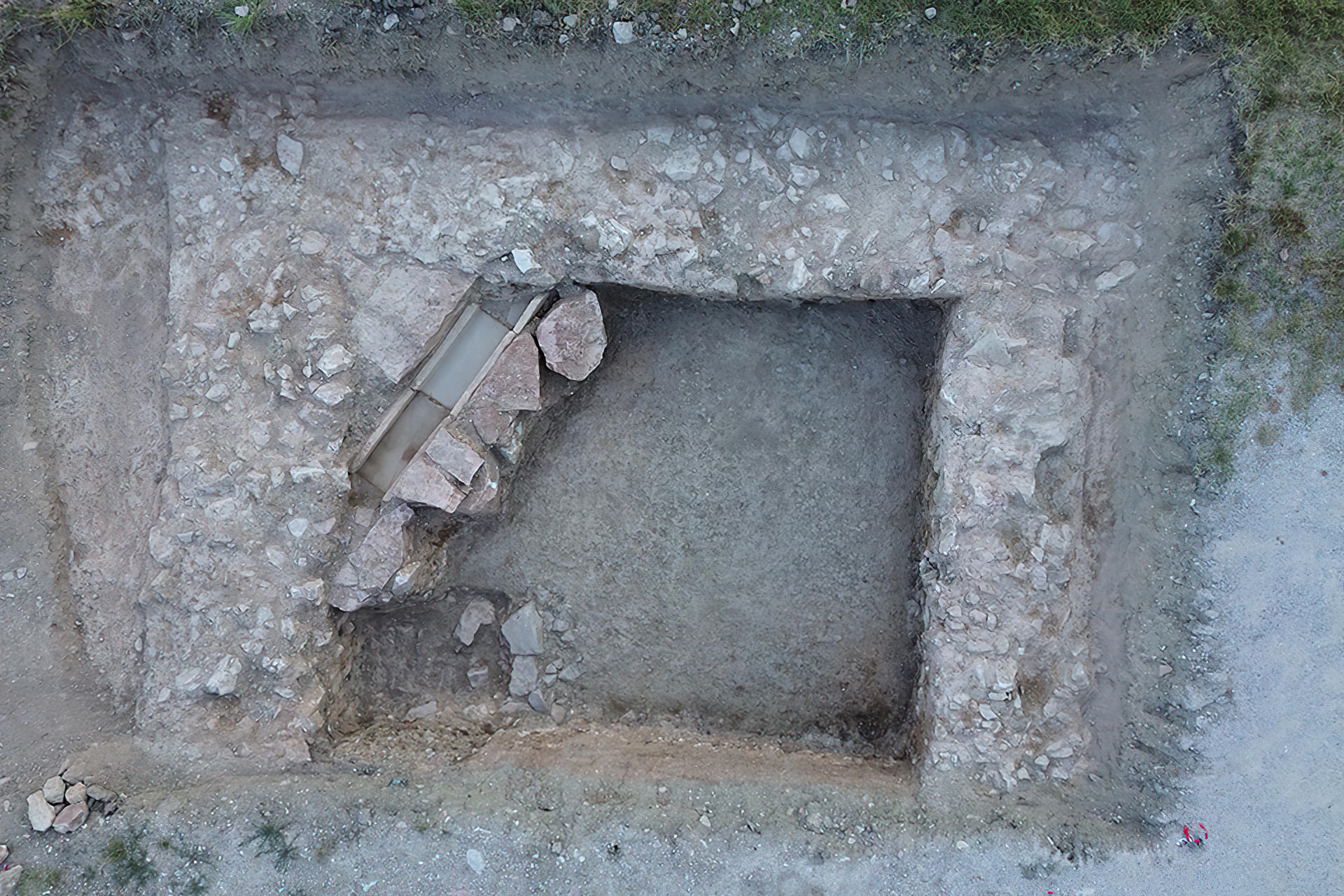
Douglas Boin, Ph.D., a history professor at Saint Louis University, unveiled a groundbreaking discovery during the annual meeting of the Archeological Institute of America. He announced that his team had uncovered an ancient Roman temple, offering a substantial new understanding of the transition from pagan deities to Christianity within the Roman Empire.
“We found three walls of a monumental structure that evidence suggests belonged to a Roman temple that dates to Constantine’s period,” Boin said. “It dates to the fourth century AD and it would be a remarkable addition to the landscape of this corner of Italy. It will significantly aid in the understanding of the ancient town, the ancient townscape, and city society in the later Roman Empire because it shows the continuities between the classical pagan world and early Christian Roman world that often get blurred out or written out of the sweeping historical narratives.”
Insights into Religious Continuity
Boin and his excavation team made the monumental discovery over the summer. Boin, an expert in ancient Roman and its religious transitions, had been digging in the town of Spello, the famous medieval hilltop city about 20 minutes from Assisi and 2.5 hours north of Rome. Boin selected the town based on a rescript of a 4th-century letter from Emperor Constantine to the townspeople regarding a religious holiday.
This rescript, which was discovered in the 18th century, allowed the people of Spello to celebrate a religious festival in their hometown rather than travel a great distance to another festival. However, in order to do so, the town was told it must erect a temple to Constantine’s divine ancestors, the Flavian family, and worship them, showcasing how multicultural Roman society was at the time.
“There was a remarkable religious continuity between the Roman world and the early Christian world,” Boin said. “Things didn’t change overnight. Before our find, we never had a sense that there were actual physical, religious sites associated with this late ‘imperial cult practice.’ But because of the inscription and its reference to a temple, Spello offered a very tantalizing potential for a major discovery of an Imperial cult underneath a Christian ruler.”
Boin traveled to Spello and oversaw underground imaging to determine if there were any potential ruins below the surface that needed to be uncovered. After many weeks, and almost by chance, Boin finally received promising images underneath a parking lot where the temple was suspected to be.
Very carefully, the team dug into the ground until they found two adjoining walls. More digging unearthed what Boin believes to be the inside walls of the temple. This temple immediately became what Boin calls the largest evidence ever of the Imperial Cult in both fourth-century Italy and the late Roman Empire..
“There’s evidence from other places throughout the Roman world that Christian rulers supported imperial cult practices,” Boin said. “We’ve known that pagans worshiped at their temples in the fourth century, but those findings have all been small and inconsequential. And we’ve known that Christians supported the imperial cult, and we’ve known that without any sense of where it would have happened. This temple bridges those two landmarks, and in that respect, it is unlike any temple that I know about from the Mediterranean world of the fourth century Roman Empire. Any study of the imperial cult in the fourth century Roman Empire is now going to have to take account of this temple, which is an incredible discovery to make.”
With the discovery, Boin now can show how the societal changes of the time moved very slowly. Though Constantine was the first Roman emperor to famously convert to Christianity, it would take almost 70 years for Christianity to become the official religion of the Roman Empire, under the Emperor Theodosius. During that time it still took many convincing and gradual shifts for those who worshiped pagan gods to convert to Christianity.
“This changes everything about how we perceive the pace of social change and our impression of the impact of social and cultural change,” Boin said. “This building, in a very radical way on its own, shows us the staying power of the pagan traditions that had been on the ground for centuries prior to the rise of Christianity, and it shows us how the Roman emperors continued to negotiate their own values, their own hopes and dreams for the future of the emperor and the Empire without knocking down or burying the past.”
Future Excavations and Implications
Boin and his team will return to Spello next summer to completely excavate the area to examine the full temple, where he hopes to make even more significant discoveries.
“We are on the cusp of giving people a very visible piece of evidence that really upends the neat and tidy ways people think about big moments of cultural change,” Boin said “Cultural changes are never as big as we think they are when living through them, and there’s a lot of gray area in between people’s customs and the broader society and culture. And a lot of those can be left out of the story. So to have this temple potentially be a temple dedicated to Constantice’s divine ancestors as a way to worship the emperor in an increasingly Christian world at the time, it’s so weird and I love that we can bring it to light.”
Never miss a breakthrough: Join the SciTechDaily newsletter.
Follow us on Google and Google News.
3 Comments
It was the writing staff of Flavius Titus who invented “Jesus” and “Christianity” in order to pacify rebellious people of Rome’s middle eastern provinces. See Joseph Atwill’s book “Caesar’s Messiah.”
This is a very ignorant post.
A bit depressing when one thinks of the cultural changes we need to make to prevent Anthropogenic Global Heating getting any worse than it has become. Switching religion is simple by comparison.