
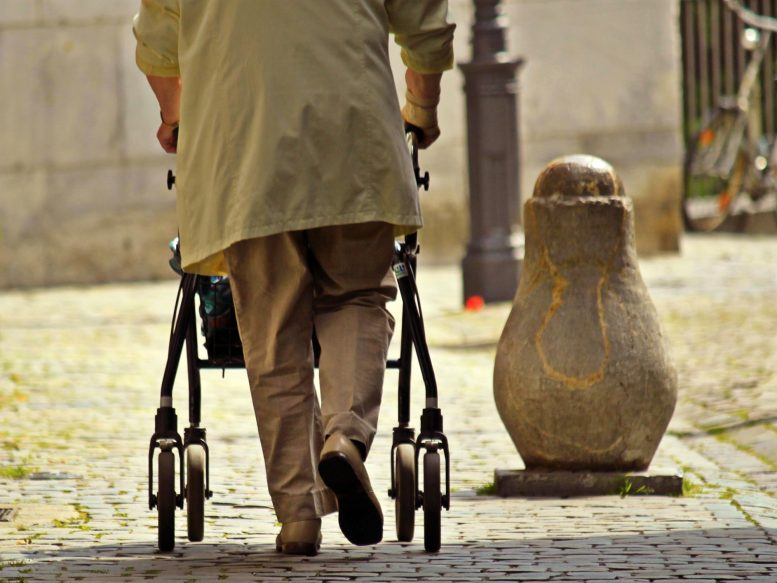
Frailty, not just age, significantly increases the risk of death and long-term care needs in COVID-19 patients.
New research led by the University of Birmingham has revealed for the first time the extent to which frailty increases the risk of mortality in COVID-19 patients.
The clinical observational study, involving 5,711 patients with COVID-19 at 55 hospitals across 12 countries, found that very severely frail individuals with COVID-19 are three times more likely to die than those who were not frail, even taking into account their age. It also found that those with severe frailty who survived the virus were seven times more likely to go on to need increased care at home or in care homes.
The Geriatric Medicine Research Collaborative (GeMRC) — the group of experts behind the study — are now calling for improved global public health policy after their research showed that frailty, independently of older age, increases the risk of death from COVID-19.
Frailty is a state where the body becomes more vulnerable to the effects of illness. It is identified by clinicians using a holistic assessment that considers how much support the person needs from others in their daily living before becoming unwell — not just their medical problems, but the person as a whole. The risk of frailty increases as we get older, but it can develop at different ages.
Age Isn’t Everything
Senior author Dr. Carly Welch, clinical research fellow in geriatric medicine at the University of Birmingham’s Institute of Inflammation & Ageing, and Chair and Co-Founder of GeMRC, said: “It was identified very early in the pandemic that older age was a significant risk factor for a higher chance of death with COVID-19.
“However, not all older people are the same, we all age differently — some people can live well into their 90s without developing frailty, and it can develop even without the presence of other long-term conditions.
“Our findings are important as we have been able to demonstrate that not only older age but also frailty, independently from one another, increase the risk of death from COVID-19 and also a subsequent increased need in care for survivors.”
Dr. Daisy Wilson, clinical research fellow at the University of Birmingham, added: “We now have evidence to show that those most at risk from COVID-19 are those who are older, or living with frailty, or have underlying health conditions.”
GeMRC hopes the research findings will influence public health policy, including advice on shielding and recommendations for prioritization on vaccination for those with frailty.
Better Understanding for Better Care
Dr. Mary Ni Lochlainn, of King’s College London, added: “We hope that this research will help to enable increased understanding of frailty as occurring separately to age and that frailty can be considered alongside age in policies both in and outside of hospital.
“Increased understanding of frailty within the general public will enable improved communication between clinicians, patients, and their relatives or carers, and can be used in thinking about how we ensure that the right treatment is given for all patients in line with their wishes.”
The research, published today (Feb 5th) in Age and Ageing and supported by the National Institute for Health Research (NIHR), is the largest international study of its kind to date.
The results also showed that delirium — a state of clouding of the mind and extremely prevalent in patients with COVID-19 — is not itself independently associated with an increased risk of mortality.
Meanwhile, the findings also showed an increased likelihood of transition to a higher level of care upon discharge from hospital for those COVID-19 patients with increasing age, frailty, delirium, dementia, and mental health problems.
Further research is encouraged to understand what factors affect recovery of physical function and quality of life with COVID-19, and the inclusion of older adults with frailty in such research is paramount.
Reference: “Age and frailty are independently associated with increased COVID-19 mortality and increased care needs in survivors: results of an international multi-centre study” by Wilson et al., 5 February 2021, Age and Ageing.
DOI: 10.1093/ageing/afab026
Never miss a breakthrough: Join the SciTechDaily newsletter.
Follow us on Google and Google News.
2 Comments
Especially when we’re giving them 3x the recommended dosage.
I really at a loss. Who writes crap like this. Guess I need to go somewhere else. This site was put together by preschoolers.