
A groundbreaking study introduces new noninvasive screening tools that have the potential to greatly enhance patient comfort and clinical outcomes.
Researchers have found that examining certain patterns of cell-free DNA (cfDNA) fragments in urine can accurately identify and assess the stage of bladder cancer. This method provides a promising alternative to invasive procedures like cystoscopies. According to a new study in The Journal of Molecular Diagnostics, published by Elsevier, this type of testing may lessen the need for repeated cystoscopies, reduce medical costs, and improve overall comfort and care for patients.
Bladder cancer continues to be difficult to manage because it is both common and highly prone to returning after treatment. Despite these challenges, diagnosis still depends largely on invasive and expensive techniques such as cystoscopy (inserting a thin, tube-like instrument through the urethra). Cytology, a noninvasive test that detects tumor cells shed into urine, is also used, but its sensitivity is limited.
Urine cfDNA as a Diagnostic and Monitoring Tool
To explore a more patient-friendly option, the research team examined urine from 156 individuals with bladder cancer and 79 matched controls. Using real-time PCR, they evaluated both the amount and the integrity (long-short size distribution) of cfDNA fragments from five genes (ACTB, AR, MYC, BCAS1, and STOX1).
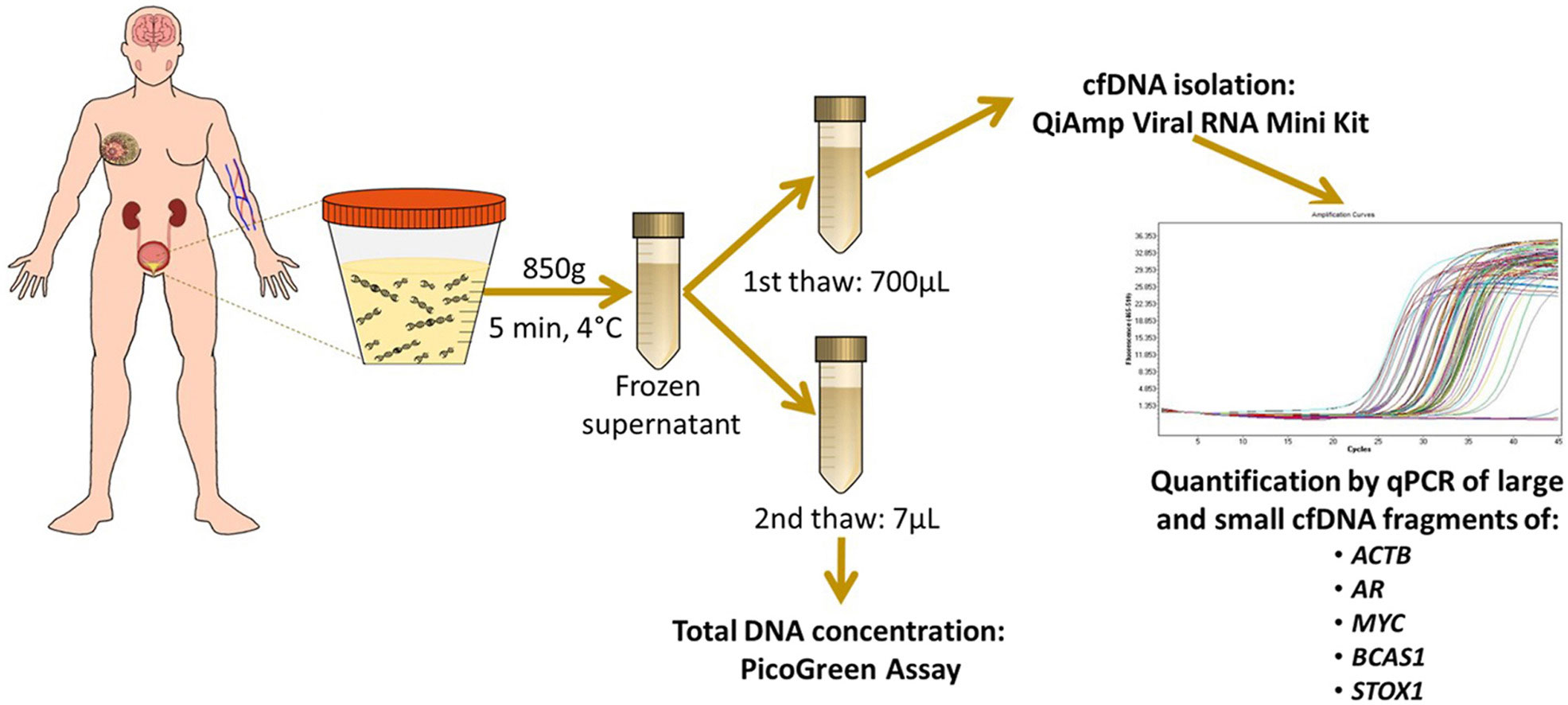
“Our most significant finding was that the small fragment of the MYC gene may represent a valuable tool to diagnose bladder cancer, as it exhibited excellent specificity (97%) and predictive value (88%) for identifying muscle-invasive bladder cancer,” explains lead investigator Pilar Medina, PhD, Haemostasis, Thrombosis, Arteriosclerosis and Vascular Biology Research Group, Health Research Institute Hospital La Fe (IIS La Fe), Valencia, Spain.
MYC produces a transcription factor crucial for regulating cell growth, proliferation, and metabolism.
New Biomarkers for Staging and Relapse Detection
Additionally, researchers found that the ratio of large to small fragments of the housekeeping gene ACTB and the small fragment of the AR gene increased with disease severity, suggesting these could be reliable staging biomarkers. The integrity of these genes may be useful to identify bladder cancer relapse.
Lead author Raquel Herranz, MS, Haemostasis, Thrombosis, Arteriosclerosis and Vascular Biology Research Group, Health Research Institute Hospital La Fe (IIS La Fe), Valencia, Spain, notes, “With growing interest in liquid biopsies and personalized medicine, our study offers a timely and practical alternative to invasive diagnostics. This study is one of the first to comprehensively evaluate urine cfDNA fragmentation and integrity across most bladder cancer stages, bringing us closer to a future in which bladder cancer can be diagnosed and monitored through a simple urine test, improving patient comfort and care.”
Dr. Medina concludes, “Our findings show that urine can tell us much more than we thought; it holds the potential to transform how we detect and manage bladder cancer.”
Reference: “Analysis of the Fragmentation and Integrity of Urine Cell-Free DNA as a Diagnostic and Staging Biomarker for Bladder Cancer” by Raquel Herranz, Julia Oto, Emma Plana, Javier Pérez-Ardavín, Patricia Verger, Manuel Martínez-Sarmiento, César D. Vera-Donoso and Pilar Medina, 26 September 2025, The Journal of Molecular Diagnostics.
DOI: 10.1016/j.jmoldx.2025.08.010
This study was supported by the Instituto de Salud Carlos III (ISCIII) research grants PI17/00495, PI20/00075, FI21/00171, PI23/00449, FORT23/00021, and PI24/01607; cofunded by the European Regional Development Fund “A way to make Europe” or cofunded by the European Union; and the Sociedad Española de Trombosis y Hemostasia.
Never miss a breakthrough: Join the SciTechDaily newsletter.
Follow us on Google and Google News.
1 Comment
I’m interested for the obvious reason. What I can’t understand from the information provided is whether this type of UA is more accurate than cystoscopy and cytology. Do any of them detect cancer that another might miss? 88% or 95% might sound promising, but being one of the 12% or 5% still sucks. If I can improve the odds of early detection by ADDING this test, I’ll do that. If it’s going to possibly result in a false negative that cystoscopy would have caught, I will endure the discomfort.