
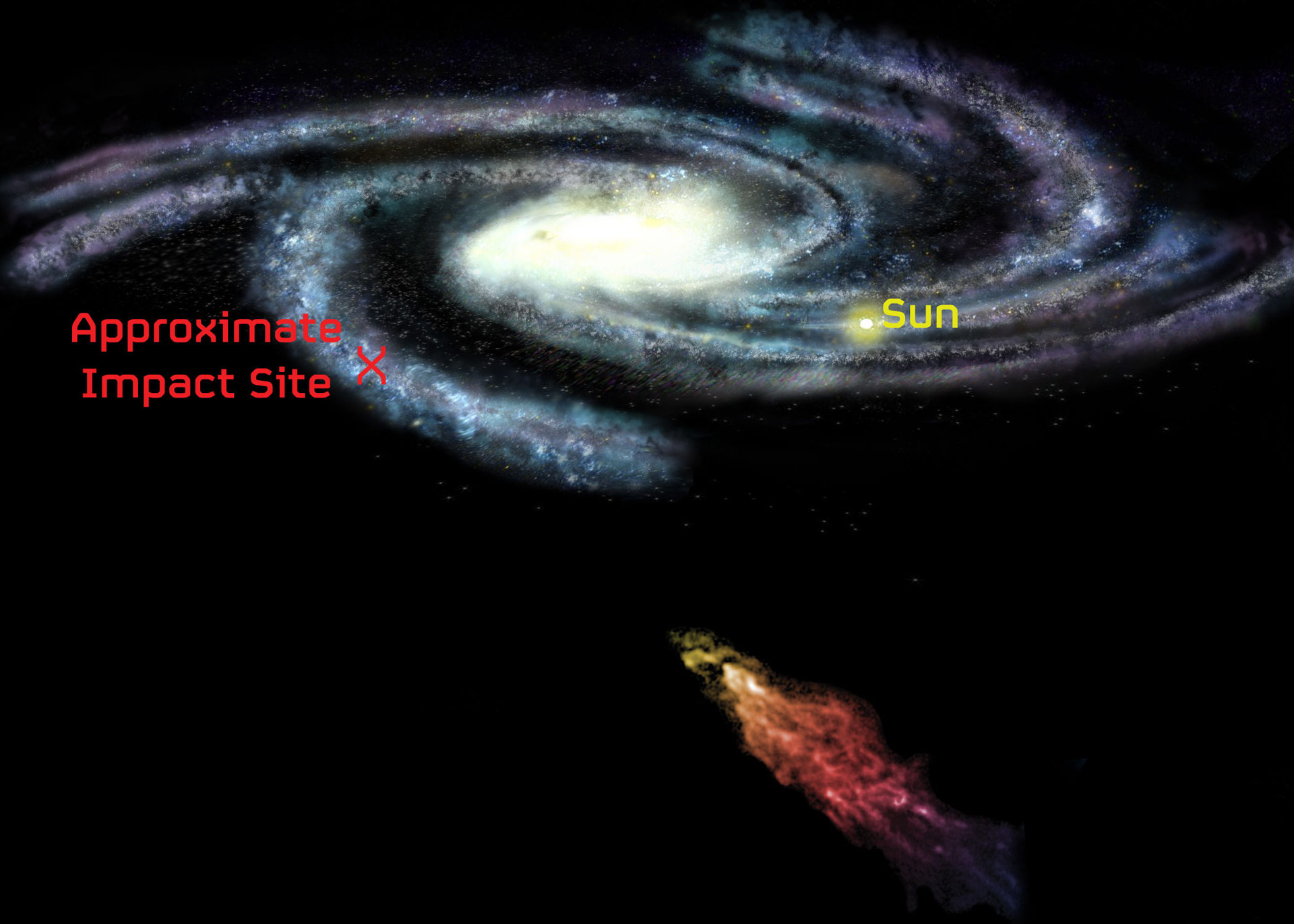
Using the National Science Foundation’s Karl G. Jansky Very Large Array and Robert C. Byrd Green Bank Telescope, astronomers discovered a magnetic field deep in the Smith Cloud, which is hurtling toward the Milky Way at more than 150 miles per second and is predicted to impact in approximately 30 million years, that may help explain how so-called high-velocity clouds remain mostly intact during their mergers with the disks of galaxies.
Doom may be averted for the Smith Cloud, a gigantic streamer of hydrogen gas that is on a collision course with the Milky Way Galaxy. Astronomers using the National Science Foundation’s Karl G. Jansky Very Large Array (VLA) and Robert C. Byrd Green Bank Telescope (GBT) have discovered a magnetic field deep in the cloud’s interior, which may protect it during its meteoric plunge into the disk of our Galaxy.
This discovery could help explain how so-called high-velocity clouds (HVCs) remain mostly intact during their mergers with the disks of galaxies, where they would provide fresh fuel for a new generation of stars.
Currently, the Smith Cloud is hurtling toward the Milky Way at more than 150 miles per second and is predicted to impact in approximately 30 million years. When it does, astronomers believe, it will set off a spectacular burst of star formation. But first, it has to survive careening through the halo, or atmosphere, of hot ionized gas surrounding the Milky Way.
“The million-degree upper atmosphere of the Galaxy ought to destroy these hydrogen clouds before they ever reach the disk, where most stars are formed,” said Alex Hill, an astronomer at Australia’s Commonwealth Scientific and Industrial Research Organization (CSIRO) and lead author of a paper published in the Astrophysical Journal. “New observations reveal one of these clouds in the process of being shredded, but a protective magnetic field shields the cloud and may help it survive its plunge.”
Many hundreds of HVCs zip around our Galaxy, but their obits seldom correspond to the rotation of the Milky Way. This leads astronomers to believe that HVCs are the left-over building blocks of galaxy formation or the splattered remains of a close galactic encounter billions of years ago.
Though massive, the gas that makes up HVCs is very tenuous, and computer simulations predict that they lack the necessary heft to survive plunging through the halo and into the disk of the Milky Way.
“We have long had trouble understanding how HVCs reach the Galactic disk,” said Hill. “There’s good reason to believe that magnetic fields can prevent their ‘burning up’ in the halo like a meteorite burning up in Earth’s atmosphere.”
Despite being the best evidence yet for a magnetic field inside an HVC, the origin of the Smith Cloud’s field remains a mystery. “The field we observe now is too large to have existed in its current state when the cloud was formed,” said Hill. “The field was probably magnified by the cloud’s motion through the halo.”
Earlier research indicates the Smith Cloud has already survived punching through the disk of our Galaxy once and — at about 8,000 light-years from the disk — is just beginning its re-entry now.
“The Smith Cloud is unique among high-velocity clouds because it is so clearly interacting with and merging with the Milky Way,” said Felix J. Lockman, an astronomer at the National Radio Astronomy Observatory (NRAO) in Green Bank, West Virginia. “Its comet-like appearance indicates it’s already feeling the Milky Way’s influence.”
Since the Smith Cloud appears to be devoid of stars, the only way to observe it is with exquisitely sensitive radio telescopes, like the GBT, which can detect the faint emission of neutral hydrogen. If it were visible with the naked eye, the Smith Cloud would cover almost as much sky as the constellation Orion.
When the Smith Cloud eventually merges with the Milky Way, it could produce a bright ring of stars similar to the one relatively close to our Sun known as Gould’s Belt.
“Our Galaxy is in an incredibly dynamic environment,” concludes Hill, “and how it interacts with that environment determines whether stars like the Sun will continue to form.”
The National Radio Astronomy Observatory is a facility of the National Science Foundation, operated under cooperative agreement by Associated Universities, Inc.
Reference: “Magnetized Gas in the Smith High Velocity Cloud” by Alex S. Hill, S. A. Mao, Robert A. Benjamin, Felix J. Lockman and Naomi M. McClure-Griffiths, 17 October 2013, The Astrophysical Journal.
DOI: 10.1088/0004-637X/777/1/55
arXiv:1309.2553
Never miss a breakthrough: Join the SciTechDaily newsletter.
Follow us on Google and Google News.
10 Comments
Is this article saying that out at the edges of our galaxy, the temperature is a million degrees? I have trouble understanding how that can be, when it’s all pretty much vacuum far from any starts out there..?
I was thinking the exact same thing?
Kind of a challenge to get one’s head around, but, let me give it a whirl at an explanation. Temperature is defined as how much energy a molecule has. The faster it is moving, or the more it is vibrating, the more energy it has, so, the “hotter” it is. So…in that area of space, there might not be very many molecules , but, the ones that are there are moving VERY quickly indeed…so are, by definition VERY “hot”. Of course when there is only one molecule or so per cubic inch of volume, there is a LOT of space that has NO energy, and so is very cold. If you are out in that area, you might only have a few thousand molecules every few minutes. While each of them might be a million degrees, they are very, very small, especially compared to the many billions of molecules that form YOU. So…each one is only going to add an almost unmeasurable amount of energy to those billions of molecules. The bottom line is that it will feel very, very cold out there.
30 million years – I think we should start getting ready now – no time to waste.
quick grab the popcorn!!!!!
30 million years. who the fu*k cares!
There is not such thing a a vacuum! But there is clearly a very low density of matter in some areas of space. The temperature may be very high but there could be very few particles per volume as well.
When you try to create a vacuum quantum fields begin to interact with themselves creating and destroying particles at random.
This line is missing an obvious reference to electromagnetism. “The field was probably magnified by the cloud’s motion through the halo.” A magnetic field can result from moving charged current. To not mention the Electric Universe Hypothesis as an explanation of this phenomenon seems intellectually uncurious.
Our Milky Way Galaxy is 100000 light years in diameter. There are other neighbors like Large Magellanic cloud , Small Magellanic cloud and Andromeda Nebula, trying to cannibalize one with the other. 300 Million light year is 3000 times the diameter of our galaxy. Other galaxies are definitely nearer. The fate of Smith Cloud heading towards out Galaxy at a snail’s pace of just 150 km/sec is sure to be brushed aside and swapped by the giants around. So, the catastrophe of its striking the Milky Way galaxy is not even theoretically possible. Thank You.
The faster it is moving, or the more it is vibrating, the more energy it has, so, the “hotter” it is. So…in that area of space, there might not be very many molecules , but, the ones that are there are moving VERY quickly indeed…https://www.upsers.app/ so are, by definition VERY “hot”. Of course when there is only one molecule or so per cubic inch of volume, there is a LOT of space that has NO energy, and so is very cold. If you are out in that area, you might only have a few thousand molecules every few minutes. While each of them might be a million degrees, they are very, very small, especially compared to the many billions of molecules that form YOU.