

Faint booms from space help track incoming debris. But the path matters more than you think.
Earth gains a little mass each year as space dust rains down from above, adding thousands of metric tons to the planet’s surface. In addition, roughly 50 tons of meteorites fall to Earth annually. Since the 1960s, discarded space equipment has also occasionally reentered the atmosphere, descending from the growing cloud of debris orbiting the planet.
This includes remnants of launch vehicles, lost tools from spacewalks, non-functional satellites, and other objects speeding through low Earth orbit at nearly 18,000 miles per hour. When any of these items—whether natural like meteoroids or artificial like space junk—enter the atmosphere, scientists work to trace their trajectory and predict where they might land.
Will it drop straight down, or travel at an angle before finally coming to rest? In a recent presentation at the General Assembly of the European Geosciences Union, Elizabeth Silber of Sandia National Laboratories explored how infrasound sensors, devices that detect sound waves below the range of human hearing, can be used to monitor bolides. These are the intense flashes and sonic booms produced when large meteoroids break apart high in Earth’s atmosphere. The explosions release significant energy, generating shock waves that can travel as infrasound signals for thousands of kilometers.
Why bolides complicate sound analysis
The difficulty lies in the fact that bolides are not stationary explosions occurring at a single point. Instead, they move through the atmosphere, producing sound continuously along their flight path. This movement is especially important when meteoroids or space debris enter at shallow angles. In such cases, infrasound sensors located in different areas may detect signals coming from various points along the path, making it more difficult to accurately determine the origin of the event.
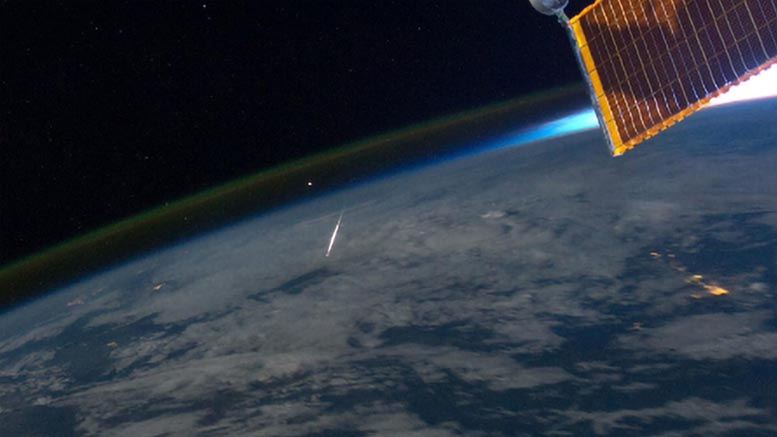
Motivated by this problem, Silber used a network of infrasound sensors around the world maintained by the Comprehensive Test Ban Treaty Organization (CTBTO), an organization tasked with listening for illicit explosions. These instruments also record anything else that claps or booms, from thunder to supersonic aircraft. Using signals specifically from bolides, Silber isolated the purely geometric component for her analysis. She found that if a bolide enters Earth’s atmosphere at a relatively steep angle— greater than 60°—analysis of the infrasound signal gets the trajectory right. But when it comes more horizontally, the uncertainty increases.
Why bolide sound is not a single event
“Infrasound from a bolide is more like a sonic boom stretched across the sky than a single bang,” Silber says. “You must account for the fact that the sound is being generated along the flight path.”
And so, this study highlights a critical need: to consider the trajectory of an object when interpreting infrasound data. Infrasound instruments are indispensable for planetary defense, according to Silber, and the findings are relevant to Earth-bound space junk. If you don’t know where something is going, then you have a hard time preparing for it.
Reference: “The shadow of the wind: photovoltaic power generation under Europe’s dusty skies” by György Varga, Fruzsina Gresin, András Gelencsér, Adrienn Csávics and Ágnes Rostási, 14 March 2025, EGU General Assembly 2025.
DOI: 10.5194/egusphere-egu25-9264
Never miss a breakthrough: Join the SciTechDaily newsletter.
Follow us on Google and Google News.