
Close Menu
    Facebook X (Twitter) Instagram
    SciTechDaily
    • Biology
    • Chemistry
    • Earth
    • Health
    • Physics
    • Science
    • Space
    • Technology
    Facebook X (Twitter) Pinterest YouTube RSS
    SciTechDaily
    Home»Science»‘Sticky’ Nanoparticles Provide More Precise Drug Delivery
    Science

    ‘Sticky’ Nanoparticles Provide More Precise Drug Delivery

    By William Weir, Yale UniversityMay 22, 2017No Comments3 Mins Read
    Facebook Twitter Pinterest Telegram LinkedIn WhatsApp Email Reddit
    Share
    Facebook Twitter LinkedIn Pinterest Telegram Email Reddit
    Sticky Nanoparticles Promise More Precise Drug Delivery
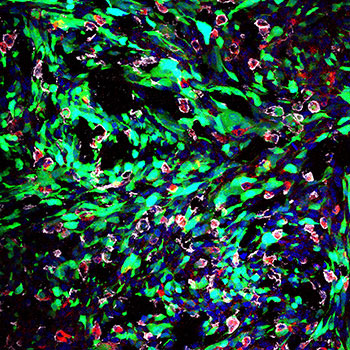
    Nanoparticles (in red) being taken up in the brain of a live rat model with glioblastoma (in green).

    By tampering with the surface properties of drug-loaded nanoparticles, researchers from Yale University can potentially direct these particles to specific cells in the brain.

    By making nanoparticles bioadhesive, or “sticky,” the researchers have answered a long-standing question: Once you get the particles to the brain, how do you get them to interact with the cancer cells there? Their findings are published May 19 in Nature Communications.

    “Until now, research has focused on whether you can load the nanoparticles with drugs and whether we can get them into the brain at all, without thinking too much about what cells they go to,” said senior author W. Mark Saltzman, the Goizueta Foundation Professor of Chemical and Biomedical Engineering, professor of cellular and molecular physiology, and member of the Yale Cancer Center. “This is the first exploration of the particles’ affinity for different cells.”

    The ability for nanoparticles to deliver drugs to specific areas of the body holds great promise for fighting cancer and other diseases while minimizing the side effects of drugs that are often very toxic, according to scientists. Their use in treating brain cancer, though, has been particularly challenging. That’s partly due to the blood-brain barrier, which acts to keep foreign elements out of the brain. Researchers have been able to get nanoparticles to penetrate the brain in recent years with help from a polymer coating that gives the particles “stealth” properties, allowing the particles to hide from the body’s immune system. Those same stealth properties, however, also keep cells from recognizing the particles.

    “So they’re just kind of in the space between the cells, and not really doing what they’re supposed to be doing,” said co-lead author Eric Song, a graduate student at the Yale School of Medicine.

    The Yale researchers found that they could correct for this by altering the chemistry of the nanoparticles. In two groups of rats — ones with brain tumors and ones with healthy brains — the researchers found that differences in the particles’ surface chemistry played a significant role in whether the particles were internalized by cells in the brain.

    They covered one group of particles with polymers rich in aldehydes, which chemically bind to amines — a compound found in most proteins. These bioadhesive particles were most likely to be taken up by cells of all types in the brain: Tumor cells were among those that internalized the bioadhesive particles at a particularly high rate.

    These results suggest that tailoring the chemical properties of particles provides an opportunity to control the distribution of the drugs they’re carrying, said the researchers. Further, they believe that the particles could be tailored for specific therapies to improve efficacy in target cells, and minimize toxicity to the cells they’re not targeting.

    Reference: “Surface chemistry governs cellular tropism of nanoparticles in the brain” by Eric Song, Alice Gaudin, Amanda R. King, Young-Eun Seo, Hee-Won Suh, Yang Deng, Jiajia Cui, Gregory T. Tietjen, Anita Huttner and W. Mark Saltzman, 19 May 2017, Nature Communications.
    DOI: 10.1038/ncomms15322

    Never miss a breakthrough: Join the SciTechDaily newsletter.
    Follow us on Google and Google News.

    Biomedical Engineering Medicine Moelcular Physiology Nanoparticles Neurology Yale University
    Share. Facebook Twitter Pinterest LinkedIn Email Reddit

    Related Articles

    Researchers Combine Nanoparticles and Machines To Improve Transplant Outcomes

    Study Shows Electrical Activity in the Brain after Clinical Death

    New Technique Allows Researchers to Measure Electrical Activity in a Living Neuron

    Naturally Occurring Nanoparticles Harnessed to Target Disease

    Brain Disruption Shows That Mental Illnesses Have Biological Similarities

    Drug-Loaded Nanoparticles Offer New Approach to Treating Brain Cancer

    Regenerative Electronic Biosensors

    Nanoparticle Delivers a Combination of Therapeutic Agents to Tumor Sites

    Nanoparticle-Based System Advances Stem Cell Culture Techniques

    Leave A Reply Cancel Reply

    • Facebook
    • Twitter
    • Pinterest
    • YouTube

    Don't Miss a Discovery

    Subscribe for the Latest in Science & Tech!

    Trending News

    Largest-Ever Study Finds Medicinal Cannabis Ineffective for Anxiety, Depression, PTSD

    250-Million-Year-Old Egg Solves One of Evolution’s Biggest Mysteries

    Living With Roommates Might Be Changing Your Gut Microbiome Without You Knowing

    Century-Old Cleaning Chemical Linked to 500% Increased Risk of Parkinson’s Disease

    What if Your Memories Never Happened? Physicists Take a New Look at the Boltzmann Brain Paradox

    One of the Universe’s Largest Stars May Be Getting Ready To Explode

    Scientists Discover Enzyme That Could Supercharge Ozempic-Like Weight Loss Drugs

    Popular Sweetener Linked to DNA Damage – “It’s Something You Should Not Be Eating”

    Follow SciTechDaily
    • Facebook
    • Twitter
    • YouTube
    • Pinterest
    • Newsletter
    • RSS
    SciTech News
    • Biology News
    • Chemistry News
    • Earth News
    • Health News
    • Physics News
    • Science News
    • Space News
    • Technology News
    Recent Posts
    • The Most Elusive Number in Physics Just Got Even More Mysterious
    • Scientists Uncover Hidden Trigger Behind Stem Cell Aging
    • Scientists Discover Coral Reefs Are Teeming With Previously Unknown Life
    • Scientists Find Way to Reverse Fatty Liver Disease Without Changing Diet
    • Could Humans Regrow Limbs? New Study Reveals Promising Genetic Pathway
    Copyright © 1998 - 2026 SciTechDaily. All Rights Reserved.
    • Science News
    • About
    • Contact
    • Editorial Board
    • Privacy Policy
    • Terms of Use

    Type above and press Enter to search. Press Esc to cancel.